
News


Words: Nadine N. Sayegh
“All that once was directly lived has become mere representation.” — Guy Debord, The Society of the Spectacle, 1967
I was in a coffee shop in downtown Amman, all argileh smoke, tarneeb games, and Ro’ya News muted in the corner. I was waiting for a friend, writing, half listening to the men at the next table arguing over a hand of cards, when the sirens started. Every head in the room turned up at the same moment, toward nothing in particular, then went back down to the cards, the sickly sweet smoke, the coffee, without anyone saying a word. I picked my phone back up mid-motion and kept scrolling.
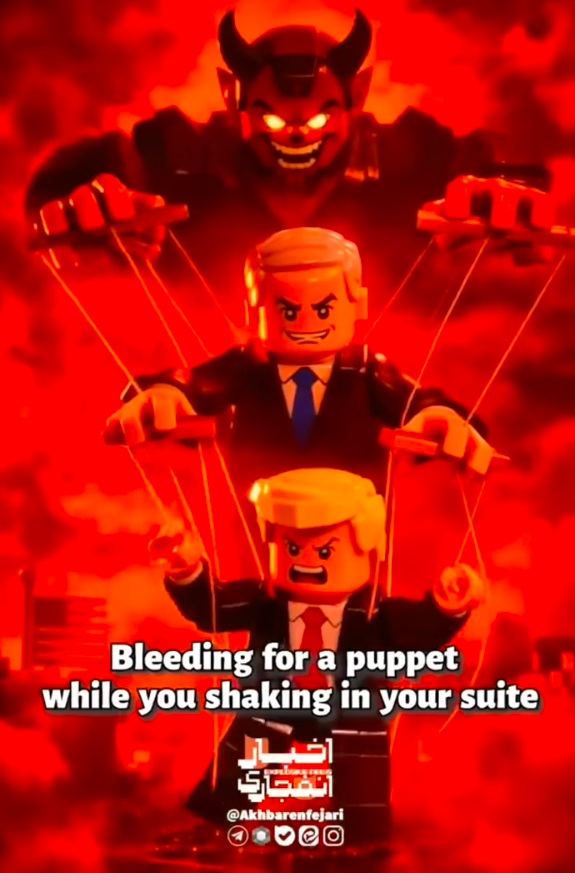
The first thing I saw was a Lego video. A blocky Donald Trump, flanked by a cackling Lego Netanyahu and a literal Satan, flipping through a folder marked “Epstein File.” A trap beat thumped underneath. An AI-generated rap track over it: “L-O-S-E-R, yeah we’re spelling out your name / Sent them to the slaughter, you the only one to blame.” The video cut to Lego missiles raining down, blocky figures scrambling, then a Lego Trump watching a parade of Lego caskets draped in American flags while the lyrics turned over: “the slaughterhouse is open.”


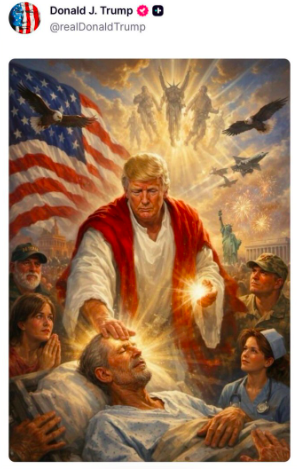
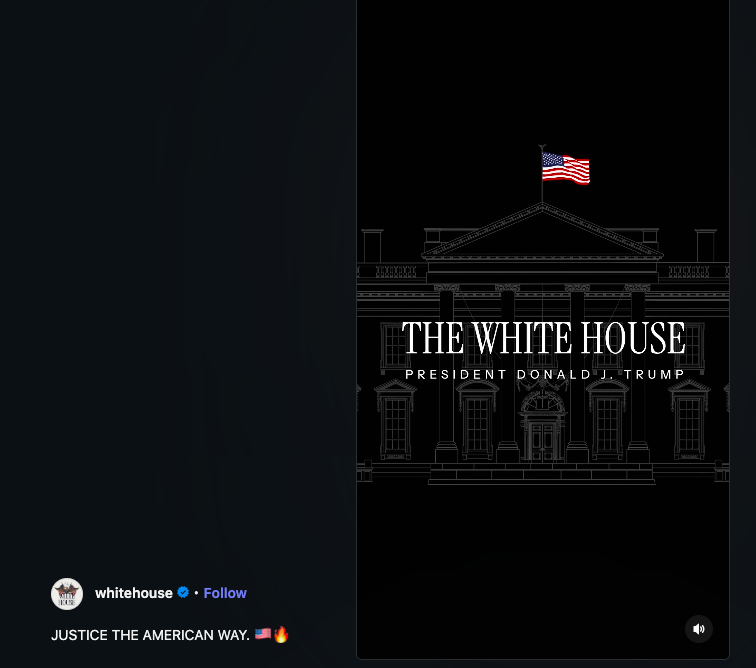
Then the algorithm put everything next to everything else, a White House clip of Trump losing his composure in meeting after meeting, online creators questioning his position on the axis of insanity and dementia, a performance of fury that changed nothing on the ground, an AI image of Trump as Jesus Christ, another as the Pope, another as an angel issued by the White House itself, and the American flag draped over a map of Iran, captioned “United States of the Middle East?”, posted during active ceasefire negotiations.
Next to that: an AI-generated image of an Iranian Shahed drone with Tupac’s face printed and stuck onto its casing, and images of a memorial for the 156 people killed in a US strike on an elementary school on the first day of the war. When Trump was shown the footage, he said: “It’s also possible that those images are AI-generated.” Days and weeks on, the same scroll still had bombs falling on south Lebanon, on Gaza, footage almost identical to footage from months before.
Underneath all of it sat the feed’s ordinary noise: a gym routine, a skincare tutorial, a beauty influencer’s morning stack.
Guy Debord wrote that the spectacle isn’t a pile of images; it’s the social relation between people that images now do the work of mediating. Watching this scroll, I don’t think anyone involved is confused about what they’re doing. The Lego rap, the fury clips, the flag caption, the angel Trump, all of it is aestheticised violence, and each piece is doing its own version of the same job: make the war feel manageable, distant, almost fun to watch. The agenda here goes further than concealment, though; the game seems to be downgrading the severity of the war, and of war more generally.
What collapses then is the material image distinction, the line between an event and its picture of itself. Debord already understood the spectacle as an active project, not an accident of culture but something produced by the existing mode of production itself, what he called the concrete inversion of life. The difference in this spectacle is that it went from systemic to personal, from something capitalism produces structurally to something a specific government, a specific president, deliberately stages and posts. It’s a manoeuvre now in the smaller sense too, run at every scale from the state down to the interpersonal, making the record of a thing indistinguishable from a joke, a performance, or a sale.
Debord was writing before satellite news, influencers, or synthetic generation. He didn’t anticipate that so many different actors would learn to profit from that substitution, or that the state would become one of them. He argued that lived experience gets replaced by its representation. Jean Baudrillard’s addition, a decade later in Simulacra and Simulation, was that the representation eventually stops referring back to anything real at all, becoming a copy with no original. Therefore, attempts to call footage of dead bodies synthetic not only replace the event with an image of the event, but also sever the image from the event entirely. The intent, ultimately, is an evasion of accountability that leaves it unverifiable and answerable to nothing.
There’s a name in media law for this: the liar’s dividend. It’s the leverage power gets simply from AI existing, allowing any authentic footage of state violence to be waved off as a deepfake. The real cost is paid in exhaustion, since this conscripts as much as it deceives. Every flick of your thumb becomes an unpaid audit of pixels and timestamps, a tiny forensic labour one repeats for the sake of their conscience until you’re simply too tired to care. That fatigue, more than any single deception, is what the spectacle actually produces.
This strategy, it seems to me, is similar to “Shock and Awe,” the actual US military doctrine from 1996 built on the idea that overwhelming, highly visible force could paralyze an enemy’s sense of what was even happening, not just their army. The 2003 invasion of Iraq was the first war televised like this, live, for an audience, and the Lego videos, the angel Trump, and the fury clips aren’t a break from that idea so much as its continuation, running now on a phone instead of a TV, with the paralysis no longer confined to a battlefield but sitting in a thumb that can’t quite tell a war crime from a joke.
What all of it belongs to, this ecosystem of content that flattens war into feed, has a name. In a 2025 study by Michał Klincewicz, Mark Alfano, and Amir Ebrahimi Fard, slopaganda is defined as content disseminated to manipulate cognitive and affective processes for political ends, scaled up past the point where it still resembles traditional propaganda, micro-targeted and decentralised enough to circulate on the same epistemic floor as the #momtok influencer and the bots in her comment section. Neither the Lego video nor Trump’s erraticism on social media is trying to persuade anyone of anything in particular; they’re trying to make it impossible to tell what’s worth believing in the first place, so that you default, exhausted, to whatever comforts or enrages you most.
Gaza was the ‘warm-up’ for this; footage of bodies pulled from rubble sat next to gym routines and skincare ads for months, until the two stopped feeling different in weight. By the time the US began the war, that flattening was already done. Trump could call footage of 156 dead, synthetic, because the feed had already trained people to treat every image as up for debate.
And then there was the four-second video. A woman’s shoes, filmed from above. A voice, possibly Press Secretary Karoline Leavitt, asking, “It’s launching soon, right?” A man’s voice, barely audible, answering yes. Deleted ninety minutes later. A second video followed: static, a phone notification chime, a distorted flash of the American flag, no caption, ever. The confusion was the whole point.
By the most recent tallies, Iran’s own Foundation of Martyrs counts 3,468 dead, HRANA documents 3,636, and US and Israeli estimates run past 6,000, with injuries as high as 26,500. Lebanon has confirmed more than 4,000 killed on its own. The US, the country that started the war, has lost somewhere between 13 and 18 service members. Global GDP losses for the year are estimated near $1.3 trillion, concentrated on the countries and income groups least able to absorb them, and the war has produced what the International Energy Agency calls the largest disruption to the global oil market on record, damage that touches Iran, Lebanon, the Gulf states, and the shipping routes through Hormuz in a way it never touches the country that decided to start this.
Iran’s viral warfare and the US’s come from the same apparatus. When the primary battlefield shifts to algorithmic feeds, even anti-imperialist defence gets forced into the dominant visual register: AI slop, shitposting, and content optimised for instant outrage. Iran picked up the tool out of self-defence, perhaps, but it is playing a game whose rules and aesthetic register were written by Western imperialism first.
Debord thought the spectacle was still a monologue of power performed for a public, something that happened in front of us. Baudrillard’s point was colder: eventually the performance stops referring to anything at all, and there’s no original left underneath it to recover. What’s on the feed now, the Lego rap, the angel Trump, the flag caption, the shoe video, isn’t power lying about the war so much as power no longer needing the war to be legible as a war. It just needs the war to be available as content, indistinguishable in weight from whatever comes after it in the scroll.
What’s left after that isn’t much of a choice, but it’s not nothing either. Baudrillard would have said don’t bother resisting, that resistance just feeds the system more material to absorb, and that the only honest move is to let the excess run its course and see if it collapses under its own weight, with no guarantee that it will. Accelerationists would push further and call that an argument for speeding it along, since if the wreckage is coming either way, better to get there faster. The smaller option, the one that doesn’t require betting on collapse or speeding up impending doom, is just to keep noticing, to hold the difference between a joke and a body count even when the feed insists that there isn’t one.
I put my phone down. The men at the next table were still on their hand of cards, the argileh coals still glowing, the tea going cold in front of me.
Sirens went off again.
THIS FEATURE WAS PUBLISHED IN THE 11TH EDITION OF ICON MENA PRINT MAGAZINE. ORDER YOUR COPY HERE.