
News



Decades after a casual promise, Dalida and Youssef Chahine finally reunited for The Sixth Day, a film shaped as much by delayed dreams and shifting careers as by the political and artistic pressures surrounding them.
“One day I’ll put you in a movie. He made me wait and wait. And thirty years later, he did.”
During her promotion tour for The Sixth Day in 1986, Dalida recalled this with a small smile, as if the memory still surprised her. She and Youssef Chahine had once shared the same kind of youthful confidence, the kind that allows promises to sound easy; it is only later that such promises grow roots. When they come back after years of distance, they carry the gentle shock of something returned, something remembered.
The promise had aged with her. It carried the weight of a dream that took the long way back. What shape does a dream take when it arrives long after the person who asked for it has changed?
The Sixth Day, the film Chahine made in 1986 with Dalida in the lead, was the long-delayed fulfillment of that promise. The film arrived late. So late that it touched a different woman than the one who first received the promise. When I watch The Sixth Day, I think about that long wait; what it does to a person and what it takes from them.
Chahine directed it with a kind of steadiness that comes after a brush with mortality. He had recently survived a life-threatening heart surgery; an experience that left him slower and more deliberate in his artistic endeavors. His previous work, Adieu Bonaparte (1985), had not been received kindly, with some dismissing it as politically toothless, others accused it of leaning too far toward European sensibilities. Chahine was caught between audiences who wanted opposing things from him. Egyptian films of the mid-eighties were leaning toward predictable comedy and safer television productions. He walked into The Sixth Day with the awareness that the world around him was no longer aligned with the work he felt compelled to make.
For Dalida, the timing carried its own meaning. She was still beloved, still able to draw a crowd, yet her new music no longer reached the charts. The spotlight that once followed her so faithfully had begun to wander. This role arrived in the quiet between what she had been and what she was becoming.
Before all of that, before leaving Cairo and Paris becoming her stage, she had dreamed of acting. It was her first dream, muted before it started by French casting rooms and remarks on her Italian accent. That dream settled quietly inside her until Chahine revisited it, casting her as Sadika in The Sixth Day.

At 53, Dalida, already a musical showbiz legend, arrived with her own form of vulnerability. She stepped into a role without glamour – a grandmother caring for her sick grandchild during Egypt’s 1947 cholera outbreak. A woman defined by devotion rather than spectacle. Dalida had recently undergone another eye procedure before filming, stirring memories of her Cairo childhood surgeries she rarely discussed. The bandages. The prolonged darkness. The fear of being unsure when the light would return. All of it must have been brewing quietly beneath her character’s skin.
Her Arabic had faded after so long abroad. The entire dialogue was rewritten for her in Latin letters. She learned the sounds phonetically, slowly, patiently; letting the language return to her. The words were not quite hers anymore, yet she held them with a kind of careful devotion, as if language itself could take her back to a place she feared she could no longer enter. A fear that matched the one living inside the woman she was portraying.
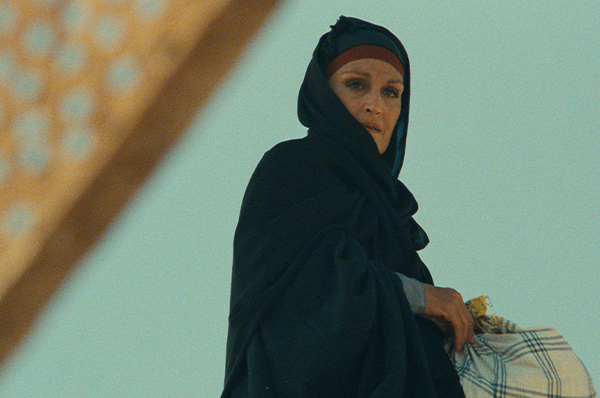
Chahine filmed her with a sense of patience. His camera did not rush. It observed. Sadika walks through Cairo with the child in her arms. Streets marked by illness. Light that feels thoughtful rather than dramatic. Chahine seemed to trust that the smallest gestures could carry the emotional truth of the story. Melodrama had always been one of his instruments, and a way of telling political truths through emotional excess, yet here the force of it shifted, and the scale narrowed. He was no longer interested in making a statement. He wanted to sit beside a character and let her breathe.
At a press conference that year, he said, “Women have been liberated. Arab women, Egyptian women. They were liberated long ago. We must stand beside them. This is why Sadika had to exist.” His words carried belief and a quiet hopefulness. As if he were naming a freedom he hoped to feel within himself. As if Sadika’s story might give him and Dalida a way toward something more honest.
The Sixth Day did not offer clarity or resolution. It offered closeness. It asked its audience to sit with fatigue. To watch a woman unravel not because she failed, but because she had carried too much for too long. It is a film about the endurance of care. A film that respects the gravity of pending grief.
The movie was met by confusion, an audience unsure of what to do with its fevered melodrama. Dalida’s superstar presence, meant to anchor it, only made the gap between expectation and intention more stark.
Her brother Orlando would later say she barely recognised her aging self on screen. It was not the image she wanted to leave her public. When filming ended, Sadika stayed with her. Some insist the role broke her, that it took her to a place she could not come back from. A year later, Dalida was gone.
Chahine himself returned to the autobiographical storytelling he knew so well with movies like Alexandria Again and Forever and Alexandria-New York. Yet The Sixth Day lingers. It sits quietly between the rest of his work as a reminder of a promise fulfilled with risk rather than triumph.
It survives as more than a film. It is a record of a word finally honored. No lessons, no closures. A meeting between two people who had grown into their lives and accepted that wishes fulfilled later do not glow the way they do in youth. They deepen and reveal what remains after time has done its work.
Some dreams do not arrive to save you. They arrive to show you who you have become in their absence.
WORDS: ELIO MARDINI


