
News


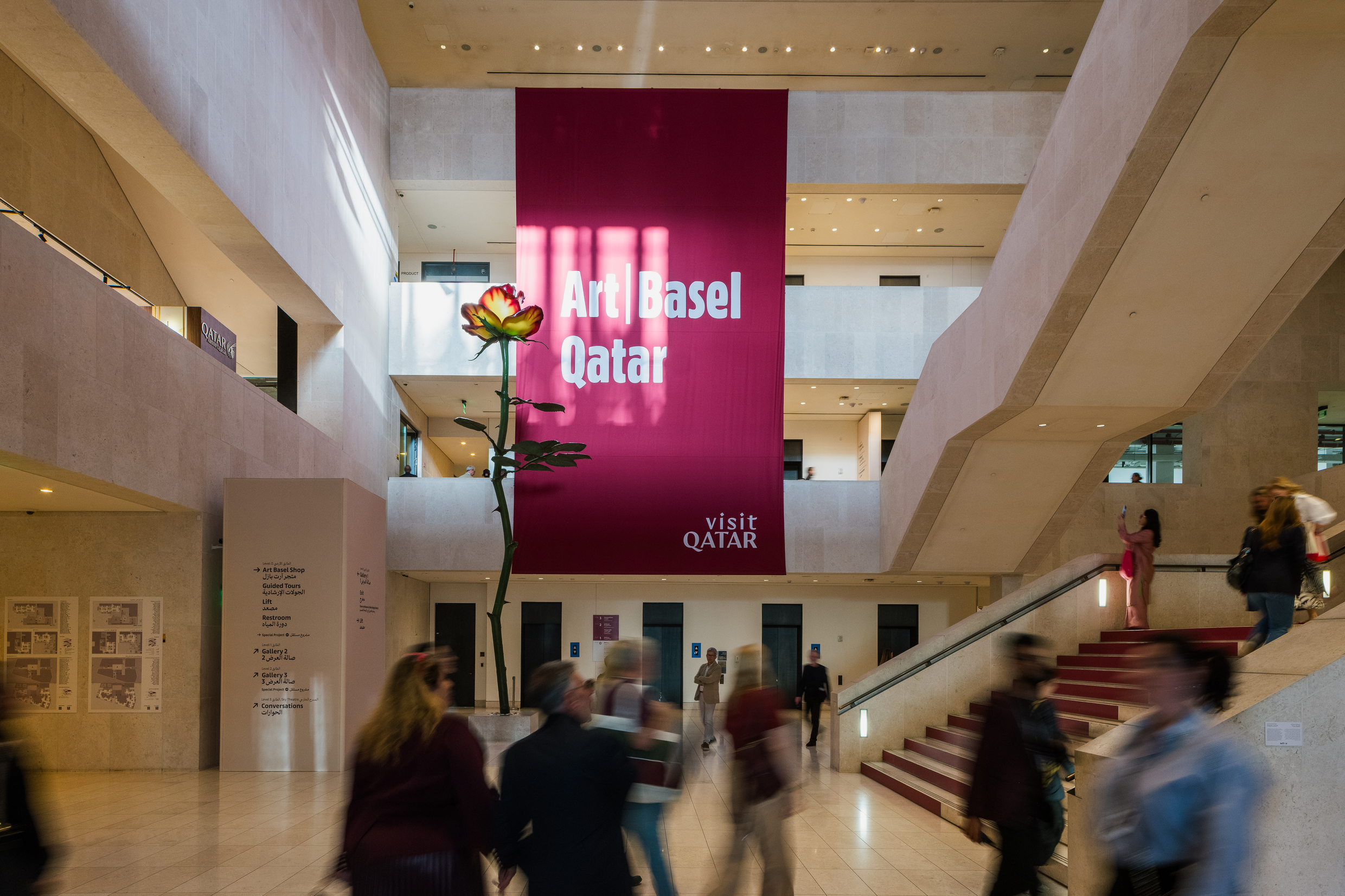
Opening to the public on Thursday, February 5th, and running through Saturday, February 7th, Art Basel arrived in Doha this week. Marking the fair’s first expansion into the Middle East since its founding in 1970, Art Basel Qatar unfolds across M7, the Doha Design District, and a series of public sites in Msheireb Downtown Doha, with preview days held on February 3rd and 4th. Bringing together 84 artist presentations by 87 galleries from 31 countries and territories, the inaugural edition positions Doha as the newest node in Art Basel’s global constellation, alongside Miami Beach, Hong Kong, Paris, and Basel.
The Doha edition signals a departure from the fair’s conventional booth-based model. Conceived under the artistic direction of Egyptian-born artist Wael Shawky, in close collaboration with Art Basel’s Chief Artistic Officer and Global Director, Vincenzo de Bellis. Art Basel Qatar has been structured as an open-format exhibition organised around a single curatorial framework. Titled Becoming, the fair explores transformation as a constant condition. Examining how belief systems, political realities, and cultural narratives are formed, challenged, and reshaped.
This curatorial approach is reflected in the composition of the fair itself. More than half of the artists participating in Art Basel Qatar’s first edition hail from the region, spanning North Africa, the Middle East, and South Asia, alongside international practices with long-standing engagements with questions of history, identity, and place. Across painting, installation, video, sculpture, and textile-based works. Many presentations return to themes of ancient civilisations, literary traditions, migration, and personal memory. While others address spectacle, power, commodification, and the aesthetics of authority. Together, they form a cross-section of practices shaped by ongoing processes of transition rather than fixed narratives.
Alongside its core artist presentations, Art Basel Qatar introduced a newly expanded Special Projects programme, conceived as a city-wide extension of the fair. Comprising ten large-scale, site-specific works across sculpture, architectural intervention, film, moving image, performance, and installation, these projects are staged throughout Msheireb Downtown Doha’s cultural and public spaces. Responding directly to the fair’s central theme, Becoming, the programme foregrounds transformation as both subject and method, addressing states of metamorphosis, thresholds, political upheavals, and shifting identities. Collectively, the projects represent the most extensive group of public works ever commissioned for an Art Basel edition, positioning the city itself as an active site of encounter rather than a backdrop to the fair.
With its first Middle Eastern edition unfolding across multiple venues and formats, Art Basel Qatar can feel expansive at first glance. From concentrated solo presentations to large-scale public commissions. We reflect on the highlights and projects the defined the event.
Nalini Malani, Ballad of a Woman (2023)
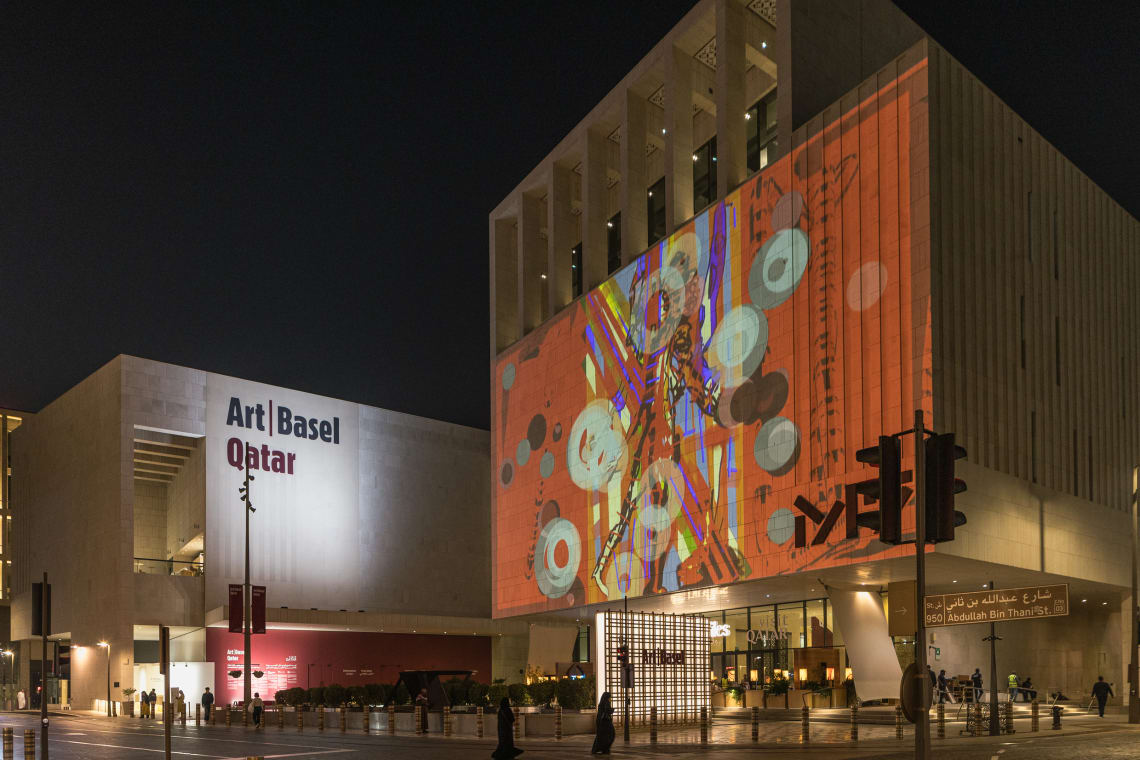
For Art Basel Qatar, artistic director Vincenzo De Bellis and curator Wael Shawky invited Nalini Malani to reimagine her celebrated iPad animation Ballad of a Woman as a site-specific work. Originally developed in 2023 for the façade of the Montreal Museum of Fine Arts, the piece draws from the writing of Wisława Szymborska (1923–2012), the Nobel Prize-winning poet whose work is known for its clarity, irony, and moral precision.
Unfolding as a fluid and atmospheric meditation, Ballad of a Woman navigates between tenderness, dark wit, and quiet unease as it reflects on gendered violence and the systemic injustices faced by women worldwide. Malani’s hand-drawn animation visually translates the emotional and symbolic force of Szymborska’s poem Ballad (Ballada), first published in 1957. In the poem, a woman who has been murdered erases all traces of her own death in the afterlife, an act intended to shield her killer from blame.
For Malani, this gesture resonates as a haunting metaphor for the enduring expectation that women absorb violence, guilt, and sacrifice even beyond the limits of their own lives. Through animation, the work renders this silence visible, implicating both history and the present in its unfolding narrative.
Aiza Ahmed, Footnotes (2025) | Sargent’s Daughters
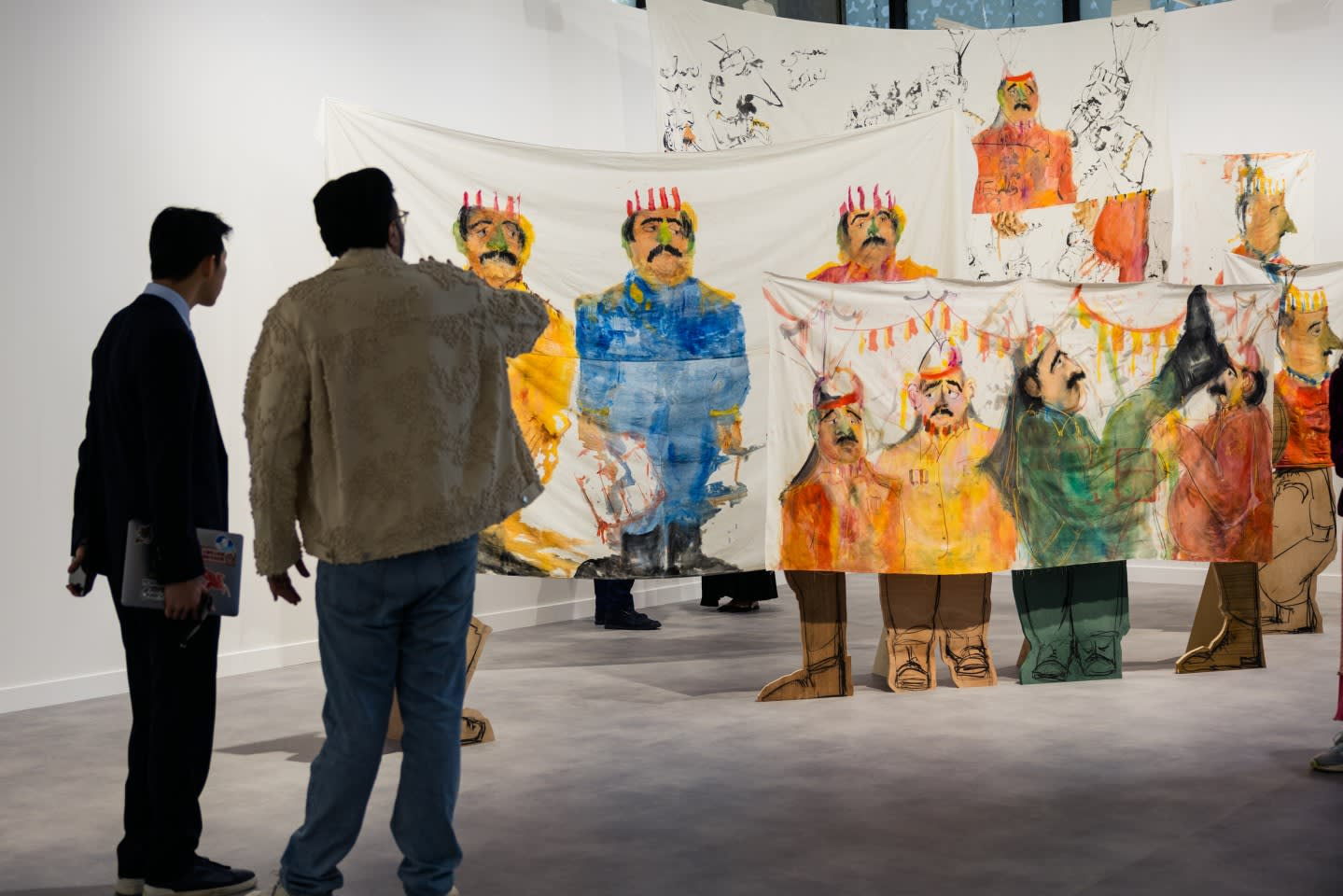
Inspired by the daily Wagah–Attari border ceremony between Pakistan and India, Aiza Ahmed turns her focus away from spectacle and toward those who animate it from the margins. Her site-specific installation centres on the musicians whose performances underpin nationalist ritual, yet often remain unseen. Suspended muslin paintings and plywood figures form a spatial environment viewers must physically navigate, rendering borders porous and movement central. The work balances playfulness with political acuity, using repetition, gesture, and sound to reconsider visibility and power.
Rashid Rana, Fractured Moment (2025) | Chemould Prescott Road
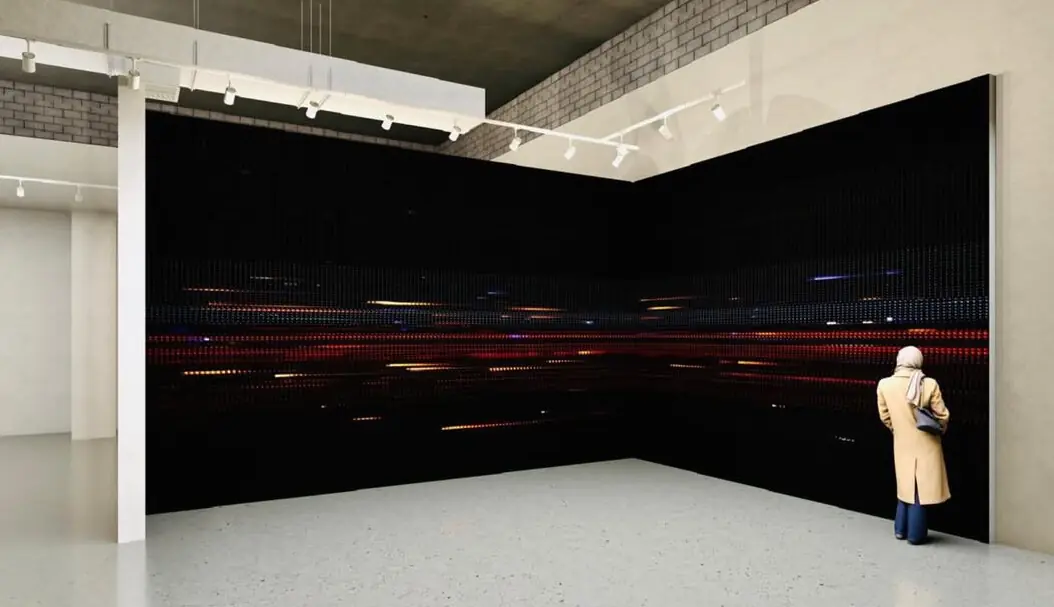
At first glance, Fractured Moment appears as a single, immersive image: a night sky over Gaza, stretched across wallpapered walls. Look closer, and the image reveals itself to be composed of sequential CCTV stills, each frame recording a different second in time. Referencing Kazimir Malevich’s Black Square, Rana transforms abstraction into an index of absence and loss, where darkness is intermittently pierced by explosions. Stillness becomes an illusion; time, insistently present.
Rana has openly reflected on the ethical complexities of depicting violence through art, noting the risk of aestheticising horrific events, including the ongoing atrocities in Gaza. The work’s use of CCTV footage emphasises how abundant and accessible evidence of Israeli violence already is for everyone to witness.
Priced at $30,000, the work is offered with a clear commitment: all proceeds from its sale will be directed toward Gaza relief initiatives. The beneficiary organisations have been selected by Chemould Prescott Road director Shireen Gandhy, working in close consultation with Palestinian community organisers.
Mustapha Azeroual | Loft Art Gallery
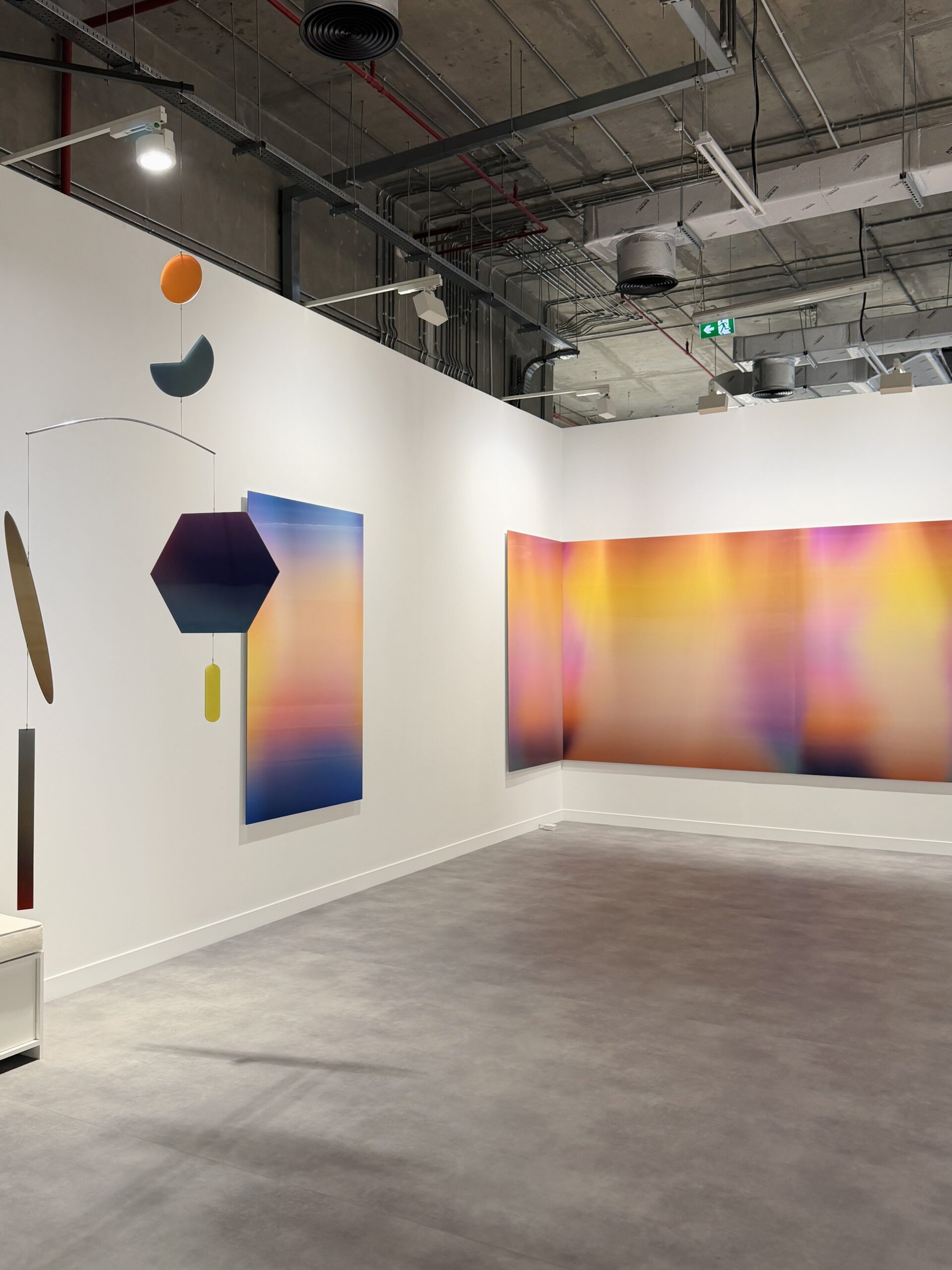
Loft Art Gallery’s solo presentation of Mustapha Azeroual signals the presence of the first — and, notably, only — Moroccan gallery participating in the inaugural edition of Art Basel Qatar. This isn’t the gallery’s first time at the event—they previously participated in the Paris edition two years ago, presenting the work of Moroccan Painter Mohamed Melehi. Loft Art’s gallerist, Yasmine Berrada, commented on this occasion: “From participating at the Art Basel Paris two years ago to presenting Mustapha Azeroual here at Art Basel Qatar, this reinforces our position as a leading Moroccan gallery that seeks to create bridges between Africa and the Arab world.”
Their presentation this year brings together three significant bodies of work: The Green Ray #5 (Arabian Sea triptych), Radiance, and Héliaque Mobile #3. Across these series, Azeroual develops a practice in which photography becomes a kinetic encounter, with light operating not simply as an image-making condition but as a mutable, time-based material.
Employing lenticular techniques alongside algorithmically constructed imagery, Azeroual’s works respond to the physical movement of the viewer. As one shifts position, the image itself appears to recalibrate, folding multiple temporal states into a single plane. Moments of dawn and dusk, appearance and dissolution, surface and recede in quiet succession, resisting any fixed point of resolution. “Mustapha’s work explores the fleeting nature of light and colour, how quickly they change, and attempts to capture it,” Berrada said. “It’s an optical artwork that moves and changes with the observer’s movement, much like the perpetual movement and change of our world today.”
Nour Jaouda, A House Between Two Houses (2025)
Nour Jaouda’s sculptural installation reimagines the archetype of the rest house through a framework of intersecting steel walls, layered architectural drawings, and suspended textile fragments. Neither fully enclosed nor fully open, the structure invites projection, memories, desires, and personal narratives to settle onto its scaffold-like form. The work resists monumentality, instead offering a quiet space for introspection shaped by fragility and incompleteness.
Lina Gazzaz, Tracing Lines of Growth (2024) | Hafez Gallery
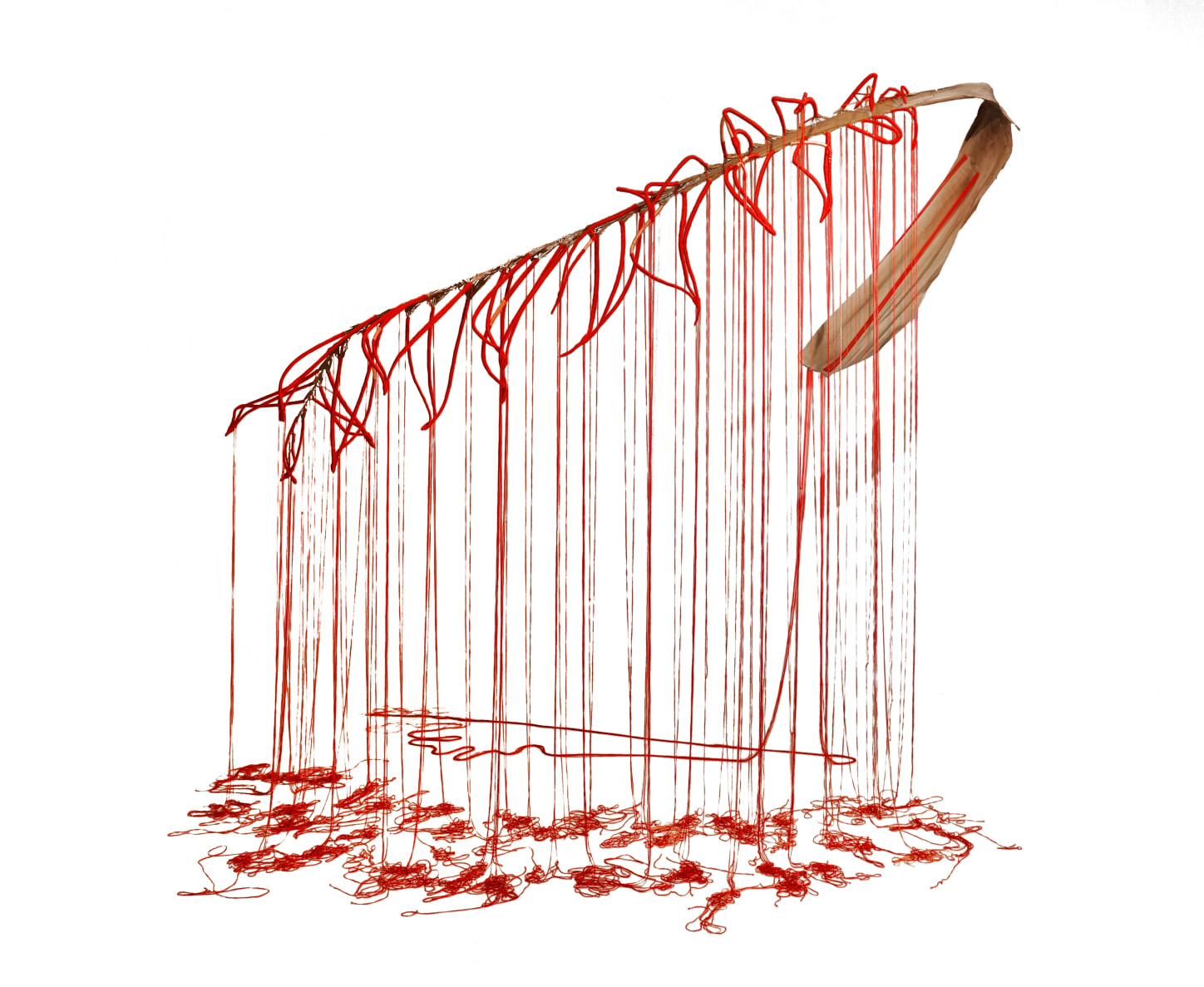
Working with discarded palm leaves stitched with fine red and black thread, Lina Gazzaz transforms organic remnants into tactile records of labor, time, and endurance. The surfaces resemble calligraphic scores, part botanical archive, part musical notation. Mapping cycles of growth, decay, and renewal. Rooted in Gulf ecologies and spiritual traditions, the palm emerges not as a symbol alone, but as an active witness to human and environmental transformation.
Tracing Lines of Growth unfolds as the result of a long-term inquiry that began more than a decade ago, evolving through sustained research, material experimentation, and close observation. What initially took shape as simple line drawings gradually expanded into a deeper engagement with the palm’s physical structure, tracing the contours of its crown shafts while attending to their cultural, historical, and symbolic resonances. Over time, the project shifted from representation toward immersion, with the palm approached as both subject and collaborator. Within Hafez Gallery’s presentation, the palm is framed as a cipher: its internal vascular pathways, once channels for sap and sustenance, reappear as linear inscriptions. These lines recall the curved bodies of ouds, the undulating rhythms of desert terrain, and gestural scripts embedded in Qur’anic and biblical traditions. Across the Arabian Peninsula, the palm’s continued role as both sustenance and export further anchors the work in lived economies and agrarian lifeways.
In the context of Art Basel Qatar’s inaugural theme, Becoming, Tracing Lines of Growth articulates transformation not as rupture but as continuity: fragments reassembled, lines reactivated, and time rendered visible through matter.
Hugo McCloud, Pollinated Migration (2026) | Sean Kelly
Created for Art Basel Qatar, Hugo McCloud’s new body of work extends his ongoing examination of migration, labor, and the mechanics of global trade. Working with discarded single-use plastic bags, the artist treats the material simultaneously as substance and subject, folding its ecological afterlife into the very fabric of the image. From this fragile medium, McCloud assembles scenes drawn from fruit markets and sites of agricultural exchange spaces shaped by movement, precarity, and invisible labor.
These works unfold as quiet studies of circulation: the flow of produce across borders, the migration of bodies that sustain these economies, and the environmental costs embedded in everyday consumption. By repurposing materials designed for disposability, McCloud renders visible the interconnected systems of commerce and ecology, revealing how global supply chains leave traces not only on landscapes but on human lives.
Khalil Rabah, Transition, Among Other Things
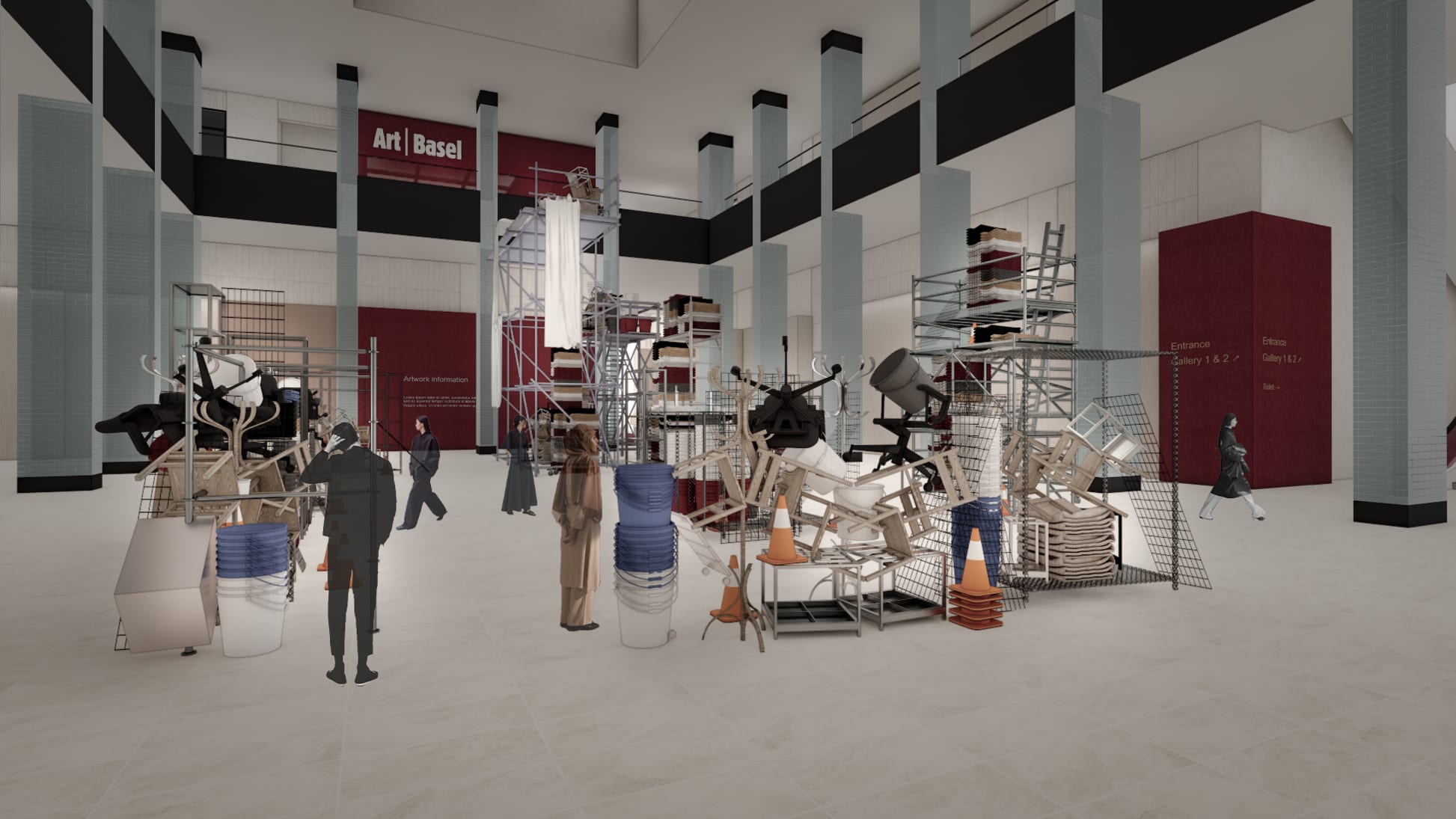
Khalil Rabah’s contribution assembles fragments of domestic, industrial, and institutional debris into sculptural constellations that operate as living archives. Objects are displaced, reactivated, and recontextualised, accumulating layers of meaning through use and reuse. The work reflects on memory, resistance, and value, mirroring broader cycles of environmental exhaustion and political dispossession. Like much of Rabah’s practice, meaning remains unresolved—hovering between documentation and fiction.
Okwui Okpokwasili and Peter Born, Sweat Variant
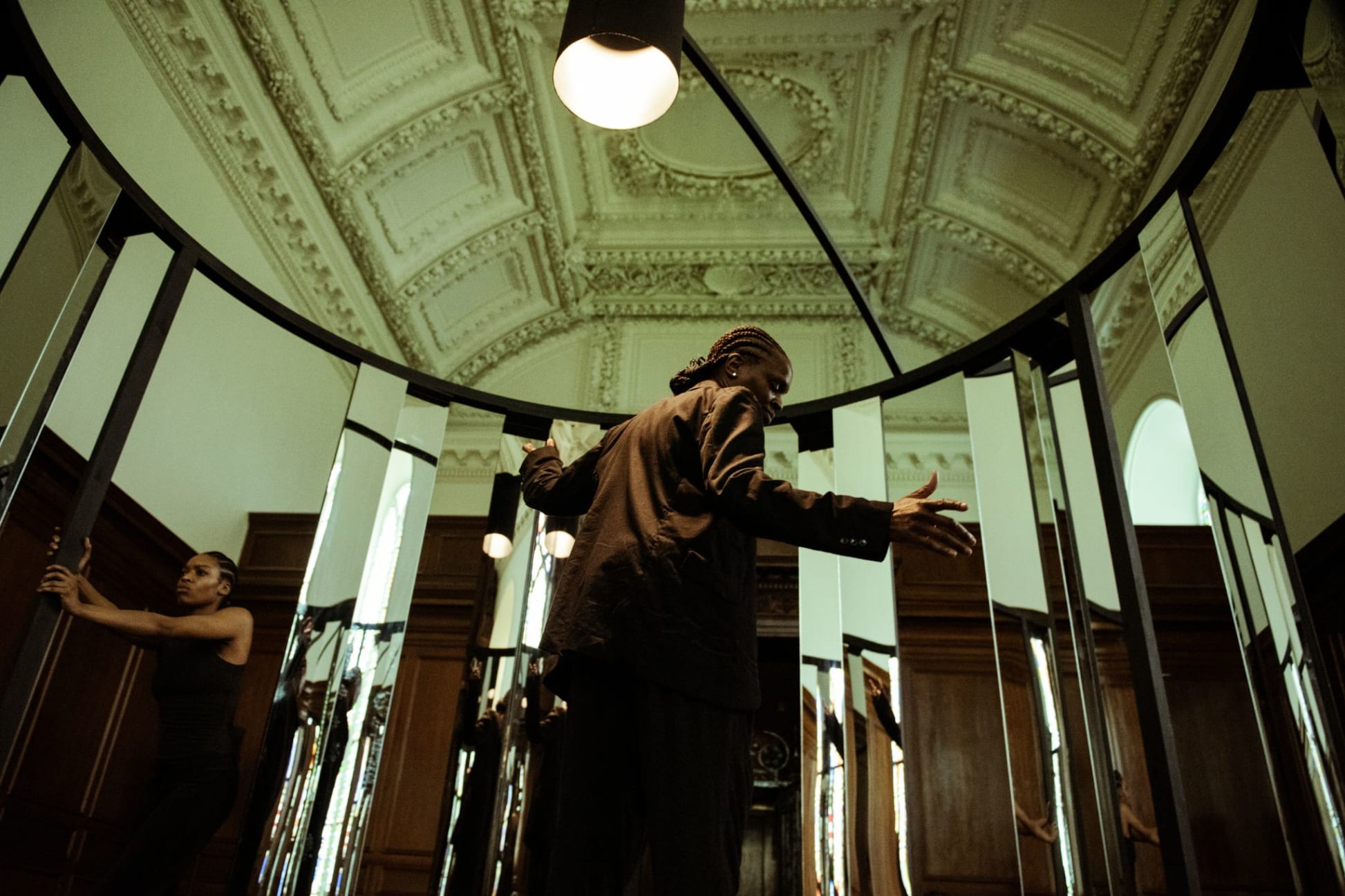
A three-hour durational movement work without a fixed beginning or end, Sweat Variant unfolds through sustained physical and relational exchanges between four performers. Developed by Okwui Okpokwasili in collaboration with composer Peter Born, the piece tests endurance, attention, and embodiment within an evolving sonic and visual environment. Viewers enter and exit freely, encountering the work mid-breath, mid-gesture.
Sweat Variant is the collaborative practice of Okwui Okpokwasili and Peter Born, who have been working together since 1996 across dance, theatre, and visual art. Their practice produces works that challenge dominant hierarchies, repositioning what has historically been pushed to the margins as a generative center through sustained engagement with Black interiority.
Central to Okpokwasili and Born’s approach is the creation of a spectacle grounded in radical intimacy. Their performances establish a charged reciprocal encounter in which performers and audiences are bound by a shared field of attention. Rather than offering a passive act of viewing, the work opens a space of heightened awareness, inviting audiences to reflect on their own acts of looking — who is being seen, under what conditions, and through which lenses.
Hassan Khan, Little Castles and other songs
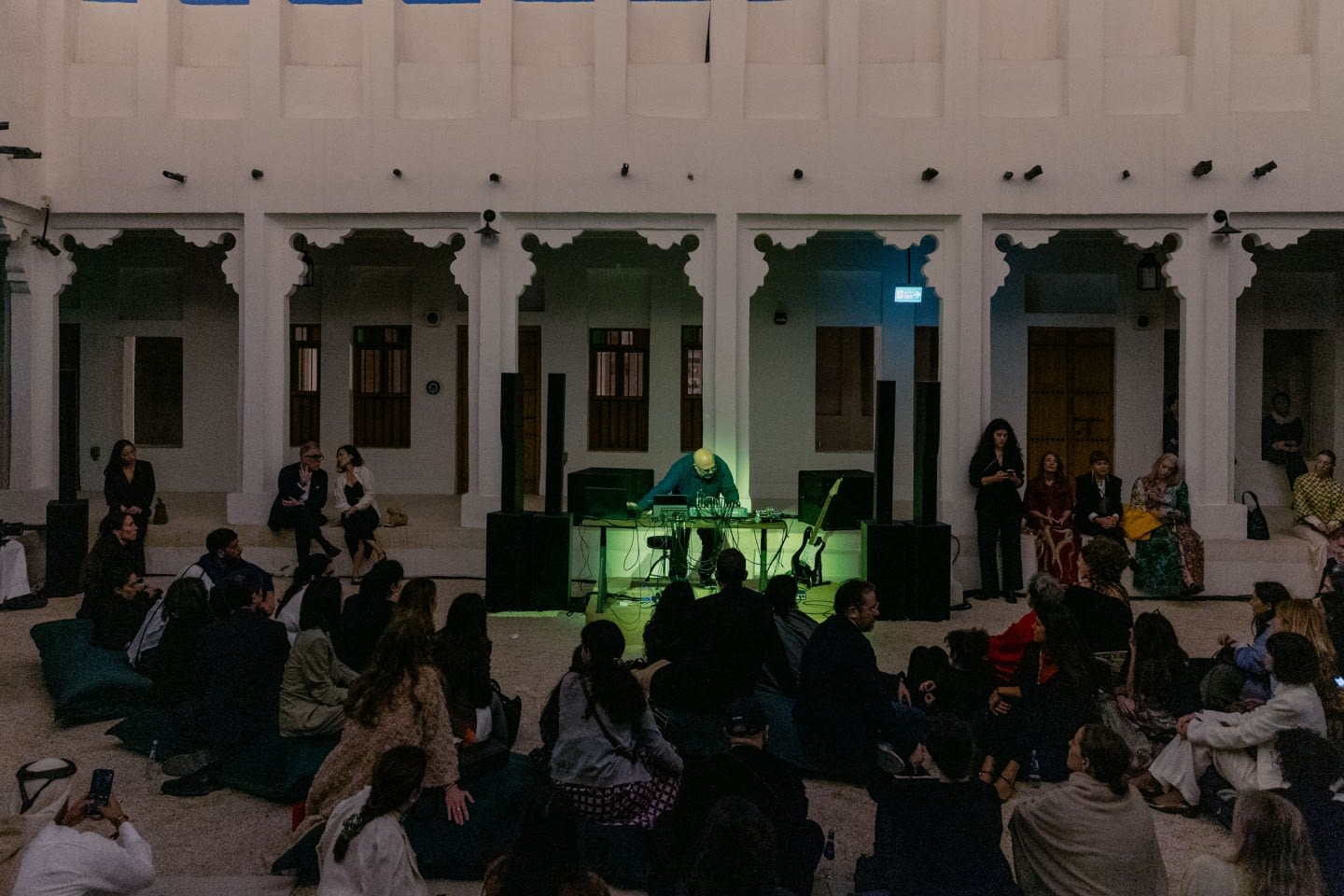
Returning to Doha after a 15-year absence, Hassan Khan presents a live concert built around newly written and produced songs, performed through a customised digital system developed with computer music designer Olivier Pasquet. Known for resisting easy interpretation, Khan’s work occupies a space between political urgency and formal experimentation. His lyrics: raw, direct, and repetitive grapple with isolation, violence, and collective responsibility, while the performance itself emphasises connection over conclusion. The work recalls Khan’s earlier presence in Told Untold Retold (2011), a pivotal exhibition in the region’s contemporary art history, while remaining firmly grounded in the present moment.
Taken together, Art Basel Qatar’s first edition reflects a broader recalibration of how and where global art fairs operate. Arriving at a moment when traditional art markets are experiencing sustained contraction in the United States and Europe, the fair enters a region increasingly viewed as a site of possibility, new collecting publics, and cultural investment. Yet in Doha, the emphasis is less on spectacle than on structure. More on rethinking how art is presented, experienced, and situated within the urban and cultural fabric. In doing so, Art Basel Qatar positions itself as a platform for sustained artistic engagement and exchange.
Art Basel Qatar opened on 5th February 2026 in Doha, marking the fair’s first edition in Qatar. Taking place across key cultural sites in the city, the fair brings together leading galleries and artists from around the world, and runs until 7 February 2026.


