
News


For all the weight of her canvases, Sara Shamma insists that her starting point is almost the opposite of control. “In terms of my creative process, I work without thinking, it’s spontaneous,” she says. “I have a blank canvas in front of me and I focus on the subconscious. I commence painting without knowing what I’m going to paint – it finishes on its own. There is no decision for it to finish; it ends when it ends. If I’m satisfied, it finishes.”
Faces are what she returns to, again and again. “I really try to create faces from my mind. I love to create and make faces,” she explains. “Music really helps me. I put music on and I start to paint. It’s a type of ultimate relaxation, a trance if you like. That’s how I paint.”
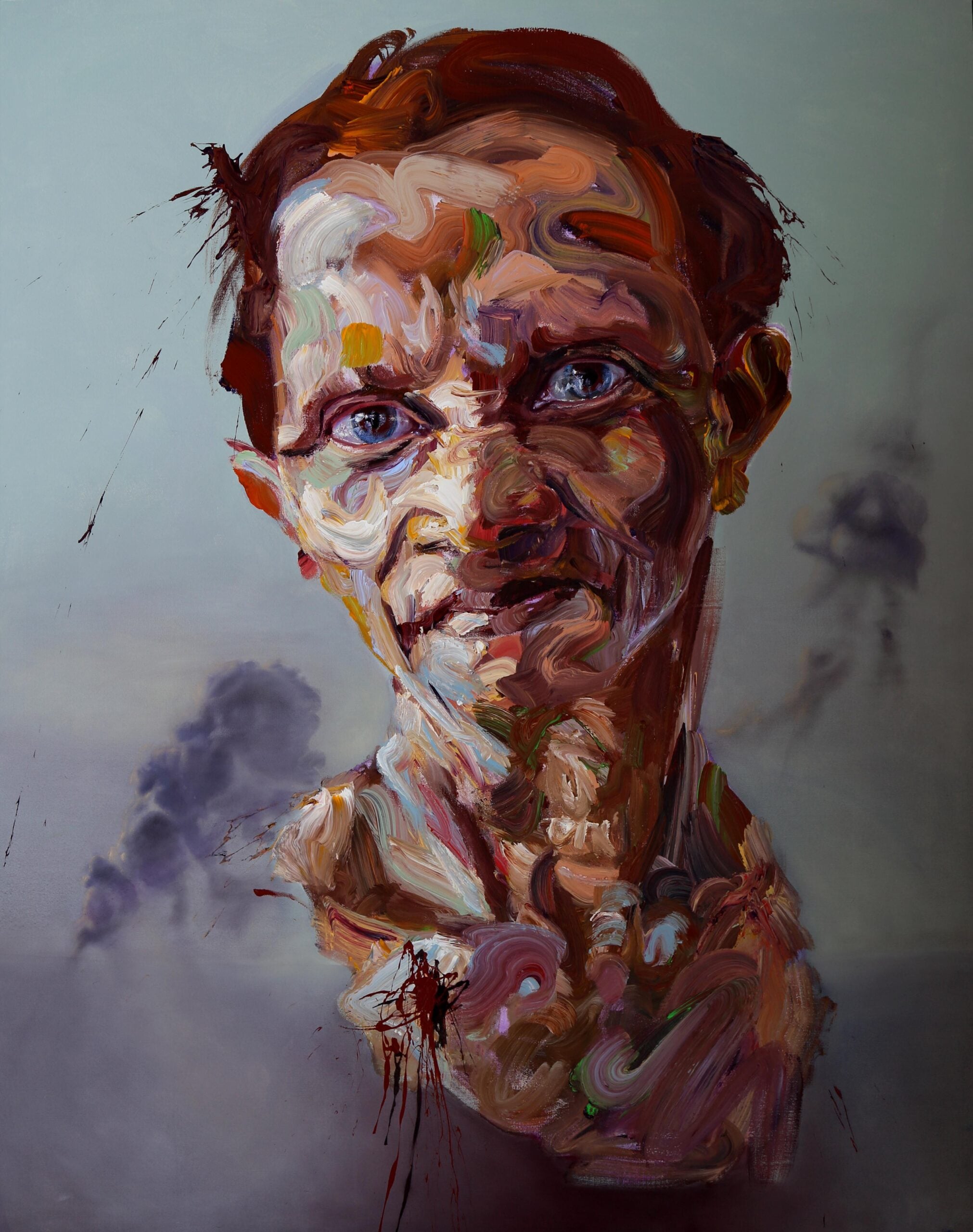
Shamma is the only Arab painter to have held a solo exhibition of interpretive works inspired by Rubens and Rembrandt at the Bold Spirits exhibition at Dulwich Picture Gallery in London.
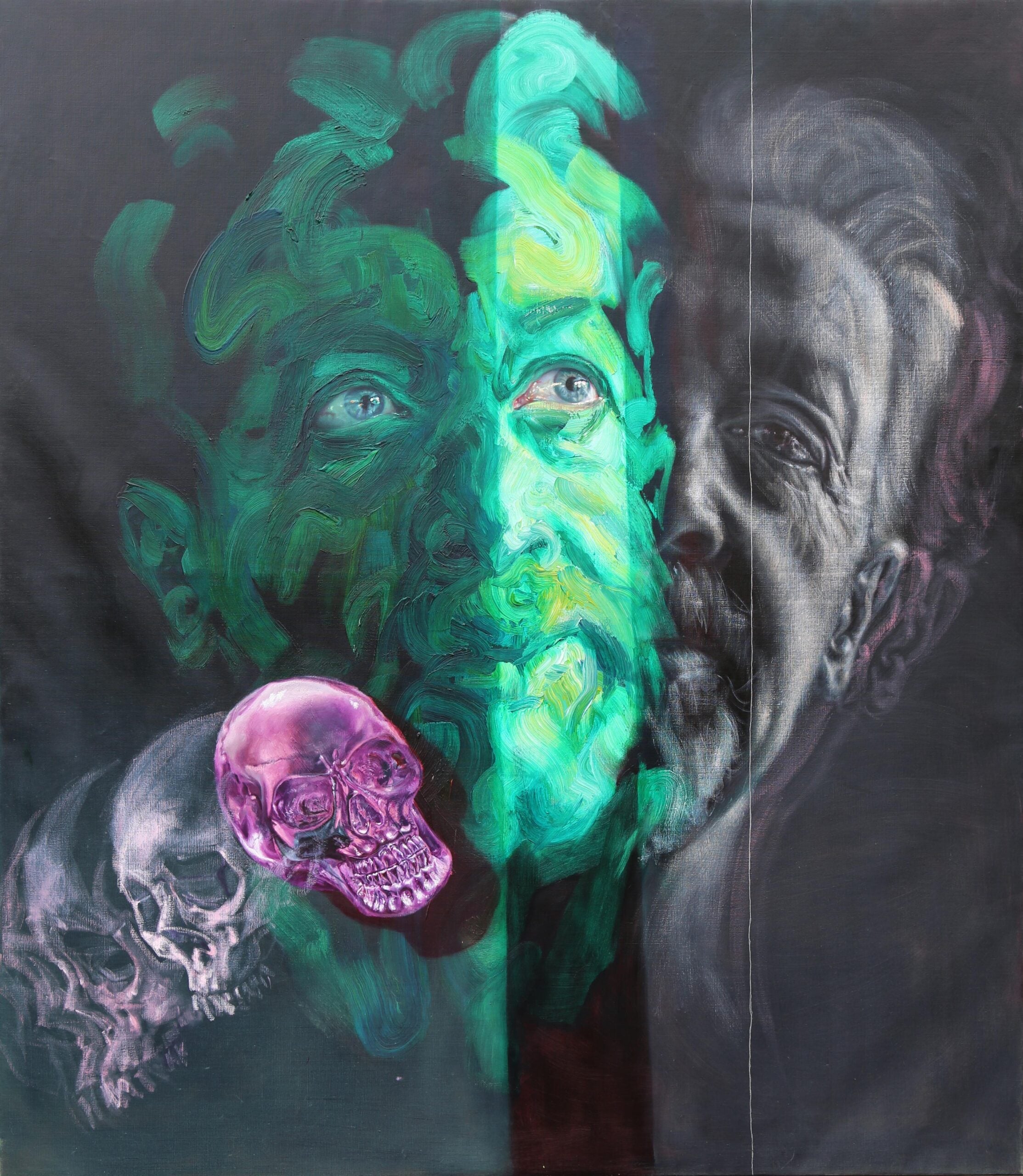
Shamma’s career has been defined by an unflinching gaze. Her canvases, often monumental, hyper-real and charged with psychological tension, orbit themes of death, trauma, memory and the fragile architecture of life. From global conflicts and modern slavery to intimate depictions of mothers, children and self, her paintings move in the space between dream and forensic record, between tenderness and horror. She paints bodies with almost surgical clarity, then fractures them with scratches, lines and streaks of paint, as if marking the exact point at which the world split in two.
From an early age, that visual language was fed by an intense fascination with the subconscious.
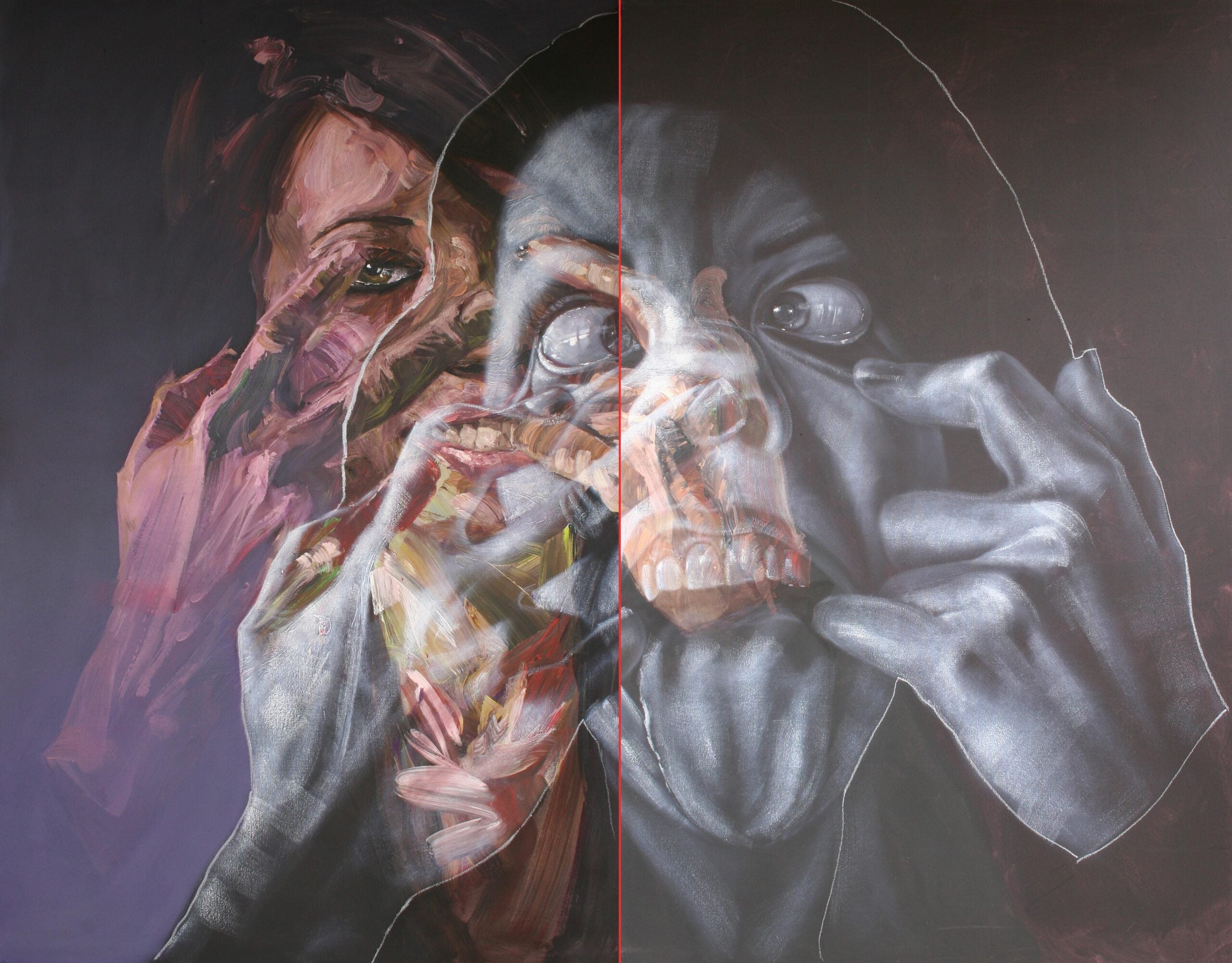
“From when I was young I loved Salvador Dalí, and I’m really enthused by the subconscious mind; that’s why you see so many elements of surrealism in my work, and on occasion hypersurrealism,” she reflects of her portfolio. “It creates a beautiful kind of realism, especially when working on eyes or painting eyes. I see the changes in the colours of the eyes and the expressions. It tells a story on its own, in the iris. These are the types of details that I follow to the extreme. I don’t have a set idea or structure, it’s spontaneous. I paint and keep painting and the canvas forms itself. I sometimes set myself an idea to try and paint on, but it never works out that way. My process is always to create on the white space, and always something new.”
In life as in work, Shamma moves between worlds. “Damascus is the city that I grew up in and it’s my real home,” she says. “Lebanon is half of where I am from, my mother is Lebanese, I’m always there, it’s also my home. London too, I always present my art in London. I love that city, I lived there very happily. My home is in three locations, those are my three homes.”
Damascus, however, is the city that formed Shamma, marked her, and now quietly houses some of her most important work. Her landmark exhibition 12 Years at the National Museum of Damascus marked a profound return after a lengthy absence, and stood as one of the most significant art events the country has seen in years. It gathered more than a decade of work that wrestled with war, loss and survival, placing it inside the national institution of a city still negotiating its own wounds. “The last exhibition I did in the National Museum was really special,” she recalls. “I wanted to do it because I hadn’t shown any of my artworks in Syria for a long, long time. It was a retrospective. I kept one or two paintings from each year. All of my exhibits post-2011 were outside of Syria.”
Yet Shamma is famously elusive in the realm of image-making beyond the canvas. It is rare for her to take part in magazine productions, and she is known for her signature all-black wardrobe, a uniform that seems to absorb the world’s colour and send it back out through paint. For this shoot, she steps into the frame as subject as much as author, but on her own terms and within a distinctly Syrian constellation of creatives.
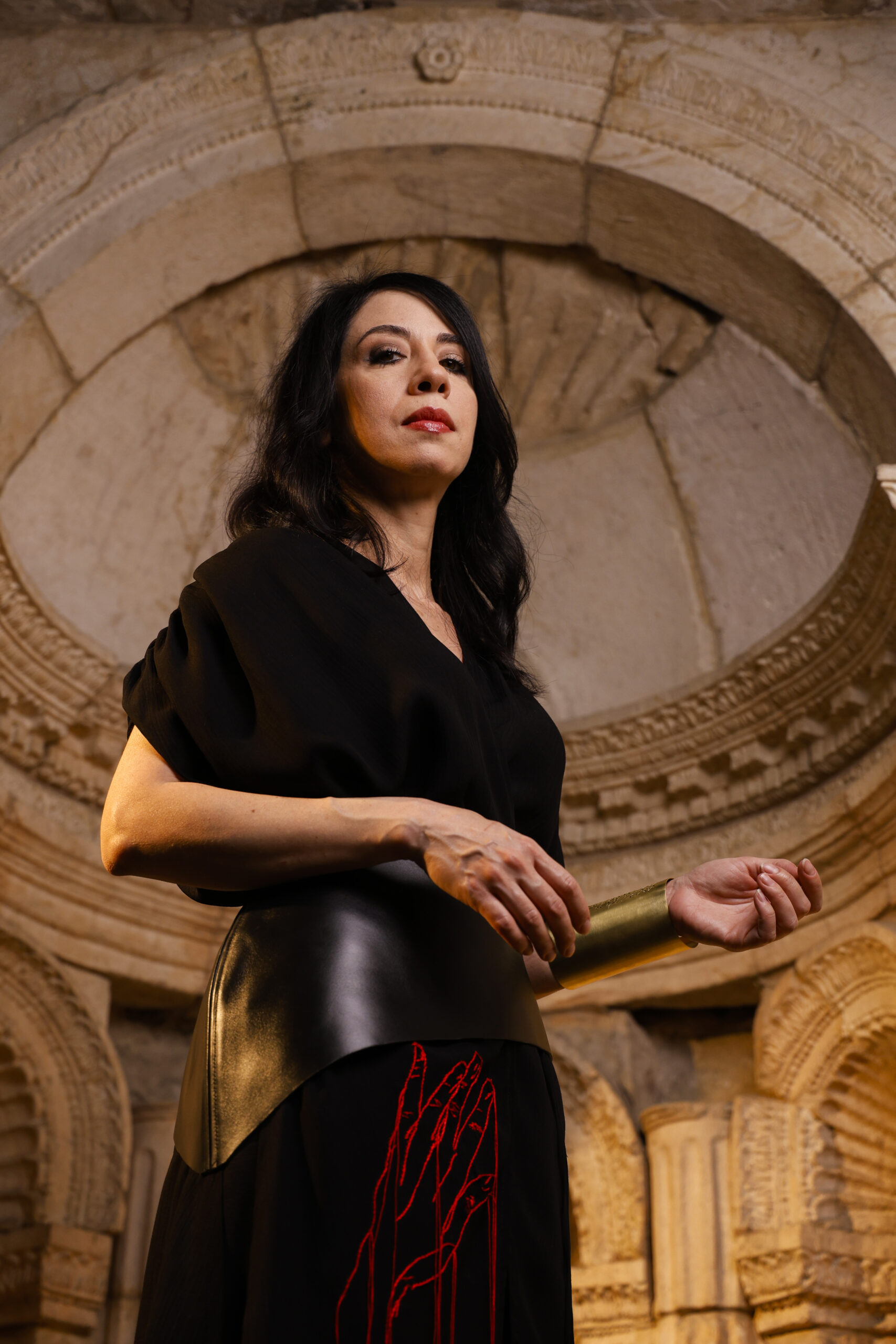
Dressing Shamma is the emerging Syrian fashion designer Tala Nehlawi, a rising force whose work fuses architectural silhouettes with the deep visual memory of Damascus. Raised in the city before studying fashion in Toronto, Nehlawi returned and founded MaisonTN. Her pieces function almost as wearable cityscapes, sharply cut, sculptural, often built around Damascene motifs, copper-plate engravings and historical references.
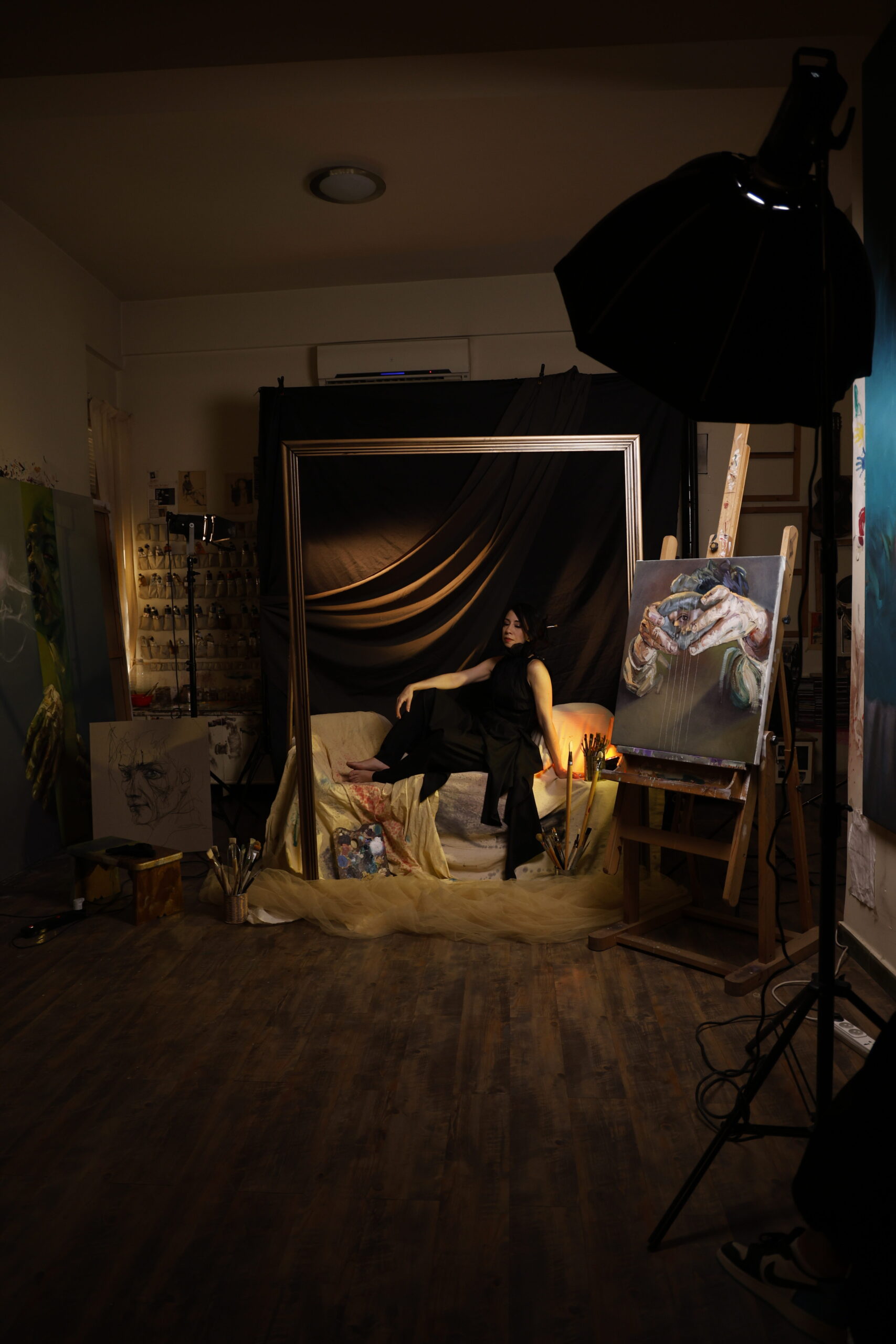
Creative director Mark A. Marcus, co-founder of Kizio Studio, told ICON MENA that it was important to do these locations because they reflect the emotional pillars of Sara Shamma’s work. “Each space – the tomb, the atelier and the home – mirrors her dialogue with memory, creation and the intimate truths behind her art,” he says.
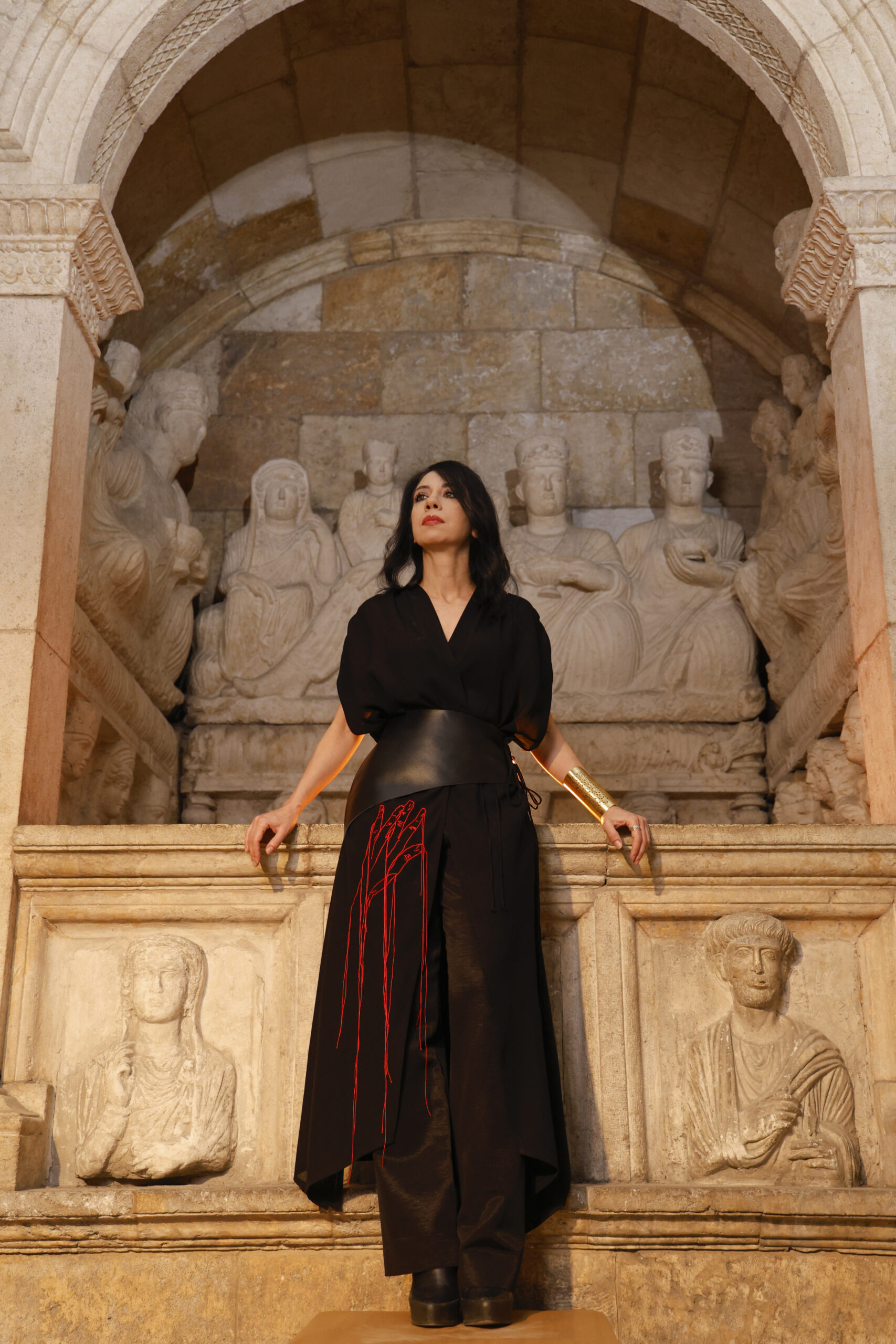
The first was the Palmyrene burial tomb at the Damascus National Museum, a subterranean chamber whose carved stone faces have watched over centuries of silence and dust. For Shamma, it is not an anonymous backdrop but a site of memory. “As an art student I used to come to the museum and sketch the faces of those engraved in the stone,” she tells ICON MENA as we walk between the sarcophagi. “This location means so much to me and my art. The concept of life, of death and of memory is crucial. It’s like walking through history, our history.”
She pauses and looks around at the figures frozen in stone relief. “What makes these faces different from us?” she asks softly. “Maybe we are the same. Maybe they occupied this land thousands of years ago, but they remain here today.” In that moment, her paintings – which so often hover between the living and the spectral – feel like a continuation of the same conversation: what survives, what vanishes, and what kind of image stays behind.
For this sequence, Shamma is dressed head-to-toe in black by Nehlawi, who builds two distinct looks around her. One is a sharp, sculpted silhouette that amplifies the artist’s familiar uniform; the other, a kimono-like piece edged with flashes of red, a quiet rupture in her usual monochrome. The red operates almost like a painted stroke, a minimal but deliberate interruption in the field of black. “It’s just the way I feel comfortable,” Shamma says of her long-standing relationship with black clothing. “Wearing black is something I’ve kept with me over the years. There’s no particular reason.” In retrospect, of course, it is hard not to read it as a code: a way of keeping the focus on the work rather than the person, of turning herself into a kind of moving shadow at the edge of the canvas.
Completing this Syrian creative circuit is jewellery designer Dania S. Haffar, whose handcrafted brass cuffs appear throughout the story. Alongside her business partner, Dima Kekhia Mahjoub, Haffar has been creating accessories since 2013, inspired by the beauty and heritage of old Damascus. Their work is minimal yet emotionally loaded: clean, graphic silhouettes that carry maps, words and fragments of memory.
When the renowned artist was asked if she would wear their pieces, Haffar recalls, Shamma agreed “kindly and wholeheartedly”. For her, it was more than a styling decision. “It was such a special moment,” Haffar reflects, “bringing together two creative expressions that share the same roots.” In the finished images, the cuffs rest against the same hands that have painted some of the most searing portraits of the Syrian era.
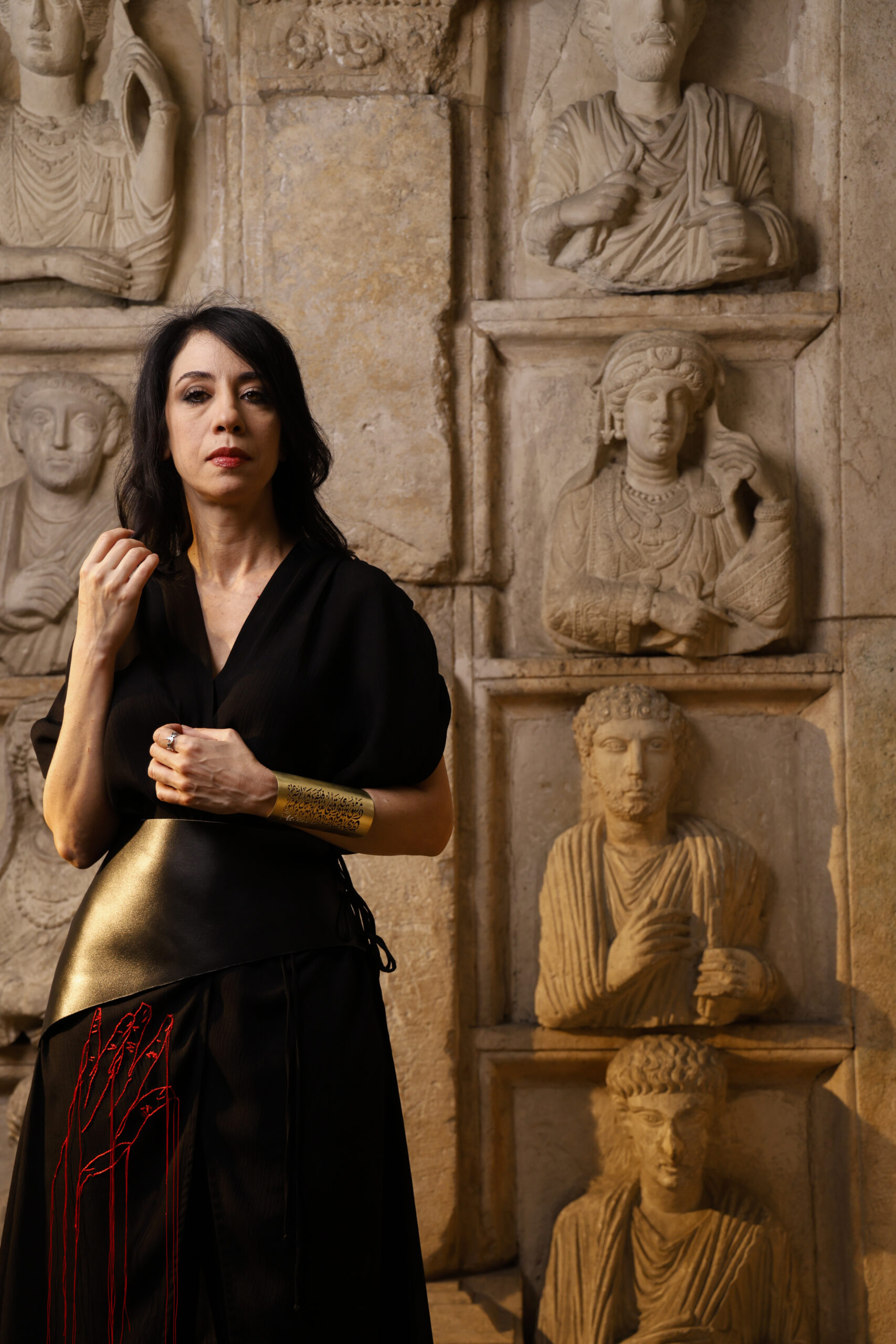
“Sara’s art captures the soul and strength of Syria,” Haffar says, “and our work is also a small tribute to that heritage. Seeing her wear our cuffs felt truly meaningful – a connection between art and craftsmanship
Words: Danny Makki
Photography: Mohammad Azaat
Creative Direction: Mark A. Marcus, Tayma Ali (Kizio Studio)
Fashion: Tala Nehlawi (MaisonTN)
Hair and Make Up: Milad Hannoun
Jewellery: Dania S. Haffar in collaboration with Dima Kekhia Mahjoub


