
News


I have never once cared who wins. And yet, here I am again.
It is June 2026, and the World Cup fever is in full effect. This 23rd edition of the global tournament is the biggest to date, featuring an unprecedented expanded format of 48 teams competing across 104 matches. To accommodate this expansion, the tournament spans across three co-host countries: the United States, Canada, and Mexico. For 39 days and 104 games, homes, cafés, and streets will turn into makeshift mini stadiums, serving as communal sanctuaries for fans of the game.
When you strip the sport down to its bare mechanics, it sounds almost absurd: 22 men chasing a ball on a patch of grass. Yet football still manages to cause a collective cortisol spike for millions of fans worldwide. Not for me, though. I view this entire spectacle through a different lens. I watch football because I like watching people watch football.
Quadrennially, I find myself completely swept away with each World Cup, watching matches both with and entirely against my will. This year is no different. I am watching the World Cup once again from the outside, from the vantage point of someone who genuinely doesn’t care about the final score on the board, but still finds themselves unavoidably moved by everything around it. I can’t deny being captivated by the endless cheers and the chants, the sight of strangers glued to all types of screens, from smartphones to public projectors, the music, the memes, and all the quiet, fleeting human moments in between. I am here for all of it.
As an Arab growing up in a culture obsessed with football, I’ve come to notice the power that football has in both uniting and fragmenting groups and spaces. Every four years, the sport manages to stop the world from turning and becomes the central point of attention. Whether you are actively within the fandom or sitting completely outside of it, it will find you.
It is funny to look back now, because before I ever paid attention to this game through a sophisticated lens, the entire universe of football was contained within the walls of my home. I will never forget the summer of 2006, when I first learned how to speak the language of football. Through watching my father watch the games during that tournament, I slowly learned how to speak the shorthand of football lingo and became familiarised with all the iconic players of that era. The World Cup always arrives like a storm, and during game days in our house, the television area becomes a danger zone. Nothing else could air, and no one dared to interrupt the screen.
In the past, I could not make sense of the irrationality and violence of the football fandom. But as an adult, its massive sociological impact intrigues me. It made me reflect on my own upbringing, remembering how football in our household was a serious topic.
Journalist Bill Buford, in his undercover book Among the Thugs, reveals that the sport serves as a simple antidote to the exhausting grind of modern life, allowing people to forget their stresses, anxieties, loneliness, and life agonies. All people want is just to disappear in the numbers.
The World Cup is one of the few global events large enough to make someone like me, who doesn’t usually subscribe to mass media events, feel both beautifully irrelevant and completely engaged with this energy. To understand that pull better, I spoke to a few fellow carefree fans.
Shafi (31) from Bahrain and Saudi Arabia thinks watching the World Cup games is the only time you partake in something that feels like a truly global moment. For him, this provides a rare opportunity for shared joy, connecting with people he wouldn’t otherwise connect with, whether family or colleagues. However, Shafi also acknowledges that “when it goes from the simple joyous side into the rigid and aggressive one, football becomes a scary thing.” There are many dark moments in the history of football where fandom goes to the far extreme, charged with violence and rage, resulting in tragic incidents.
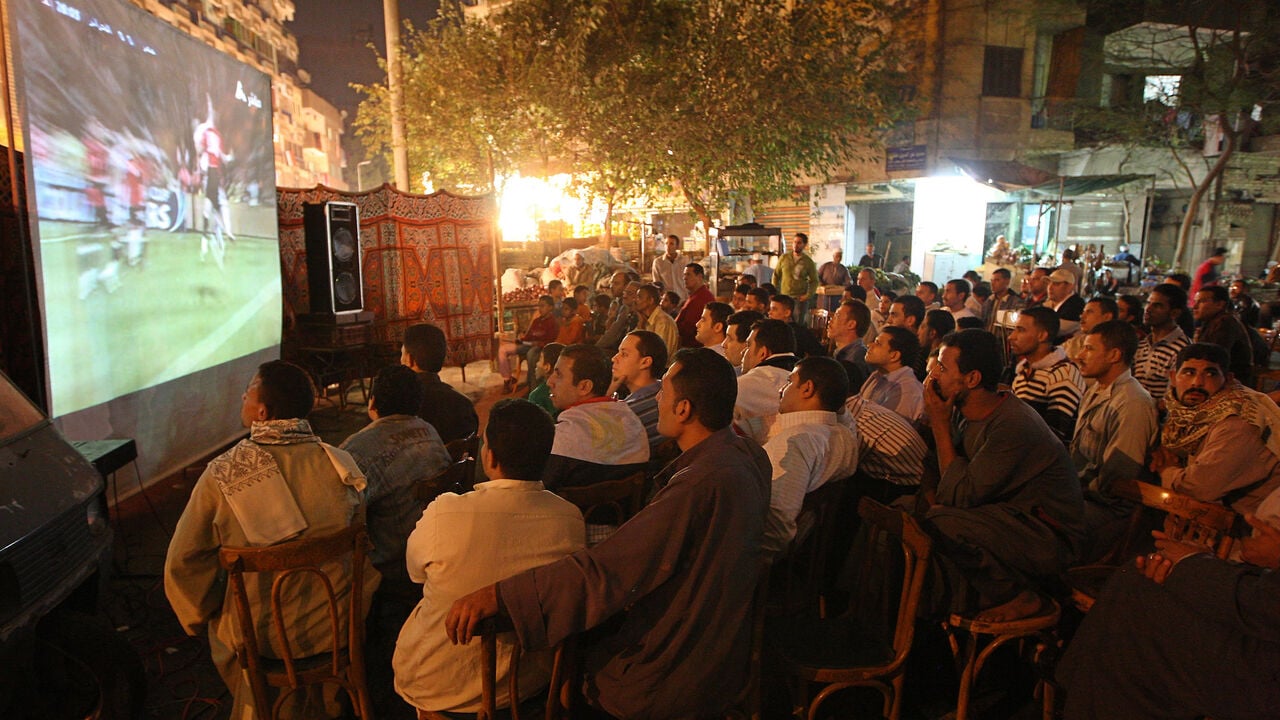
The football high is attractive to people of all ages and all genders, even if you don’t understand how the game technically works. Talking to Heba (26) from Morocco, I realised the technicalities and tactical formations don’t really matter, we both don’t understand it, and we still find it fun watching people watch the game. Reacting to the miraculous eruption of a goal or the agonising heartbreak of a near miss, the intensity and stress of those 90 minutes bring an emotional rollercoaster shared with the community within that particular time and space. Football fandom functions in a manner deeply similar to nationalism, religion, and politics, creating this sense of belonging that people are desperately longing for amid these politically alienating and bizarre times.
Heba’s experience might resonate with many women, for whom watching football is perhaps a rare way to connect with our fathers, brothers, partners, and lovers. Football somehow allows us to enter those masculine spaces from a different door. She mentioned her primary connection to football blossomed not through local clubs but through being a fan of the Brazilian superstar, Neymar Jr. Heba says, “watching World Cup games allows me to hang out and bond with my father, my grandfather, and my uncles”. In those moments, no one says football is for boys; gender and generational barriers seem to ease.
This longing to be part of something bigger describes the reality for millions of fans, even if their own country never makes it to the big screen. My friend Arzia (33) from Indonesia also started watching the World Cup and getting introduced to the world of football in 2002. She was just a child, but old enough to remember the games and the players of that time. She lived in Indonesia, and I lived in Yemen, but it feels like we both had exactly the same experience of being young, curious girls, wondering about what is getting everyone so tense and excited. “As an Indonesian, I grew up in an environment where football is a major sport and a big obsession; it is considered one of the biggest football fandoms in the world,” she tells me. Even though Indonesia has a massive population of over 280 million people, it has never successfully qualified for the World Cup, except for a single appearance back in 1938, when the country competed under Dutch colonial rule as the Dutch East Indies. She mentioned that qualifying for the World Cup is a deeply repressed dream for her entire country. And I related. I feel like if Yemen qualifies for the World Cup one day, the war might actually come to an end.
To answer this, we can tap into the writing from Franklin Foer’s book, published in 2004, How Soccer Explains the World. The book attempts to diagnose this phenomenon, writing that humans have a natural urge to associate themselves with a group, and football teams, in many instances, fill that role. This analysis touches directly on the sociological concept of “commodified tribalism.” Foer draws it nicely by giving a basic yet fundamental explanation, which is that as modern life isolates us from traditional communal space, people naturally look for new ways to anchor themselves. Football teams effectively step into this void, offering a relevant, historically meaningful, and intensely emotional belonging, replacing the organic communities of the past.
And sometimes, that belonging reaches far beyond the stadium. I have heard it stated many times that the only moment the fighting stops on the front lines is when there is an El Clásico match between Real Madrid and Barcelona airing. This has some truth to it. In October 2005, after successfully securing the nation of the Ivory Coast’s first-ever World Cup qualification, Didier Drogba dropped directly to his knees in the locker room surrounded by television cameras. Standing before his teammates, he delivered an impassioned, desperate plea begging Ivorians from the north, south, centre, and west to prove that all Ivorians can coexist. He begged the warlords on his knees to forgive and lay down all weapons. He concluded the speech singing: “We want to have fun, so stop firing the guns.”
This speech echoed across a country torn apart by civil war. The national football team helped convince both warring sides to declare an official ceasefire and restart dormant peace talks, eventually leading to the signing of an official peace agreement in 2007. Moments like that prove the sport is never really about the game; it is a massive political and social engine, maybe now more than ever.
Which makes what is happening to this tournament all the more painful. My read on the fans’ sentiment for this time seems to be more disappointed than excited. Given that the vast majority of the games are set in the United States, this World Cup is a politically charged one. When the United bid was selected at the 68th FIFA Congress in 2018, many people across the world were incredibly excited to witness the joint energy for the game, especially that of Latin America, imagining how their vibrant football culture would amplify the excitement of the tournament. A lot has changed in the last eight years. With the United States’ harsh visa restrictions and border controls, half the globe is either banned or severely restricted from entering the country. These rigid policies inevitably leave millions of passionate fans locked out from attending the games this time around. Adding to this isolation, the outrageous ticket pricing is turning a historically working-class sport into a luxury asset. The 2026 tournament is just not encapsulating the decade-long raw and electric energy. It doesn’t help that it follows what many consider the greatest World Cup in recent memory.
For Arabs, football fans and otherwise, World Cup 2022 was an absolute golden moment. It was the stepping stone for Arab fandom, which moved from a passive position of viewership to an active position of true participation on the world stage. Qatar became the first Arab nation to host the tournament. Then, the world watched in awe when Morocco became the first Arab and African nation to ever qualify for the semi-finals. The entire Arab world, alongside its global diaspora, went out onto the streets everywhere. In true Moroccan spirit, celebrations were completely over the top and the very next day the colour red became the universal uniform of the streets; the iconic Moroccan jersey transcended sports to become a symbol of cultural pride. It felt like an unbelievable breakthrough and a deeply emotional victory. Moments like these become instantly claimed by all Arabs across the entire region, bypassing borders and prejudices.
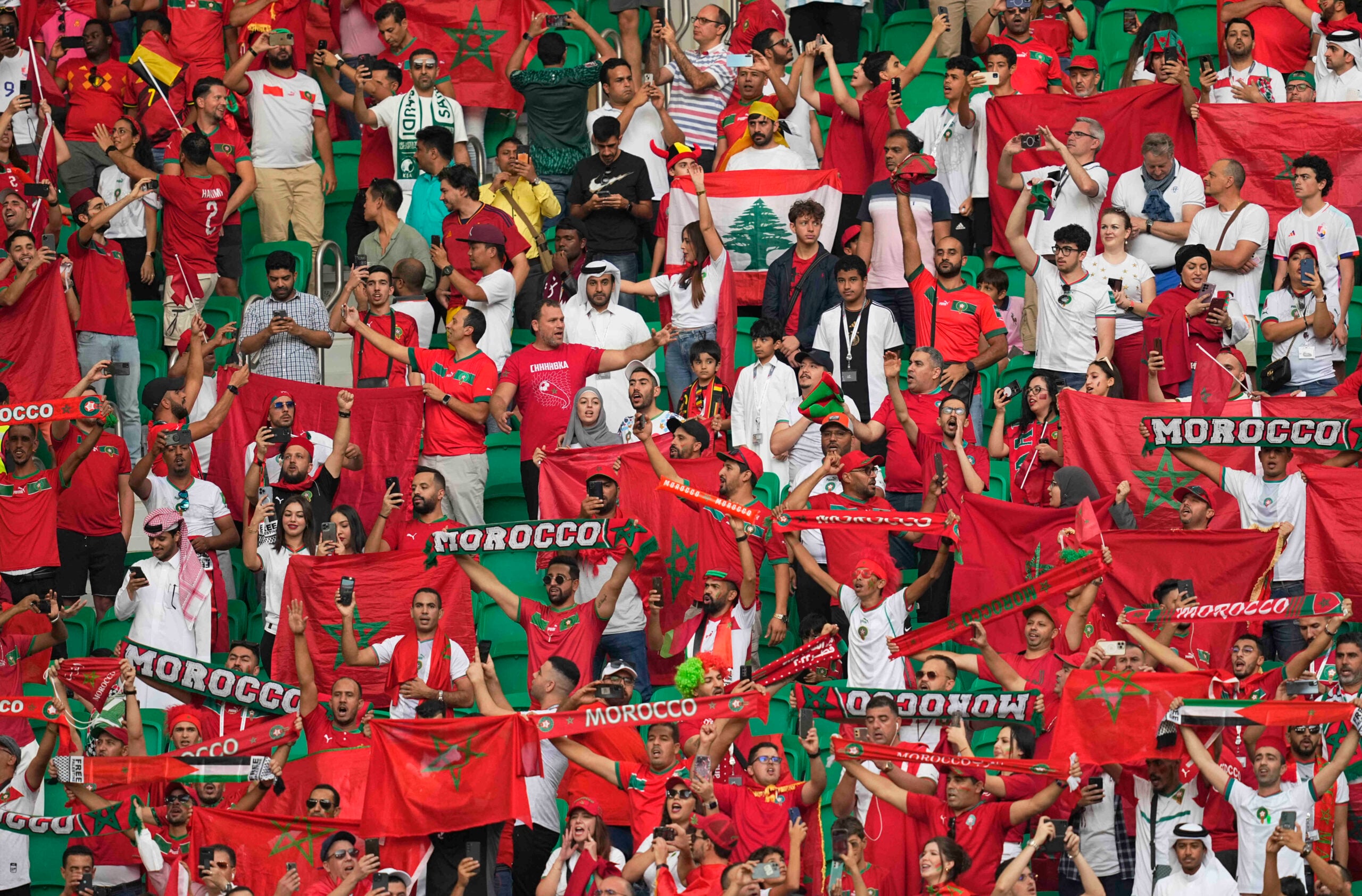
This powerful momentum continues to build this time around, as for the first time, eight Arab teams have successfully qualified for the 2026 FIFA World Cup. Algeria, Egypt, Iraq, Jordan, Morocco, Qatar, Saudi Arabia, and Tunisia have all successfully qualified to compete. Every single Arab victory on the pitch will feel like a massive, collective win for us all. That is, at least, until they play against each other.
The World Cup forces us to look and question the scale of human investment in everything surrounding this game. The 2026 tournament is happening against a backdrop of harsh border controls, financial exclusion, and brewing international war. Undeniably, this is a mirror for our reality. Even though I don’t really care about football or who takes the trophy home, I cannot help but follow the pull of this chaotic human theatre, and my excitement to watch people watch the games in a desperate search for a dopamine kick. I look forward to a summer of absolute World Cup madness.