
News


Art fairs ask you to look at the art. International guests fly in from every corner of the world to consume it in measured doses, drifting through purpose-built galleries with overhead lights and wall labels for company, before leaving the city more or less as they found it. SeeDjerba asks for something else. As its name suggests, it asks you to see Djerba.
The island, off Tunisia’s southern coast, is known for its cerulean water, long stretches of white sand, whitewashed houses and busy souks, and for a character so distinct it can feel like a place slightly apart from the rest of the country. For nine days each August, it also becomes an open-air gallery. Founded in 2017 by curators Aymen Gharbi and Bettina Pelz, the media art festival has quietly done something Tunisia’s art scene has long needed, pulling contemporary art away from the capital and planting it in the south. The 2026 edition, led by artistic directors Fairouz Nouri and Khadouja Tamzini, ran under the theme “From Encounter to Entanglement”, built around akros, the Amazigh word for the knot that binds threads in traditional weaving. Thirty-five artists from Tunisia, Europe, Latin America, Africa, Asia and the Middle East took the idea in every direction: ecological, social, historical and deeply personal.
The festival opened on 8 August at the Guellala Museum before moving to Houmt Souk from 14 to 16 August, where installations, moving images, sound and digital works were spread across five sites: Borj El Kebir, the CRAD community resource centre, the Artisanal Village, the Djerba Traditional Heritage Museum and the streets of the old town. You walk between them, and the walking is part of the work. The festival doesn’t try to change or dress up the island. It talks to it, on the walls, in the street, in the middle of a café, in Guellala, in Houmt Souk, in an old cinema hall.
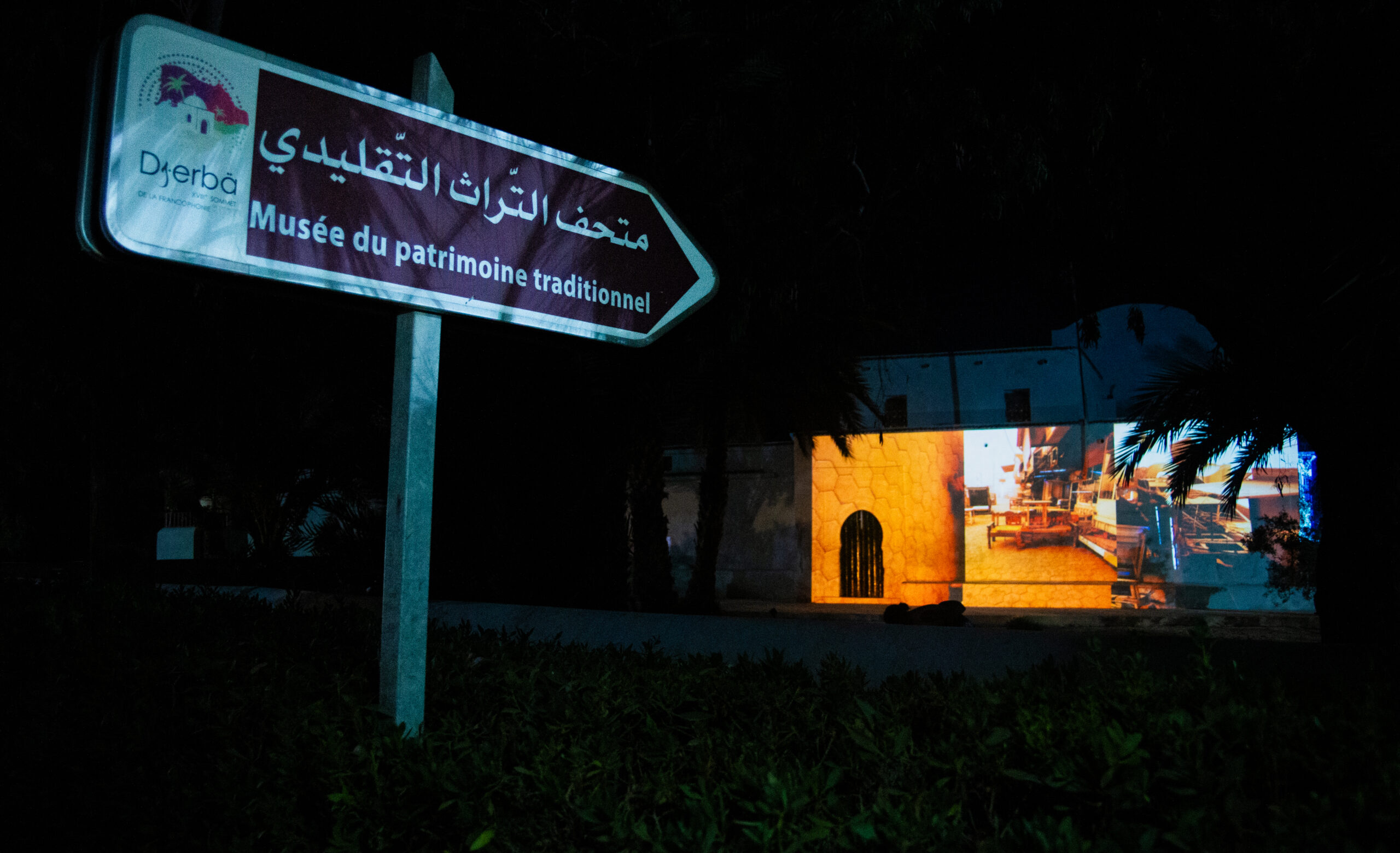
The Djerba Traditional Heritage Museum was originally a zaouia, built to honour the theologian Sidi Zitouni and Sidi Ameur. At its entrance, visitors are greeted by (Hlkt هلكت), a projection-mapping light installation from British-born Iraqi-Irish multidisciplinary artist Abdulisms. Further in, tucked into a small room beside two graves that were never removed from the old shrine, is Syrian artist Sa’ad Choeb’s His Eyelids Taught Ghazal (2026).
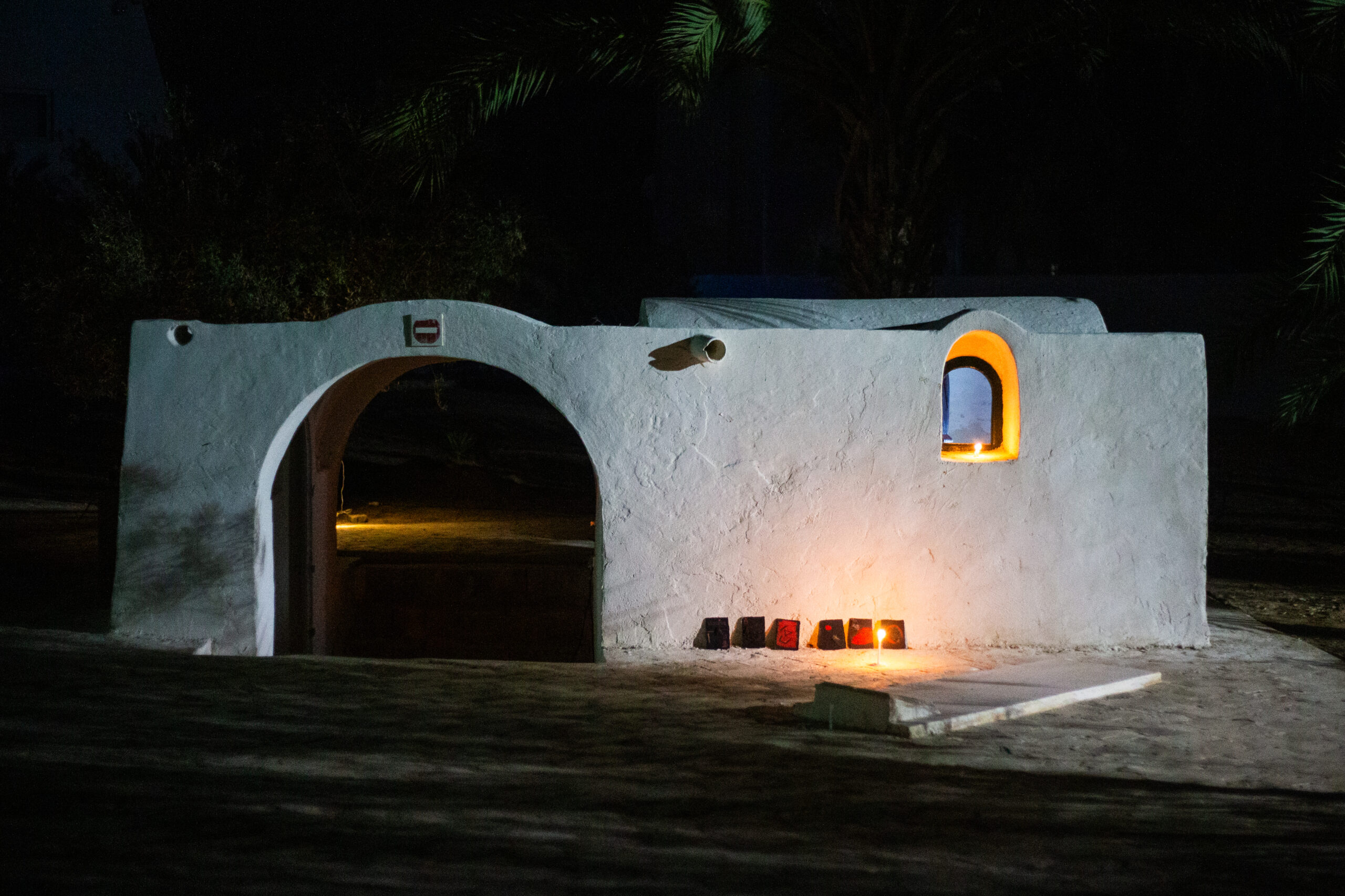
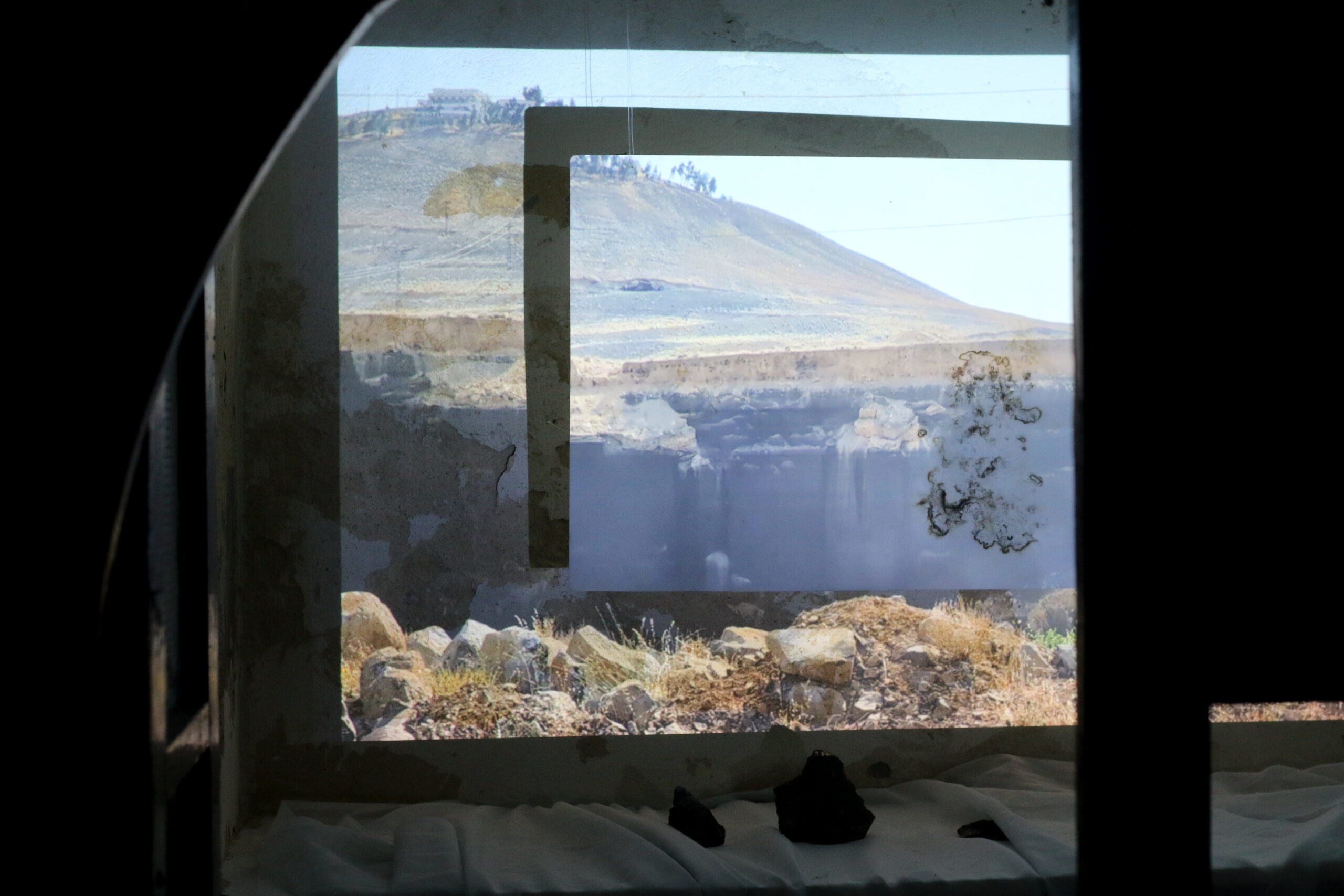
Only one person could fit in at a time. Inside, bakhoor smoulders, candles are lit, and a five-minute video loop drifts across the wall: footage Choeb shot near his family home in Swaida in southern Syria, including a tree of heaven standing behind Tell Shihan, the dormant volcano that watches over the region. The soundtrack, made with sound artist Bint Mbareh, layers Sufi chanting, the biosonified activity of living mould and fragments of Mohammed Abdel Wahab’s 1933 classic “Jafnuhu Allama al-Ghazal”, from which the work takes its name. Over it all runs the voice of the late Syrian poet Tammam Hunaidy, mourning himself. Decomposition runs through much of the Syrian artist’s work, and what he brought to Djerba is less a single installation than one stage in a longer cycle of decay; a touring exhibition that began at Manzool Space in Damascus and travels shortly after to the University of Cambridge with Shubbak Festival, the rot taking a different form at every stop, as rot does.
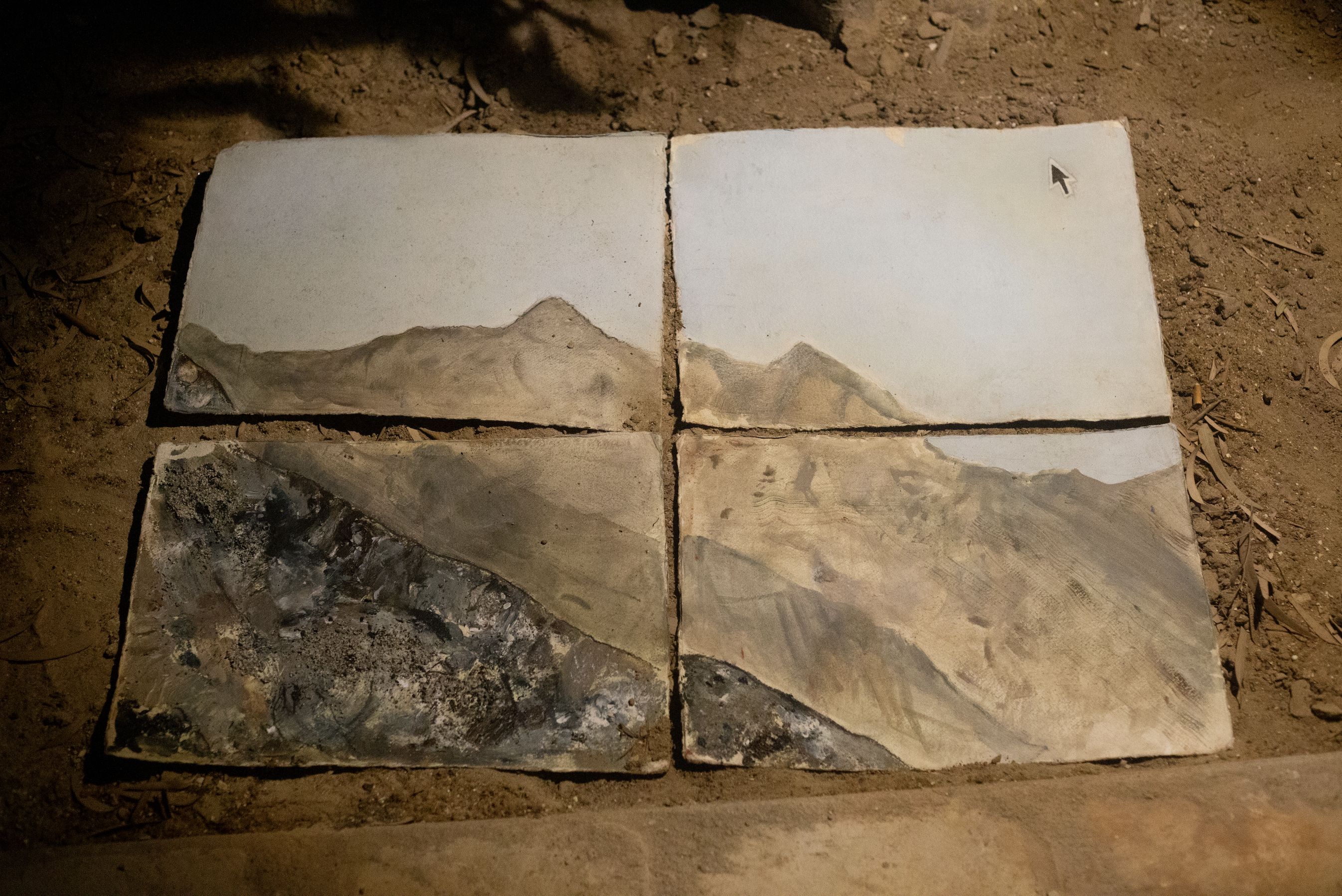
Choeb cultivated the mould in Ghazal from paper recovered from his old studio in Syria, returned to after years of exile, and set it alongside basalt stones carried from his family home. Outside, beneath an olive tree in the courtyard, a painting split across four panels lies flat on the earth, a nod to the medium Choeb, originally a painter, trained in. Much of the art made about displacement treats the archive as something fixed and fragile, a relic to be protected. But here it is alive. The rot is not the damage but the witness, still growing, still making sound. Structured around an imagined cycle of lunar phases and eclipses, the installation folds several clocks into one small room, geological, botanical, lunar and human, and refuses to let any single one of them claim authority over grief. The one-at-a-time format asks for patience from a festival crowd, but that is perhaps the point. Grief does not keep to a group schedule.
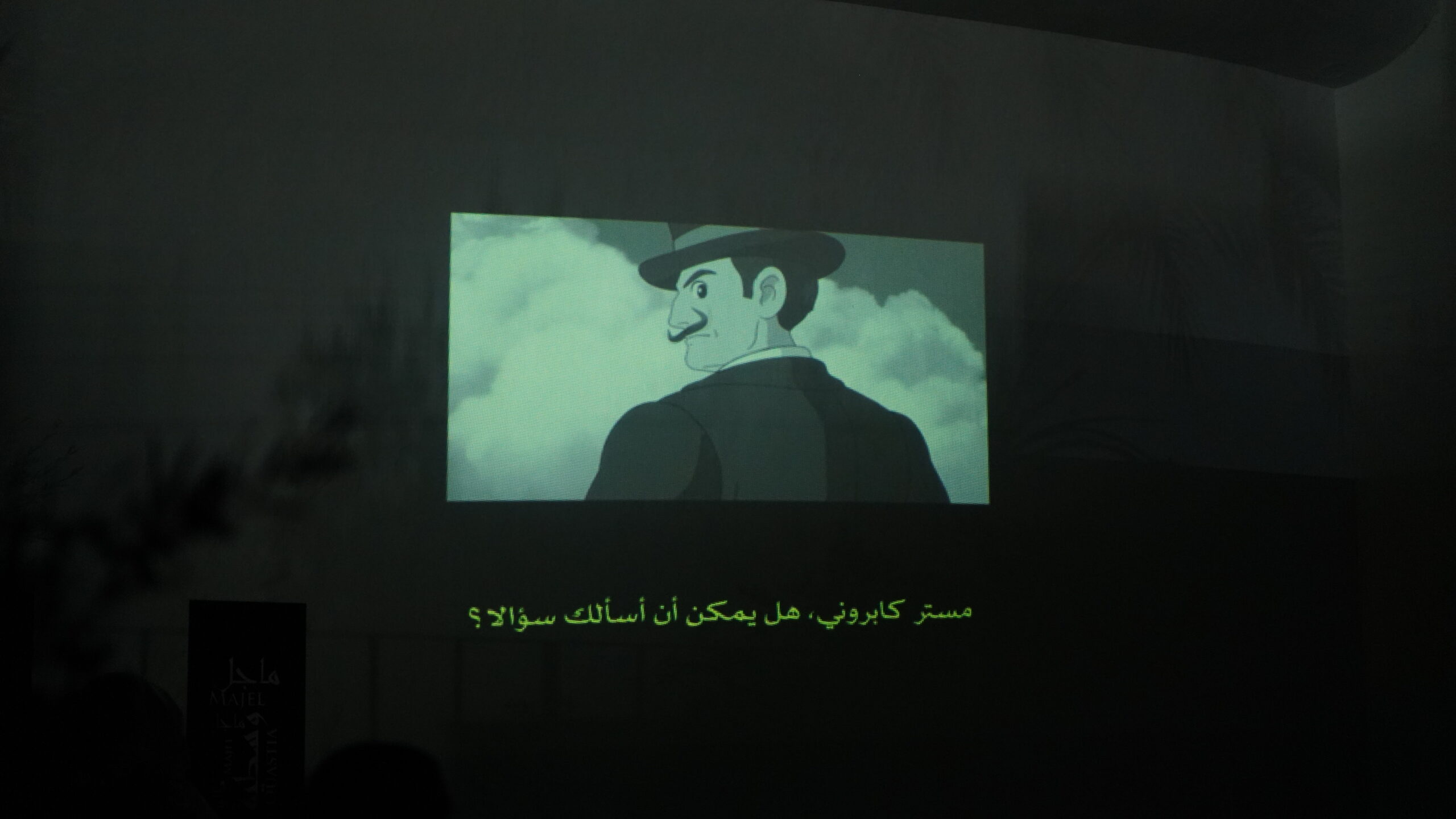
A few metres away, projected onto one of the museum’s back walls, is Libyan artist Tewa Barnosa’s The Insurgence of Ghibli Winds (2025). The film, told in chapters, returns to the first aerial bombing in history, dropped by an Italian pilot on an oasis near Tripoli during the Italo-Turkish War of 1911. It is a moment that quietly rewrote the rules of war, introducing violence from the sky to the colonial playbook. Yet, much of its history has been erased, left to survive in fragments, footnotes and the memories of those who lived beneath it.
Barnosa rebuilds it from whatever material survives or can be imagined. Each chapter takes a different medium and a different way of looking: old American computer games, archival footage, a scene from Studio Ghibli’s The Wind Rises (2013) and an invented conversation between the ghibli, the hot desert wind of Libya, and Giovanni Caproni, the aircraft engineer who built Italy’s first plane in 1910 and many of the bombers of the First World War. The knot pulls tight in unexpected places. Caproni named one of his later aircraft after the Libyan wind, and Hayao Miyazaki later named his studio after that plane. Hence, a word for a colonised landscape’s weather travelled, via a war machine, into one of the world’s most beloved animation houses. Barnosa lets that chain speak for itself.
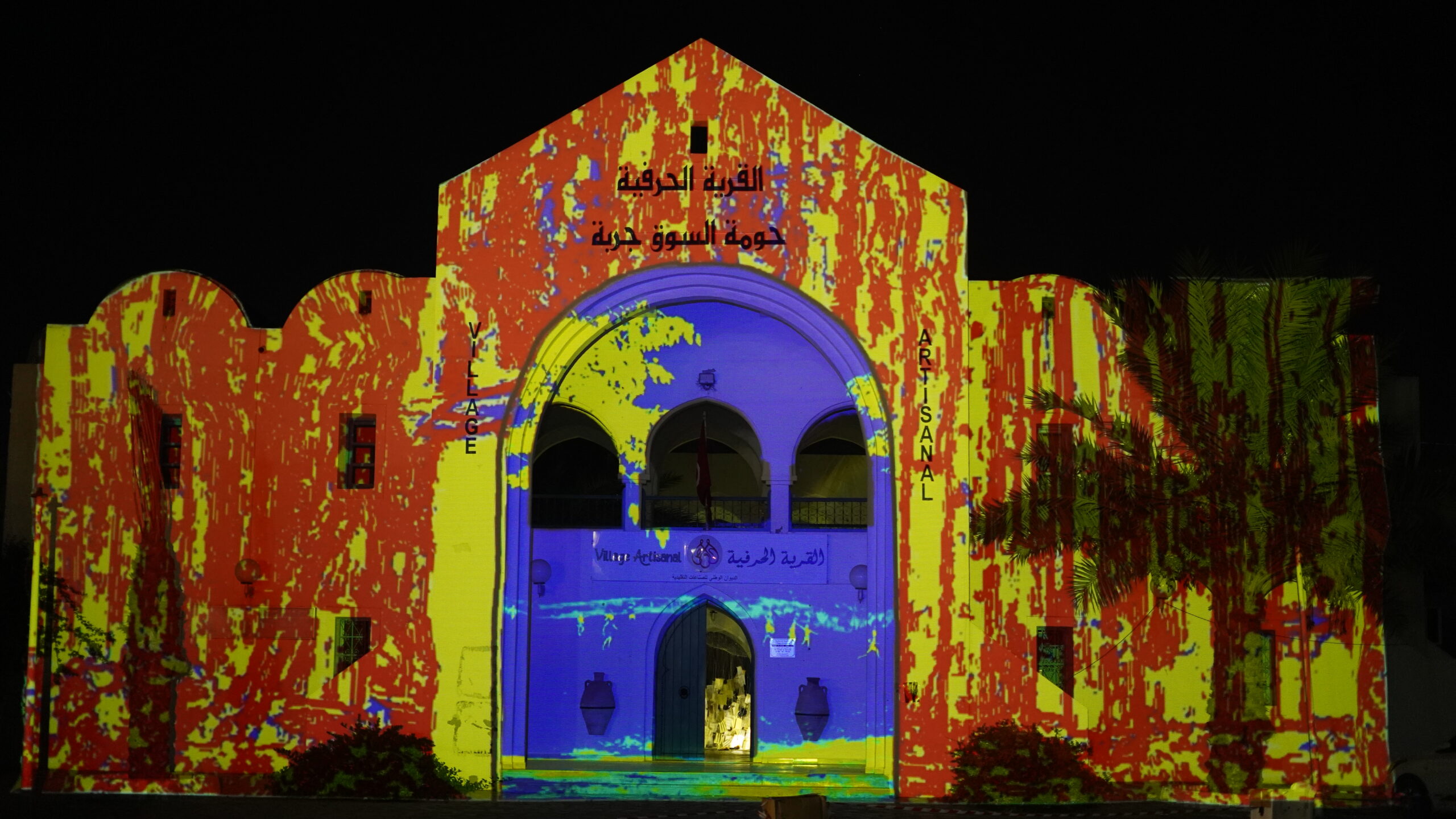
On the other side of the road, the Artisanal Village of Djerba placed contemporary work alongside the island’s living crafts, most notably basketry and strawwork woven from dried palm leaves and wild reeds, Djerba’s oldest trade and a fitting home for a theme named after a weaver’s knot.
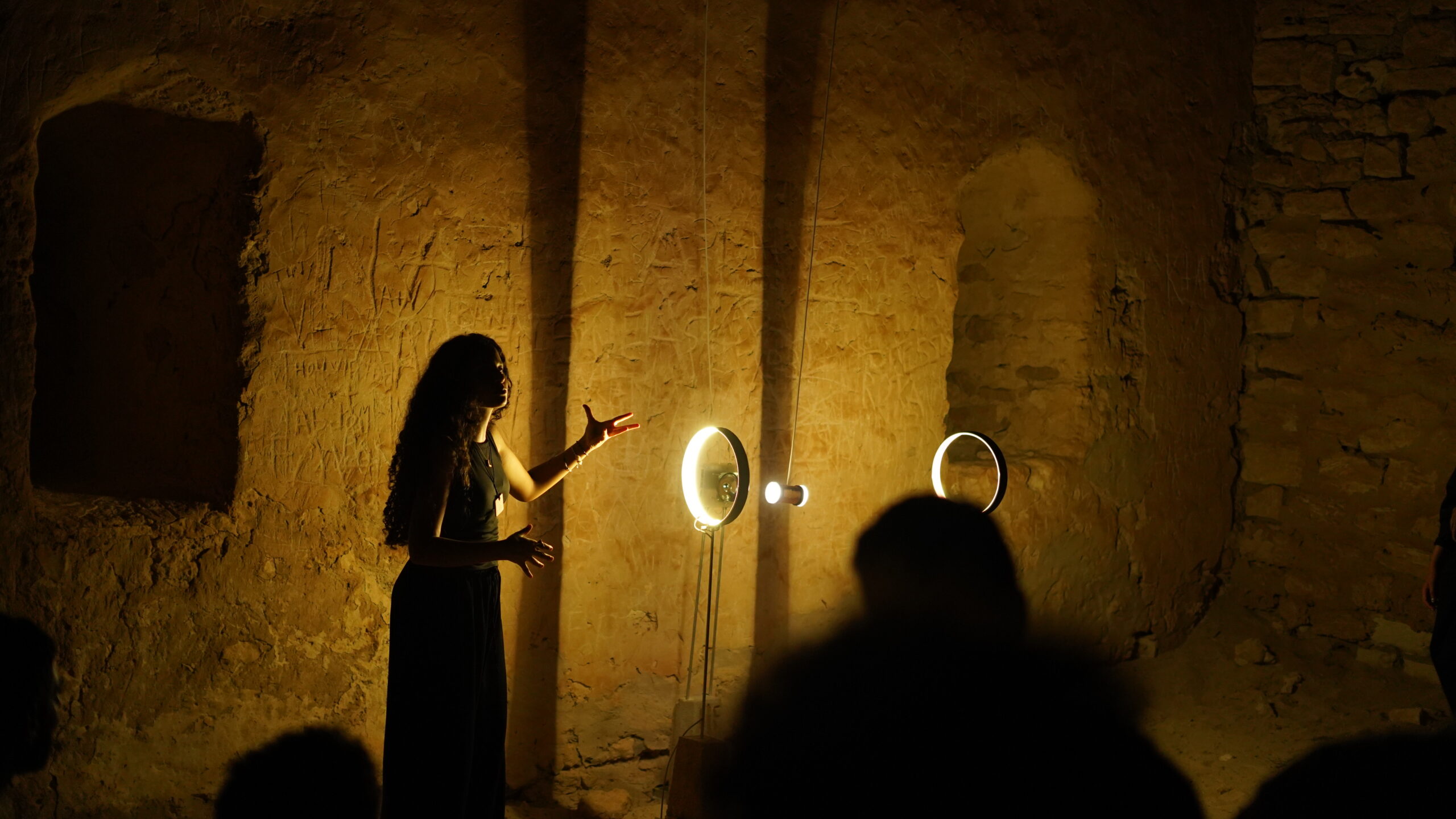
Our final stop was the Borj. Built at the end of the 14th century over the ruins of the Roman city of Girba and extended in 1450, Borj El Kebir, also known as Borj Ghazi Mustapha after the qaid who settled on the island in 1559, is the largest and best-preserved fortress on Djerba. Having visited a few days earlier in daylight, I barely recognised it. The festival turned it into a dim maze, the darkness making room for light installations by young regional and international artists. Among them was Taiwanese artist Shu-Cheng Tsao, whose practice is concerned with how memories form, shift and become tangible. One of his two works is a speaker hung as a pendulum, swinging between two rings of magnetic light that alter its frequency, so the sound slides from classical to contemporary music as it arcs from side to side. The other, I Don’t Want to Forge a Paper, looks at first like a blank white sheet. Up close, it is covered in imprinted digits, presenting a quiet argument for the material and the valuable in an age when every picture we take dissolves into data.
On the way to the Borj, our taxi driver asked my Tunisian friend why the town was so busy. She told him about the festival and eagerly invited him along. Though he didn’t come, inside the Borj, where entry was open to everyone, I saw every kind of person, families, teenagers, older residents, visitors from abroad, moving through the dark together. The festival’s training programmes in curation, art mediation and production are part of the same idea. Nothing here feels exclusive or elitist.
Nowhere was that clearer than on the opening night. The festival opened with an open-air concert in Hajji Square, in the heart of Houmt Souk, the island’s busiest spot, where Tunisian producer Pan-J (Jihed Khmiri) performed Rawema, a live electronic reworking of Tunisian malouf, joined by Vipa, one of the country’s most beloved rappers, whose 2012 track “Egleb Mandhrek” became an anthem of the revolution. There were no tickets, no guest list and no barriers. Shopkeepers, children, festival artists and passers-by who had only come out for an evening walk ended up in the same crowd, some singing along to Vipa, others perhaps hearing malouf pulled into electronic territory for the first time.
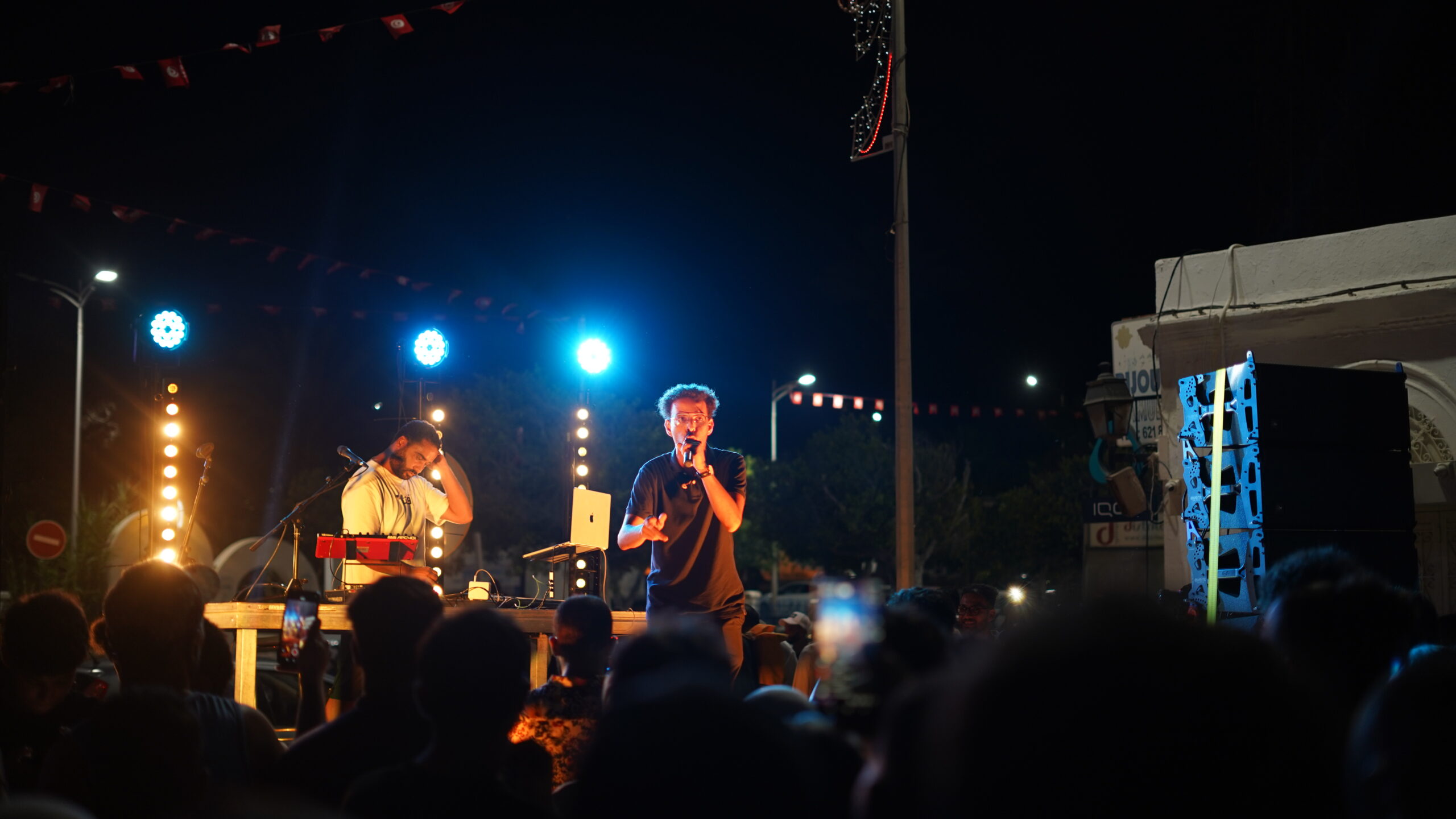
That is the festival’s real achievement. It ties history and the present together in a way that never feels forced, because it doesn’t have to force anything. When the work is installed in a 14th-century fortress, a saint’s shrine or a weavers’ village, the richness is already there, and the artists’ task is to pull on the thread. Next year, See Djerba marks ten years since its founding. On this evidence, the knot is holding
Banner image by Ahmed Zarrouki


