
News


Since the beginning of time, humans have discussed the environment through a lens of excavation, or beauty… What it provides to us. The expansiveness of the earth, the sky, the cosmos feels so large that the erosion we cause is made smaller, diluting human experience into what looks and feels like a speck of time. Our actions become a mere fraction of that time. As we experience beauty, excavating it to find purpose from the land, we forget that it is also a living archive, holding memory and history beyond what we can immediately perceive. The traces of ecological change remain as residues, embedded in landscapes and layered across time. In our lack of awareness of the environment’s life, we become even less aware of its wounds.
“The land is alive again.”
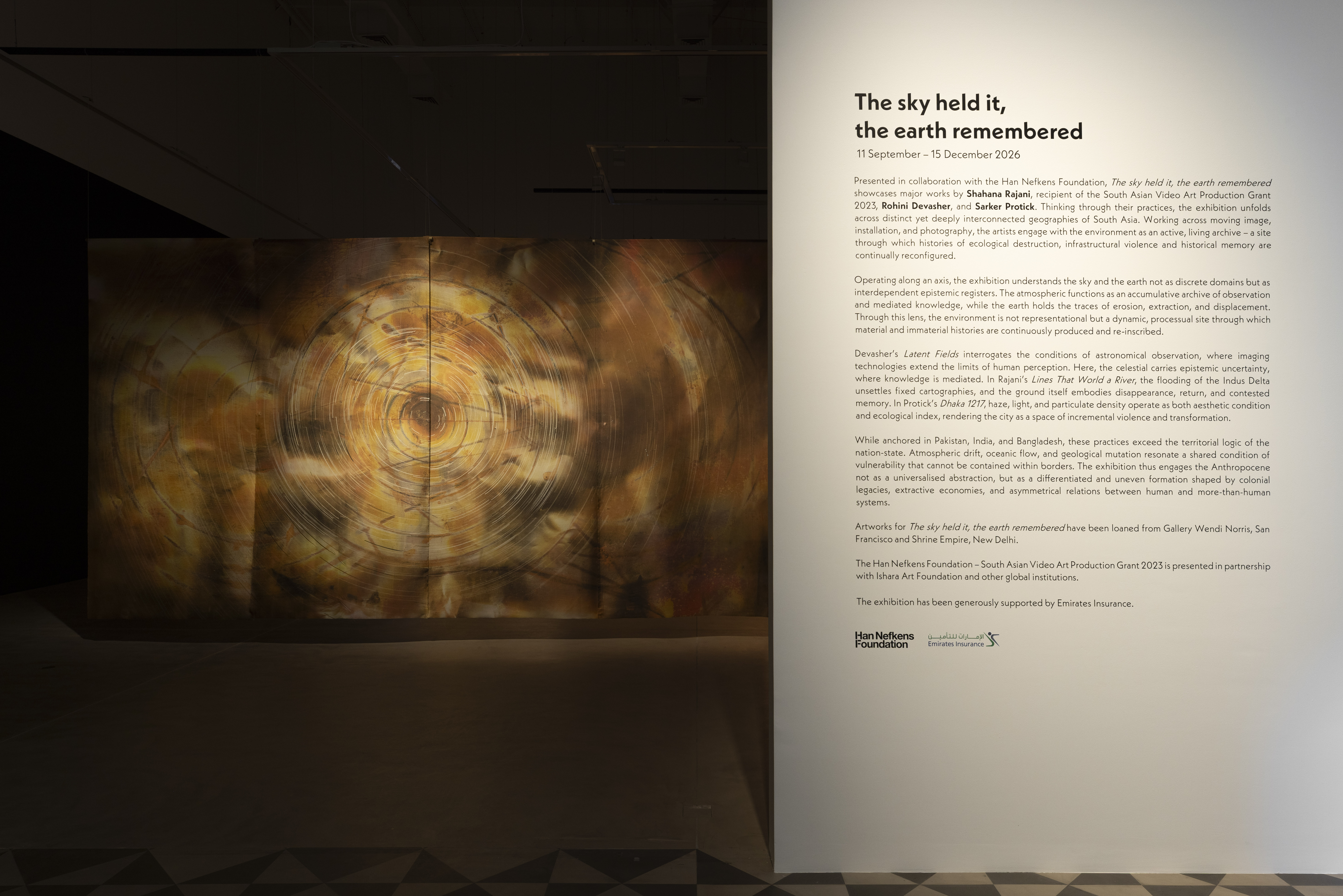
Excerpted from Shahana Rajani’s short film Lines That World a River, which is screened as part of Ishara Art Foundation’s latest group exhibition, The sky held it, the earth remembered. The show, on until December 15th and curated by Sasha Altaf, features works from Rajani, Rohini Devasher and Sarker Protick. It converges the practices of these artists to interrogate the relationship between environmental and atmospheric worlds with human questions of memory, loss and temporality. These entanglements, and the pursuit of finding ways to make visible how human and non-human changes intertwine, are where curator Sasha Altaf found a resonance among the three artists’ practices. “Less through a shared subject than through a shared way of looking,” Altaf explains to ICON MENA. “None of the three artists approaches ecology as a discrete theme or as an illustration of the climate crisis. Rather, ecological change enters their work through landscape, materiality, memory and the passage of time.”
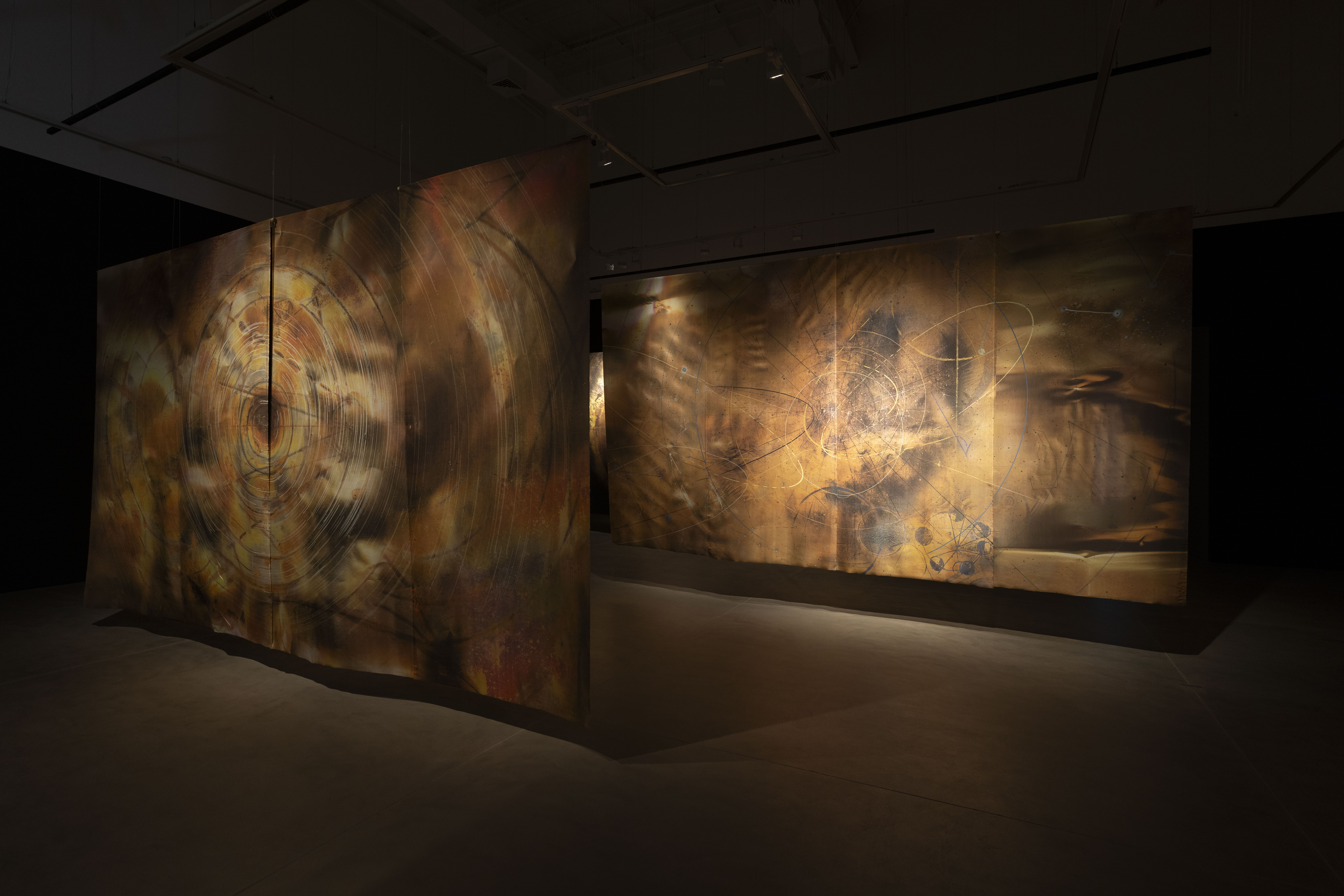
Entering the vast, lofty space in the heart of Alserkal Avenue, my eyes were tugged by the scale of Devasher’s installation Latent Fields. Three silk panels suspended from the ceiling, close to 18 feet tall. Each step closer to the large installation is both overwhelming to absorb and increasingly detailed to look at. Rohini Devasher, a Delhi-based artist and longtime amateur astronomer, uses astrophotography along with scale to create the experience of “crossing through the body of a star.” Each corner requires prolonged observation, and forces the viewer to slow down. At the onset of the exhibition, the installation is somewhat of a shock to the senses. It portrays the largest and most far-away environment in the cosmos, and creates a human experience with it.
Devasher’s intention is for the viewer to move through each field, shifting slowly from the centre to the outer periphery and back again. To me, the experience felt rather ‘meta’ whereby the question of human-environmental interaction is reflected in the very singular experience of viewing the installation. Walking in and around Devasher’s cosmic fields, I found myself feeling both small and big at the same time, questioning my own existence next to the scale of a star, but amazed by the access to viewing its particularities. The science and truth of the star itself, next to its allusiveness and beauty to the human eye, is, in experience, mystifying.
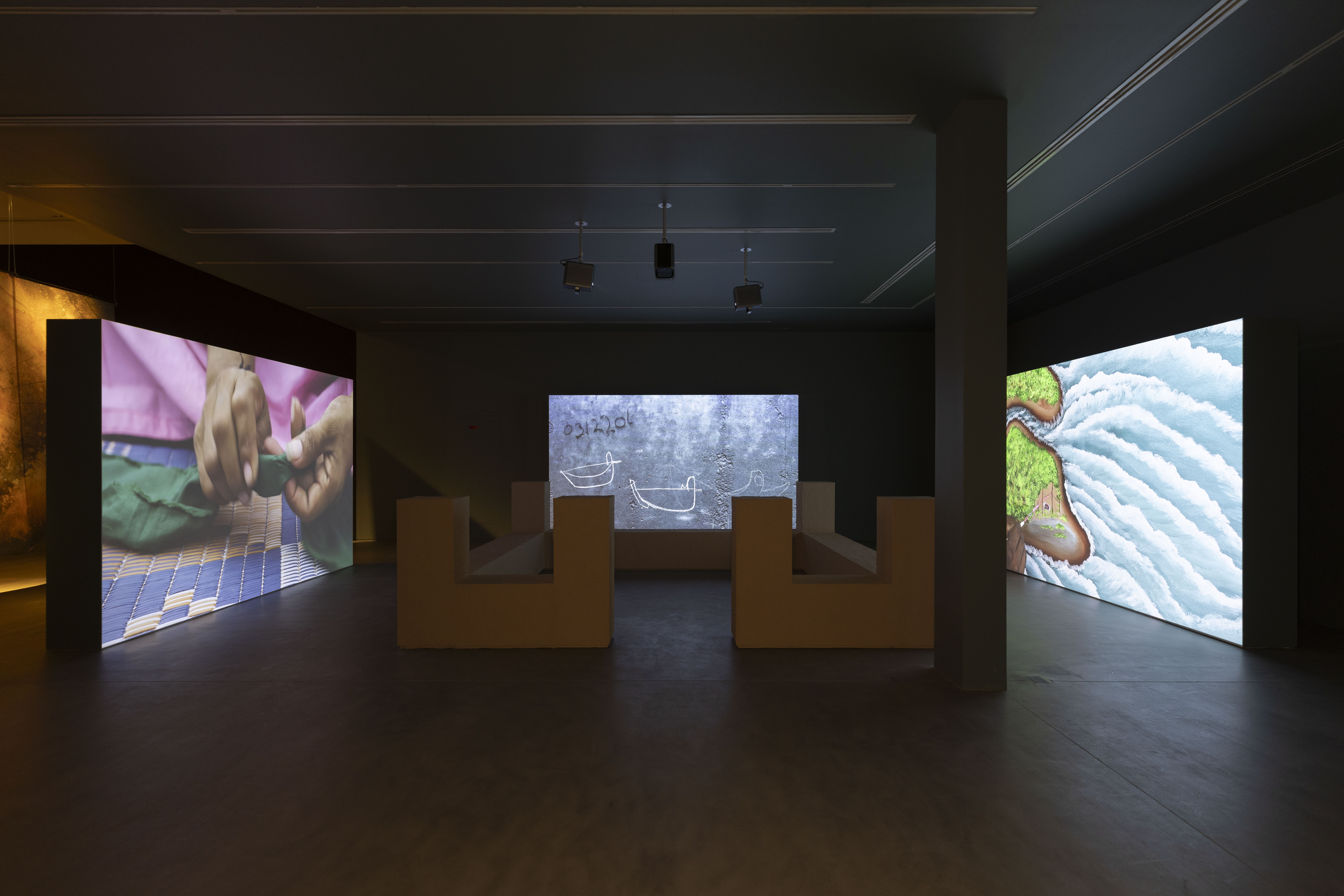
The show then moves the viewer into a square space, with a structure evoking a dargah, at the centre of multiple screens playing Rajani’s 14-minute film through three different channels. Moving from the sky to the water, Rajani’s work plays with new media, creating a moving image that, similar to Devasher’s piece, is divided into three.
This triangulation in the show is consistent. All three artists hail from South Asia, from India, Pakistan and Bangladesh (in order of the exhibition’s flow). This geographic convergence is poignant. Environmental degradation is painfully visible across South Asia, where communities that have contributed least to environmental degradation are often among those feeling its effects most acutely. They are also visible examples of what Rajani intentionally describes her film as portraying – survival.
Lines That World a River evokes the profound humanness of environmental change. Co-authored by local artists in Sindh, the film explores the reconstruction of their ancestral villages, submerged underwater through the building of dams, through painting. The film, played on three different screens with aligned audio but alternating episodes, forces one to switch their gaze between the different channels, feeling a lack of agency in what you view whilst maintaining a clear focus on the story.
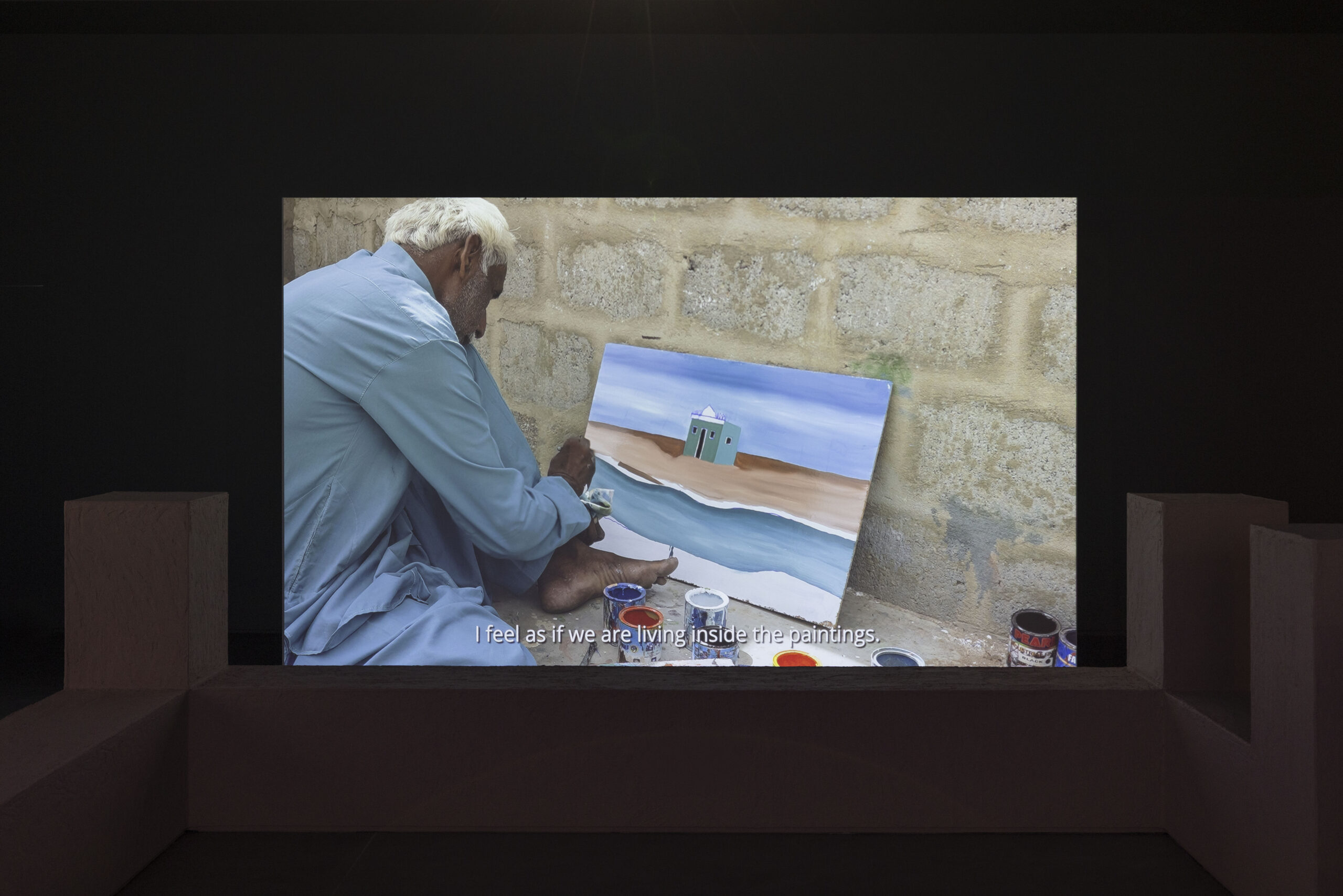
The film includes close tapings of the local paintings and drawings of the delta, as well as an exploration of the geography of the waters, its lost species and moments of the communities’ relations with the environment as it exists now.
Rajani, a multidisciplinary artist from Karachi, blends collaborative pedagogical research with visual media, viewing community art practice as a form of pedagogy and thereby establishing it as a significant form of knowledge. Emerging from long-nurtured relationships and research, Rajani’s work is an attempt to honour the lives and work of the communities and painters of the delta (painters Ustad Aziz, Abdul Sattar and the Dablo family) whilst creating new avenues for both media as a practice, and for whose knowledge and experience of the environment is centred canonically.
Rajani makes the conscious choice to present the delta’s landscapes as communities choose to represent “their own sacred geographies, to learn from existing painting practices of what and how to make visible, and what to withhold or render invisible. To be attuned and respectful to the sensitive nature of these spaces,” she reflected.
The film tells a careful and intimate tale of humans and the environment. Where Devasher’s installation makes the viewer question their scale through the vastness and detail of a star, Rajani tells the lived, honest experience of a space and its geography: its species, history, sacredness, abundance and loss.
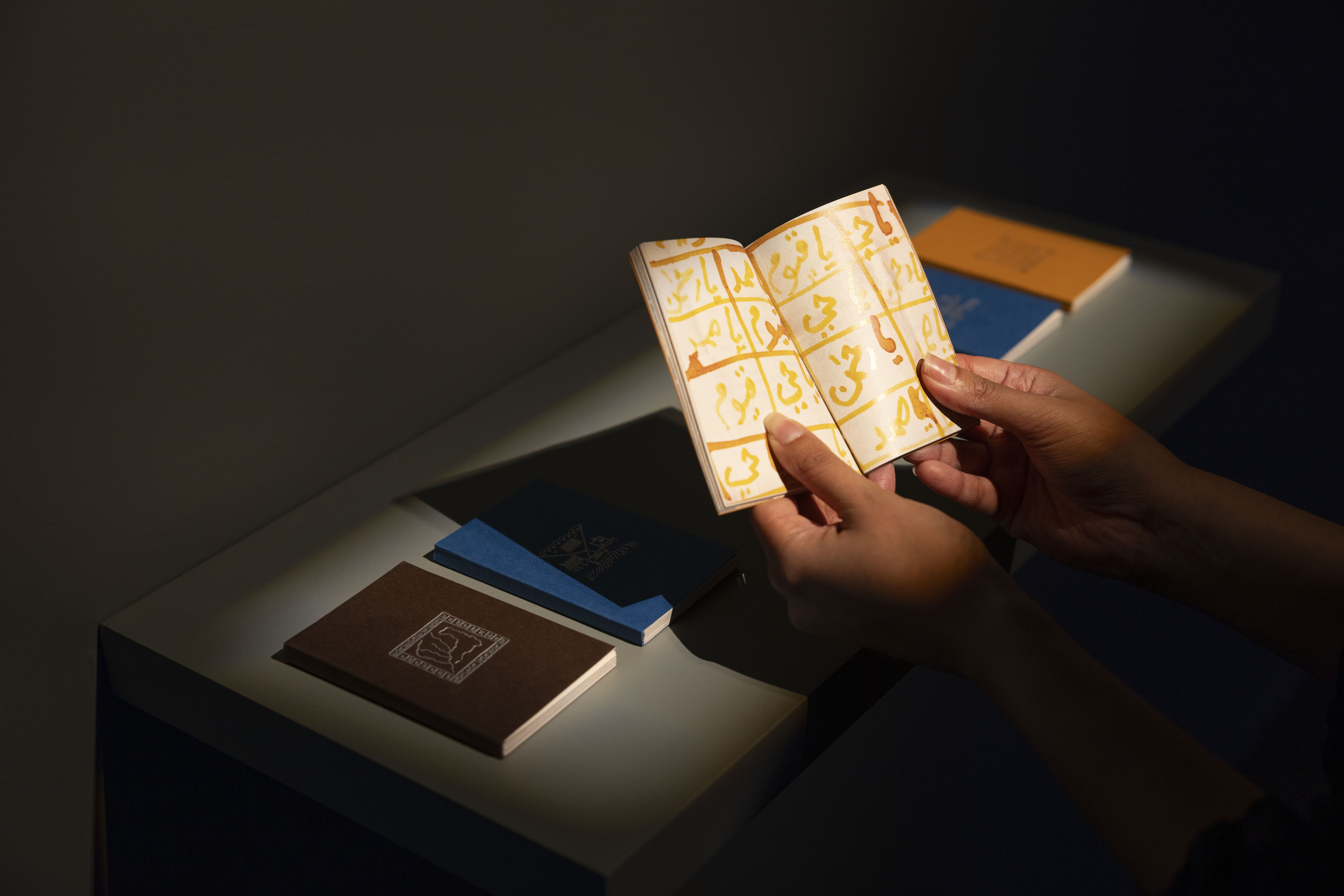
In the corner of the room, furthering the micro-storytelling of Rajani’s practice, are a selection of miniature publications, notebooks alike filled with drawings, poems of the delta, sketches of the aquatic world of the communities. Much like one’s own childhood journals, the books carry a dreamlike and a melancholic quality. Holding and reading these thoughts and imaginaries makes you feel the personal and emotional nature of the village’s relationship with its environment, as well as the material grief caused by its erosion.
The third and final part of the exhibition is Dhaka-based photographer Sarker Protick’s upstairs exhibit of his photographs from his book Dhaka 1217, spanning fifteen years of moments in time in his home city Dhaka. As such, the photographic exhibit tells its environmental story through the interrogation of time, in its practice of photography, and in its display of events.
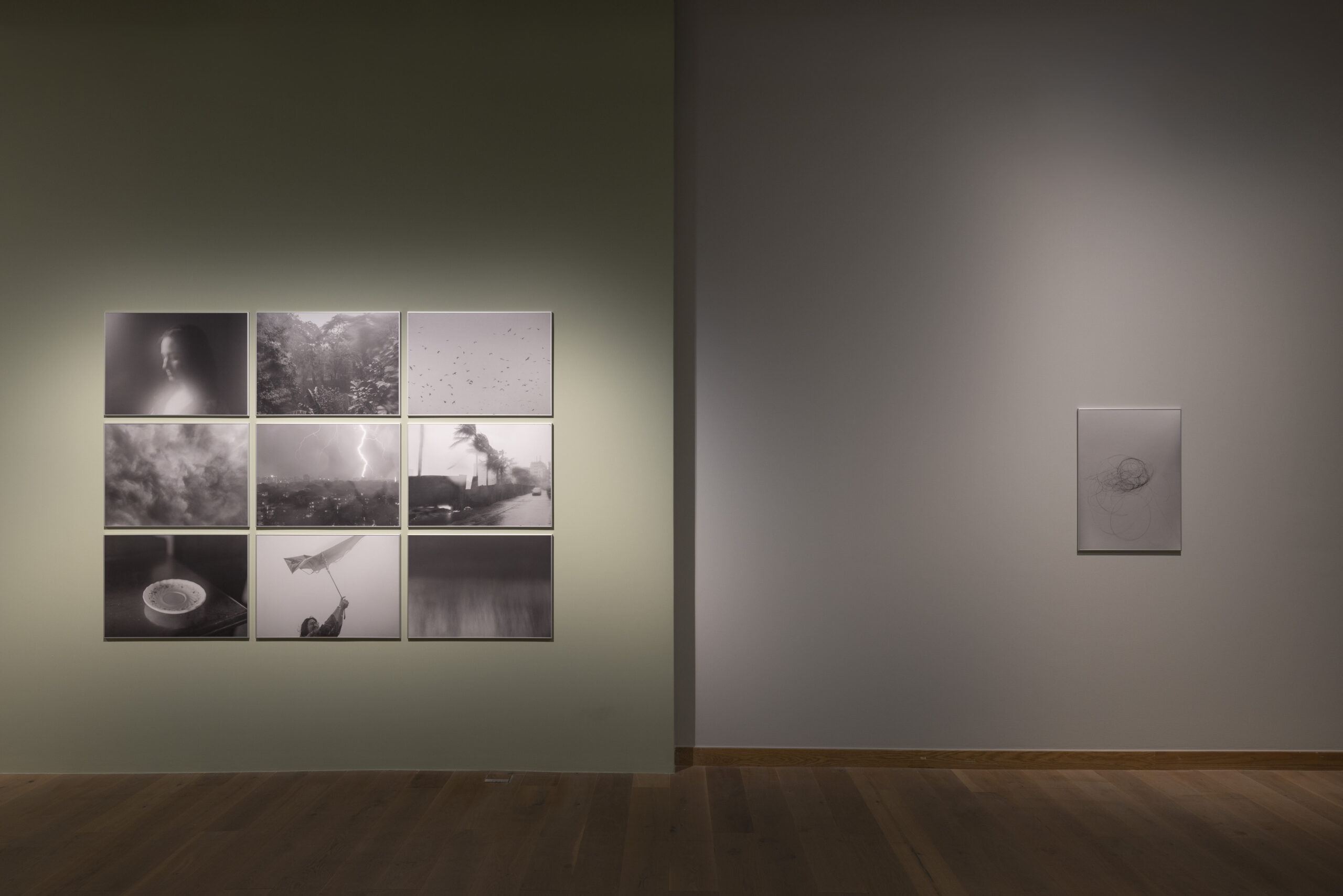
Protick’s exhibit converges some of the earlier themes, with an entirely black-and-white series, taking a lens to Dhaka over time, but with differing closeness. In his own words, “one segment could be about memory and objects, while another is more about the larger transformation of the city and its environmental changes. Another chapter might focus more on an atmosphere or a moment in the rain – something that we experience in our everyday lives living in a city.”
The artist plays with temporal specificity, from a photo as intimate as an image of his mother’s fallen hair in the shower, to a moment of history during the 2024 Monsoon Revolution in Dhaka. Interplaying between the personal and the political, each photo finds its place in the story of Dhaka’s change, the nostalgia of its past and the fear for its future. Without explaining much, Protick ends the exhibition with his lens of the same questions that one feels while walking through – slowing down to think about where we stand, where our own homes stand. On which fault lines are we, and which environments, which landscapes, which moments of beauty are sacred to us? What have we lost? What am I afraid of?
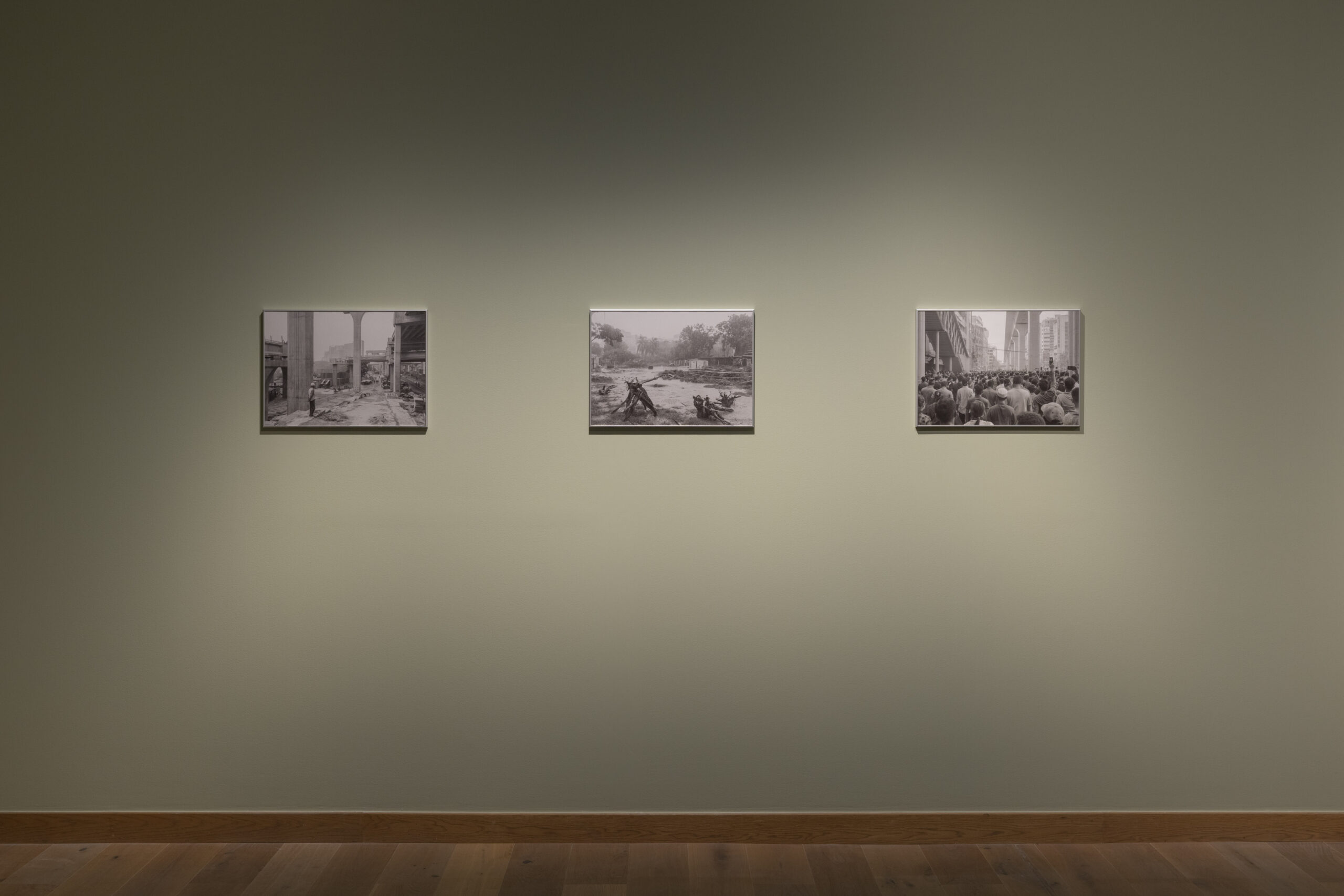
Climate anxiety, a rather neoliberal approach to watching environments crumble, doesn’t always feel like a reality one can sit with or face. The term feels like a corporatised way of thinking about something that is eerily grief-stricken. Protick’s work, documenting over time, finds a resonant way to portray the evolving relationship between environment and human. One finds pause in the observation of Protick’s images, concluding the viewing of the show with reflection and questions for oneself.
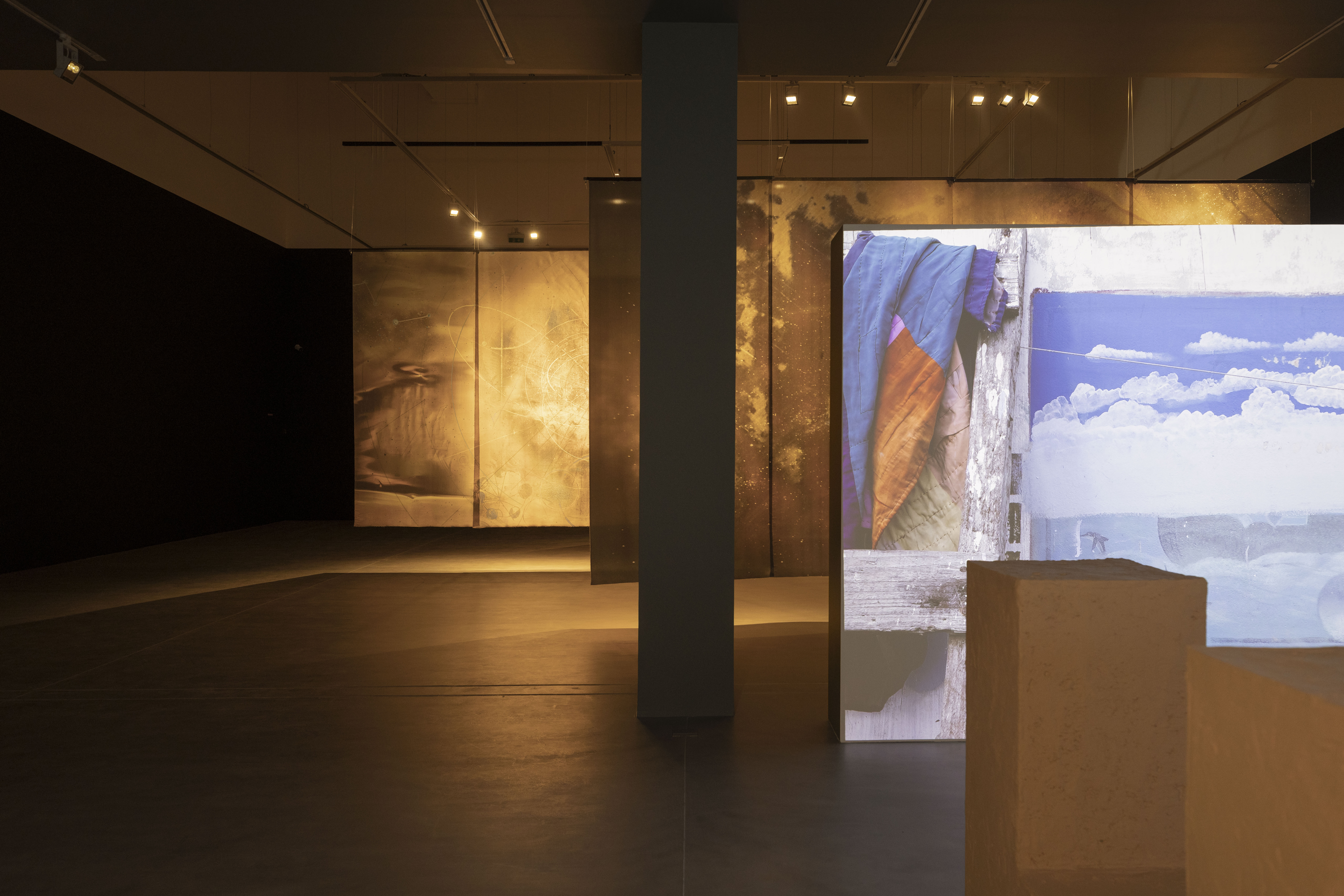
This exhibition converges three perspectives on where our relationship with the sky, the land and the sea is increasingly fragile, whilst invoking questions as to where we stand within this timespace.
I asked Altaf where she found this triad of questioning and geography converging between the three artists’ practices.
“The “triad” was not a conscious thought,” she answered. ‘It organically developed as a way of thinking about multiplicity… three perspectives, three temporalities, and three modes of registering ecological and historical change gradually evolved. The intersections can then emerge or be read through time, memory/loss, and beauty/destruction, rather than being imposed as a single narrative.”
That is how the show is felt – overlapping narratives existing in your mind at once; the world is vast, the earth is decaying, time is passing, and there is beauty everywhere. What does it mean to experience environmental change on a human scale? How am I experiencing it?
How can the land feel alive again?


