
News


In the 1950s, Colin Chapman had aerodynamicist Frank Costin strapped to the bonnet of a Lotus prototype, so he could feel and understand exactly how air moved over the car at speed. It is a faintly absurd image today, and it is also the ethos of Lotus in one photograph: an obsession with aerodynamics and the invisible forces acting on a car.
That obsession remains today, with Chapman’s famous quote “Simplify, then add lightness” echoing through the halls of Lotus’s Hethel factory and outwards into the wider carmaking industry. While rivals reached for bigger engines, Chapman reached for a scale. The ground-effect Lotus 78 and 79 are an example of using the road itself, air rushing beneath the floor to press the car down without the drag penalty of fighting the wind above it. Jim Clark won two world titles driving that philosophy. Ayrton Senna started his career inside it.
It is worth holding all of that in mind while looking at the Emira 420 Sport, because the temptation with any new performance flagship is to read it purely in the language of the spec sheet: 421 PS, a four-cylinder engine claiming the title of the world’s fastest of its kind, 0–100 km/h in 3.9 seconds. Those numbers are real, impressive, and they matter. But at Lotus they were never the starting point. They are what falls out the other end once the weight is gone.
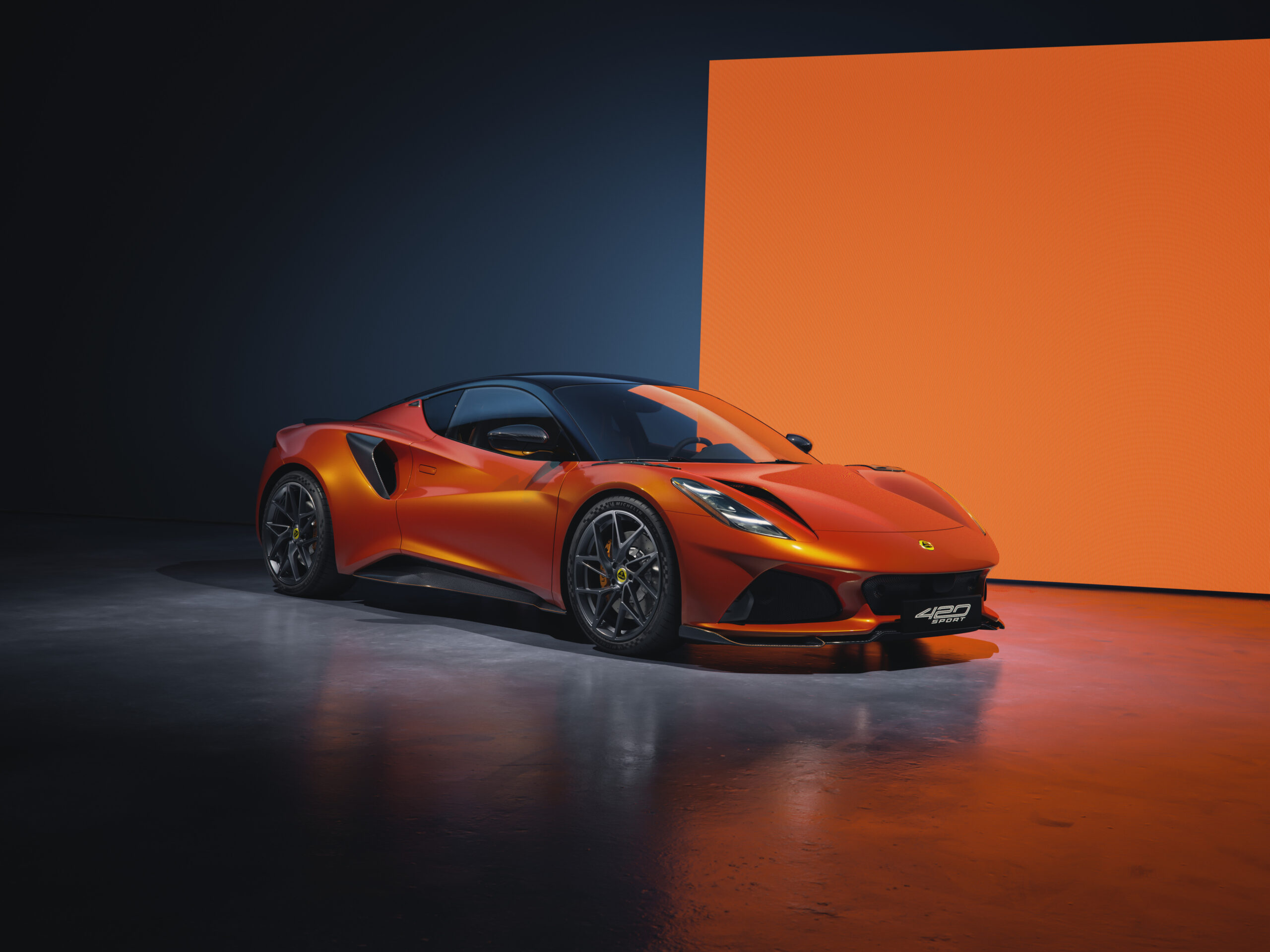
The optional Lightweight Handling Pack strips up to 25 kg from the car: a titanium exhaust that saves close to 9 kg from underneath the tail, a lithium-ion battery, a carbon fibre louvred tailgate that alone removes nearly 5 kg from high up on the body. That last one matters more than its number suggests: weight sitting high and far back is the weight that fights a car hardest in a corner, and it is exactly where a Lotus engineer goes looking first. The chassis sits 5 mm lower than the standard Emira, dropping the centre of gravity and, not incidentally, tightening the car’s visual stance too, as Russell Carr, Lotus’s director of design, put it: “every car looks better when it’s lowered.” The result is a car whose additional 25 kg of downforce, generated through a reworked front splitter, wheel-arch vents and rear diffuser, arrives with zero increase in drag, a detail the team behind it describe as the real trick of the whole car. Gavin Kershaw, Lotus’s director of attributes and motorsport, has spent 38 years at the company, since he joined at the age of 15, and has personally driven what he estimates is around 70 per cent of every Lotus ever built. He calls that zero-drag downforce figure “the genius” of the car, a small number that took a disproportionate amount of engineering to earn honestly.
Nothing on the car is there for effect alone. The redesigned front splitter looks like a race-derived styling cue, and it is one, but it also ducts air directly to the front brakes, improving cooling enough that Lotus says brake fade on the 420 Sport is effectively a non-issue. The mesh-grille side intakes increase airflow to the radiator by around 15 per cent. Even the louvred tailgate that replaces the standard glass panel is a direct callback to the Esprit, and it does a job beyond weight-saving: after a hard track session, it lets the engine bay breathe and cool far faster than glass could.
What makes the 420 Sport genuinely clever, though, is that none of this comes at the cost of everyday usability, which has historically been the one place Lotus asked owners to make a real sacrifice. This is a car built to be a supercar exactly when you want it to be one, and a car you can drive to dinner the rest of the time. The standard suspension retains full road comfort and drivability even with the 5 mm drop; step up to the optional Multimatic two-way adjustable dampers and the car can be tuned from a genuinely comfortable daily setting to a proper track configuration.
As Kershaw puts it, quoting a friend and fellow European Le Mans racer: a Lotus “makes the ordinary driver feel like a racing driver, and makes a racing driver feel like a champion.” Fittingly, for a car now arriving in the region, the Emira’s own name draws on the Arabic word for “princess.”
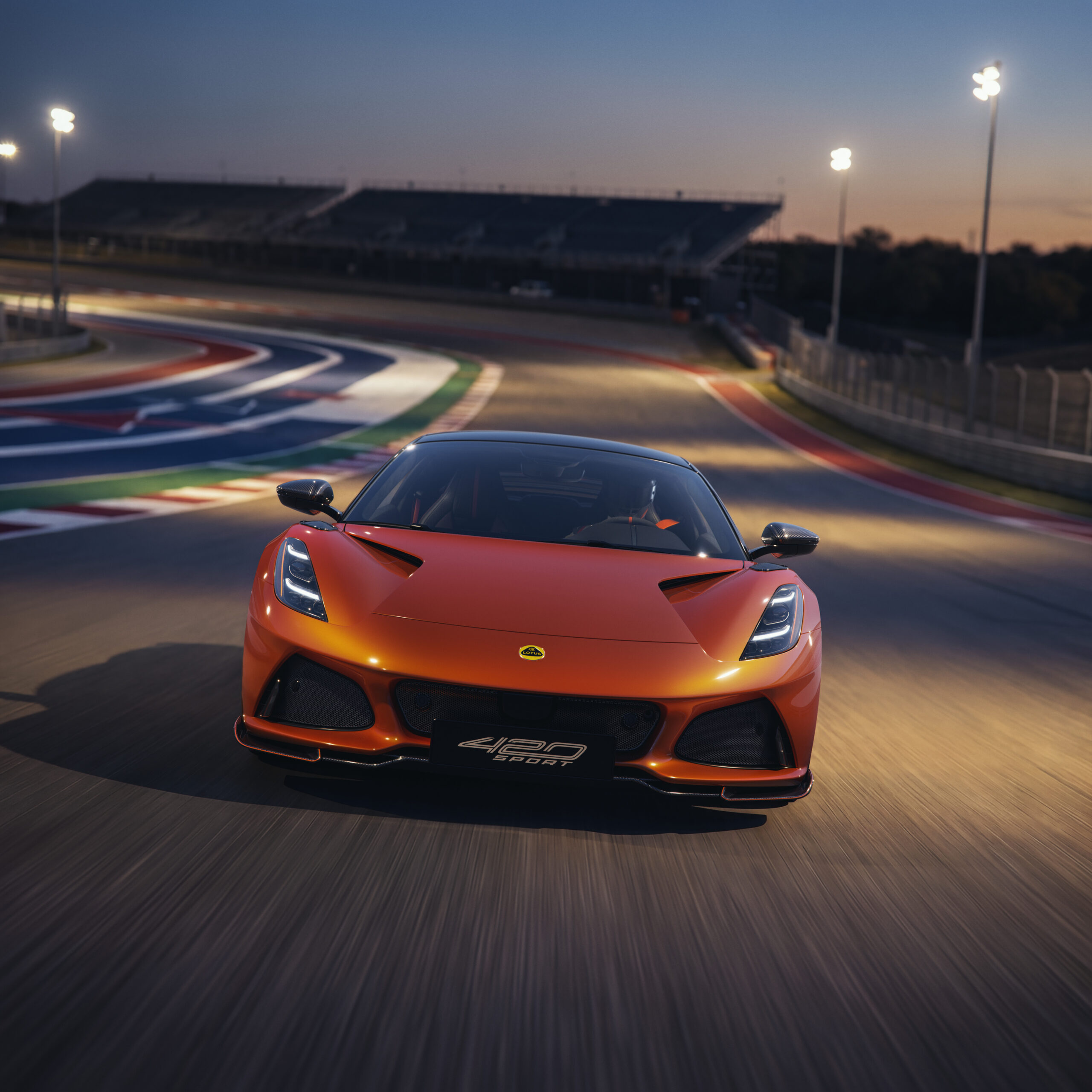
Its arrival in the UAE, through AGMC as the country’s official Lotus distributor, lands the 420 Sport in a market that has never been short of horsepower but has been comparatively short on cars built around the opposite instinct: that restraint, precisely applied, is its own kind of performance. Dr Andreas Schaaf, CEO Mobility & New Ventures, AGMC, frames it as a UAE audience that “values engineering, individuality and an authentic connection between driver and machine”, three things a Lotus has arguably had to offer since long before it was fashionable to say so out loud.
What the 420 Sport ultimately proves is less about a single car and more about a company that has spent seven decades resisting the industry’s easiest instinct, which is to solve problems by adding things. Take a genuinely good car, and instead of reaching for a bigger engine, go back and ask what still doesn’t need to be there. It is a harder way to build a sports car. It is also what Lotus knows how to do best. And with the Emira 420 Sport arriving in the UAE, you too can feel like a champion.


