
News


Centuries of Syrian craft carried technique, creativity, and knowledge, passed from generation to generation, until war, isolation, and years of quiet institutional neglect scattered the people who held it. Now, in a Damascus reachable again, two independent projects, MSN3 DMSHQ and the Syrian Crafts Council, are aiming to rebuild what was lost before it disappears for good. Neither is interested in nostalgia. Both believe the only way forward is to understand the past well enough to truly revive it.
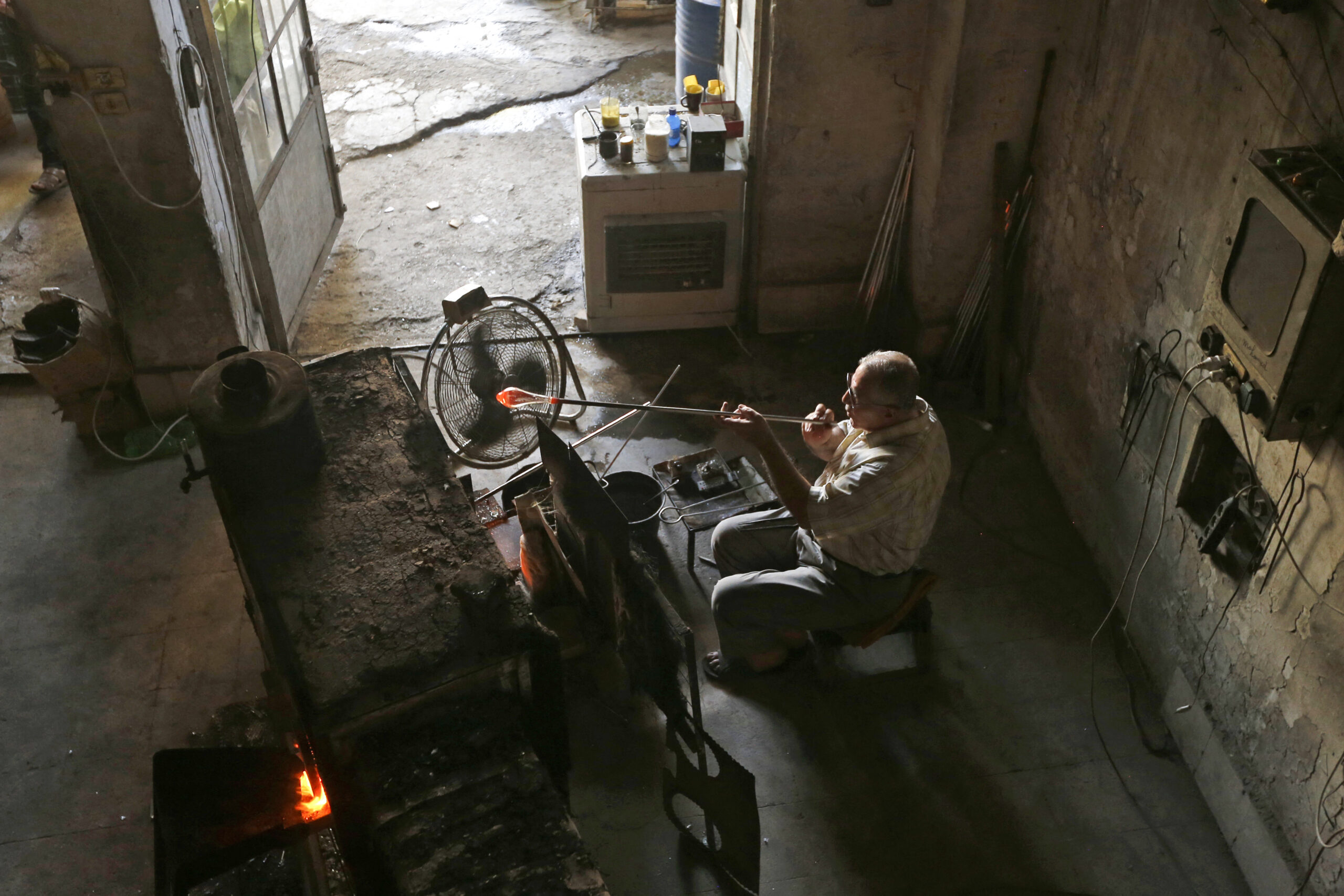
For centuries, craft was an essential element of the Damascene identity. Quite literally. Surnames across the city still carry the trade of some ancestor who worked wood or copper so completely that the job replaced the family name. To be a najjar (carpenter) or a sayigh (goldsmith) for long enough was to stop being separate from the work at all. Craft signalled social status. It demanded a lifetime of devotion to master, and it evolved constantly, shaped by craftsmen who watched, borrowed from, and pushed against one another. Centuries later, that craft is being lost, not because Syrians have stopped making things, but because so much of what made the making meaningful has quietly gone missing along the way.
Walk through Old Damascus today, and you will see craft, or kitsch replicas of it, everywhere: oud instruments, mother-of-pearl boxes, little wooden heart keychains with names inlaid in them. It’s also, in a sense, nowhere. Part of the reason is the reductive collective perception of the craft. “In Syria, we treat craft as a static category,” says Kenan Alkuwatly, founder of the Damascus-based research and design lab MSN3 DMSHQ. “There’s no real discourse around craft revival, or around how terminology and meaning shift across periods.” What’s disappearing isn’t the skill in the hand. It’s the knowledge and narrative behind it.
That distinction sits at the centre of two very different projects working on the same gap. MSN3 DMSHQ, Alkuwatly’s lab, treats craft as a living design practice to be studied, prototyped, and reactivated. The Syrian Crafts Council (SCC), a research non-profit founded in 2024 by Saleh Kalarge and Rami Alafandi, treats it as an archive to be rebuilt from the ground up before it can be reactivated at all. Neither believes documentation alone will save anything. Both are betting that understanding, not nostalgia, is the only way through.
Rami Alafandi, SCC’s co-founder and head of research, also Collections Curator at the Aga Khan Documentation Center, MIT Libraries, arrived at this work through research, not sentiment. His PhD examined ajami (Damascene decorative wood-panel painting), and it was there, he says, that he first saw the scale of the problem. “These issues existed even before the [2011] revolution and the war,” he explains, “but they became far worse because of the destruction, the displacement of so many people, craftsmen among them, and the collapse of the tourism market they depended on.”
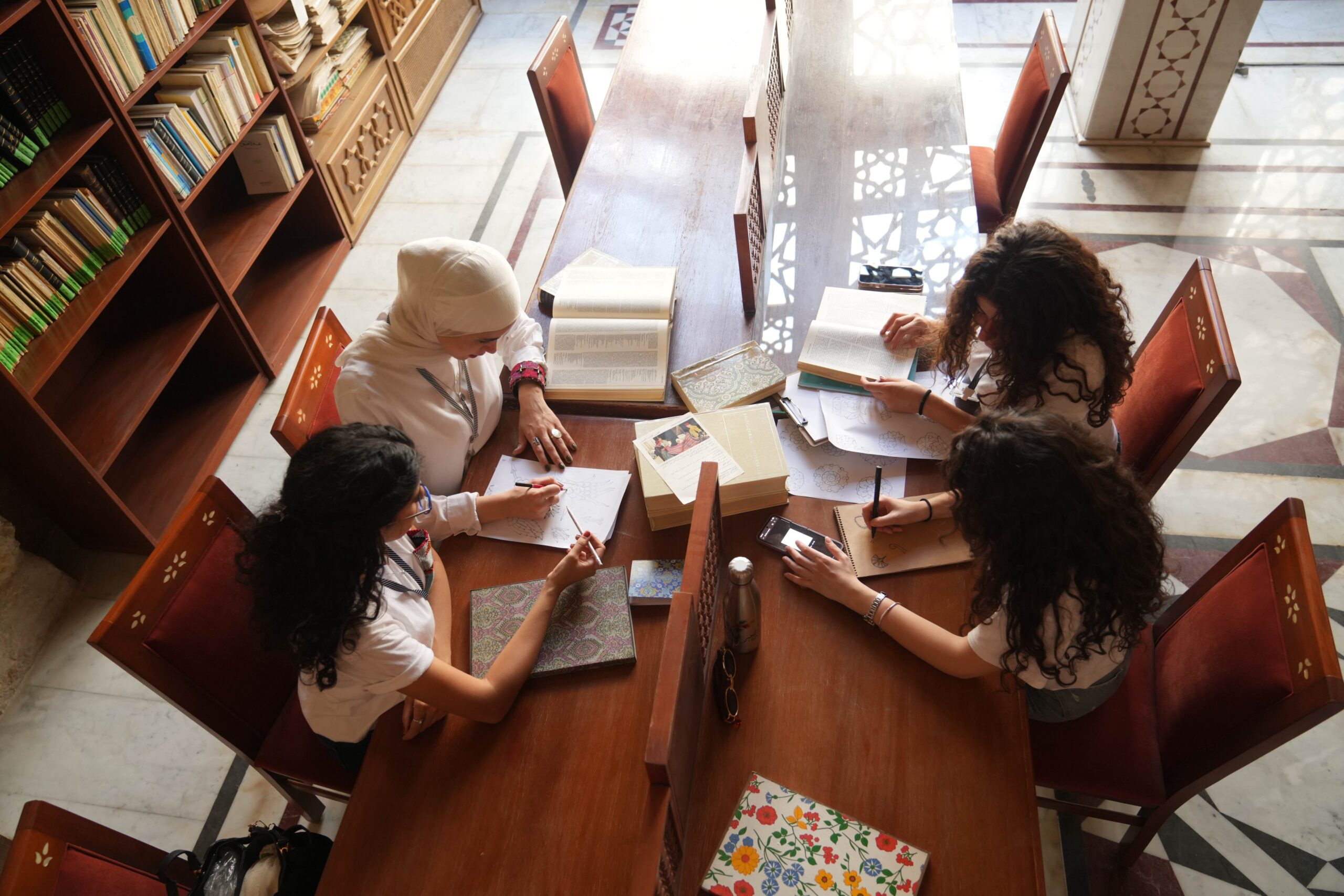
For Alafandi, the crisis isn’t that Syrian craft has disappeared. Some of it is still, technically, being practised. The real issue is how it’s practised. A craftsman today can execute a technique flawlessly and still be unable to place what he’s looking at when he studies an original piece that might span 500 to 1,000 years of stylistic evolution. “He looks at it as one single thing,” Alafandi says, “and takes elements from across that whole span without any method for knowing where each one came from, or why.” The result, in his words, gets called heritage when it’s really something closer to reinvention.
Alkuwatly arrives at nearly the same diagnosis from another direction, not the archive, but the workshop. “In the workshops, the skills and practical knowledge are present,” he says. “What’s missing is R&D, an innovation pipeline, any real feedback loop with markets, tastes, technology. That’s why practices get stuck. They just repeat.” He also notes the collapse of the transmission line that ran unbroken from master to apprentice. “Right now, we have only a few master craftspeople left, mostly sons of sheikh al-kar [craft grandmaster] and of course, they’re ageing.” Even where knowledge survives, it isn’t necessarily moving anywhere. “It’s not just about transferring it,” he says. “We need to build a dialogue around these crafts, to create new methods, new shapes.”
To reach that goal, Alkuwatly needed to actually be in Syria, talk to craftsmen, and learn from them in person, something that he wasn’t able to do before the regime fell in 2024. The SCC’s founding follows the same timeline, where it was officially established only after the fall. On a bigger scale, that shift has brought a real sense of hope to craftsmen themselves, as Alafandi points out.
During the Assad regime, guilds were replaced by state-sanctioned syndicates whose loyalty tests had nothing to do with skill. “The standard for being recognised as a good craftsman became political allegiance, not preservation of the craft,” he says. Even the right to a stall in the historic Tekkiye Suleimaniye souk depended more on connections than mastery.
What followed was a slow retreat into isolation. “This directly affected the decline of craft knowledge,” Alafandi says. “There was no more communication, no more exchange. It all became a competition. Instead of learning from each other, they started working against each other, gatekeeping techniques from each other. Instead of the craft developing, it shrank into something much smaller.”
This continued into the decade and a half of turbulence and instability Syria has lived through, which resulted in scarce materials, unreliable electricity, and a tourism economy that collapsed and took supply and demand down with it.
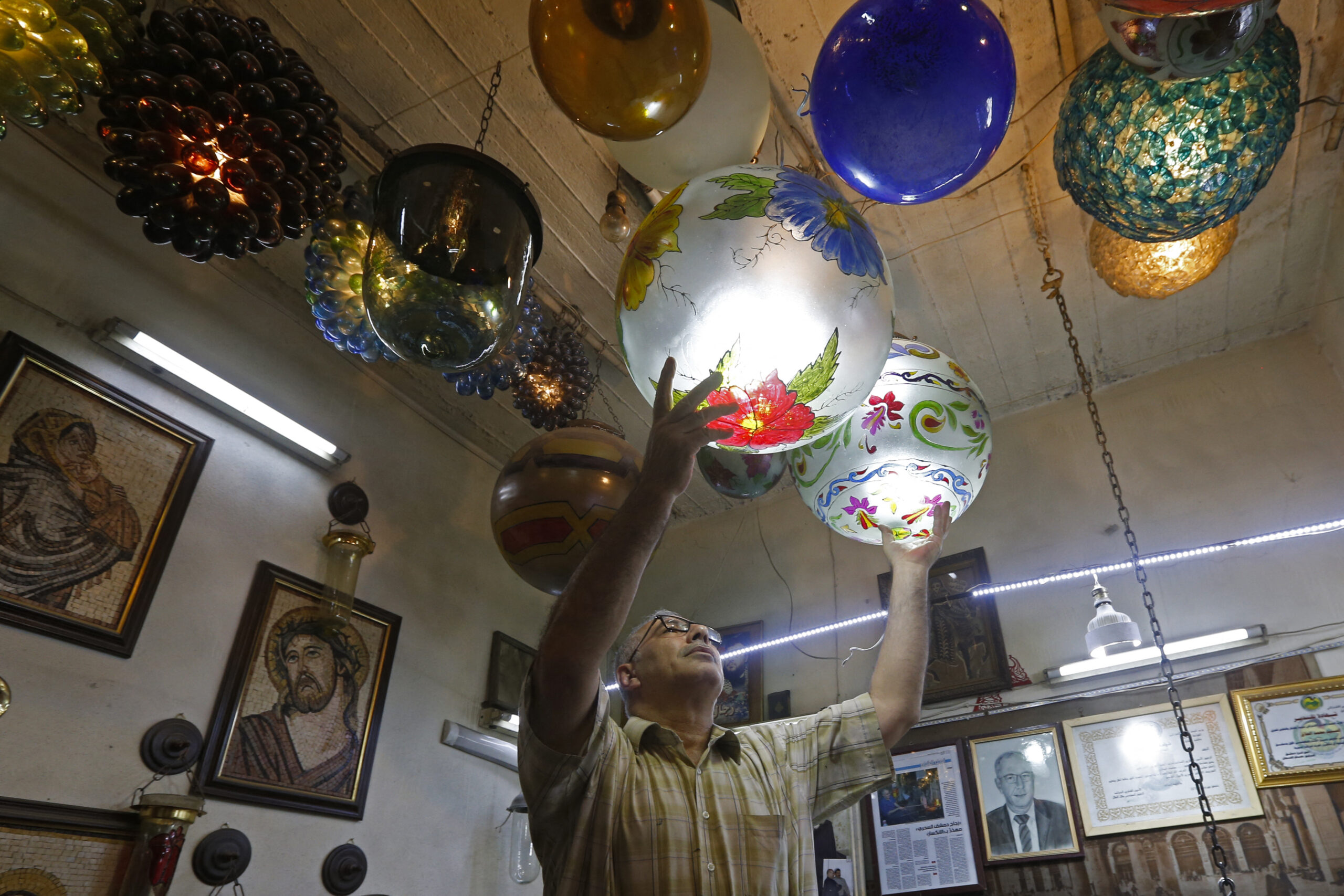
There was also a subtler and more costly damage – one that is human. The exodus of the people who knew how to make things. Craft in Damascus was also rent, food, a livelihood, and when that wasn’t found anymore, many craftsmen simply left to resettle in Beirut and Amman and continue working. ”The war posed a real threat to the crafts ecosystem in Syria; the destruction of its spatial environment in the suburbs led many craftsmen to leave,” Alkuwatly notes. “Now, a good proportion of craft-based design work shown in this region is made by Syrian hands outside Syria. But slowly, working side by side with our craftspeople, I believe Damascus deserves a seat at the Arab and global design table.”
Taken together, these issues have opened up a deep knowledge gap and, with it, stripped the craft of its very capacity to keep evolving.
SCC’s response has been meticulous and thorough. Alafandi describes a three-part research method: analysing the original surviving objects still in Syrian homes or in museum collections abroad, however partial the record; returning to whatever fragmentary written sources exist; nineteenth- and twentieth-century references and, most importantly, sitting with living craftsmen for hours, using an interview methodology adapted from UNESCO frameworks and adapted for the Syrian context. In one year, the team logged 21 hours with six ajami practitioners and conservation specialists, and 12 hours across six brocade artisans in Damascus, mapping over 50 documented motifs across more than 130 brocade pieces. What the interviews exposed wasn’t a shortage of technique but a shortage of understanding of what the technique was for; the design logic, the meaning of a motif, why it changed the way it did across eras.
Image Courtesy of the Syrian Crafts CouncilThe craft’s continuity through centuries rested on the guilds, where knowledge moved between craftsmen, but also on passing the craft from father to son. The transmission of these teachings was often so guarded that some refused to teach them to anyone outside the family. As we all drift further from working with our hands, the younger generation has largely lost the will to learn at all. SCC is chasing this generational gap through education. The Council is now offering scholarships for Syrian students to study traditional arts abroad, through a partnership with Dr Khaled Azzam and the School of Traditional Arts at the King’s Foundation, to teach at the Council’s centre upon completing their studies.
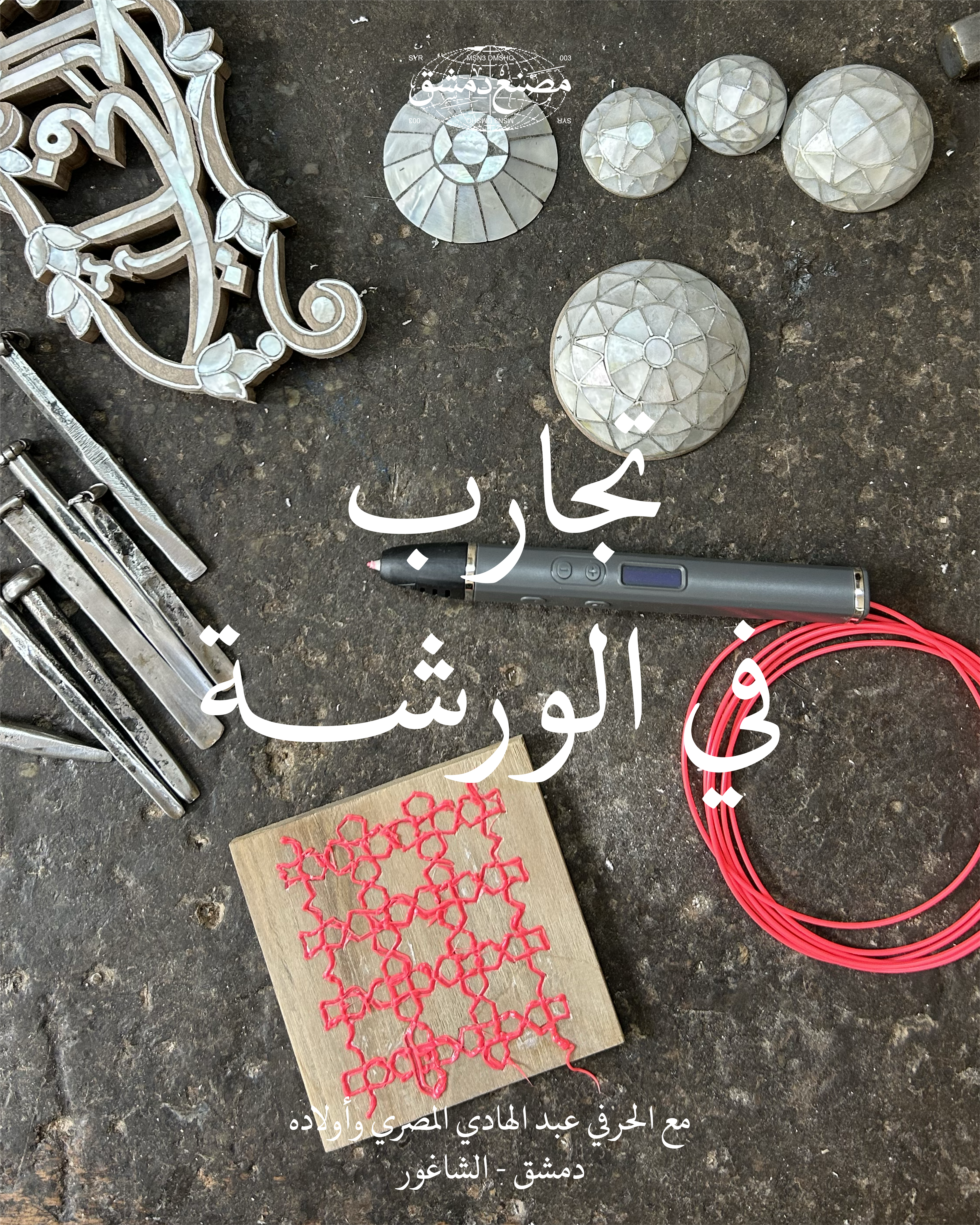
Alkuwatly’s approach to engaging the younger generation is through technology. Having studied product design in Germany and stayed based there since, he remained plugged into a scene that treats technology as part of the design process itself, not an add-on.”One of the biggest problems facing crafts today is the apprentice shortage, and when we want to think about the future of crafts, we should be thinking about the younger generations,” he states. “Digital acceleration has widened the gap by pulling younger generations toward faster, more visible work. Curiosity has faded, and the younger generation is largely disengaged.”
In practice, that means exploring new tools and technical narratives that expand the vocabulary of Damascene crafts. letting digital tools and new materials into the process: recycled plastic instead of mother-of-pearl, 3D pens instead of tin wire, coded generative patterns instead of hand-etched ones “The use of digital tools does not necessarily compromise the craftsmanship itself, as long as the knowledge and vision of the craftsman stays anchored at the heart of the making process, But it will attract young people to be interested in the craft again,” he says. “The journey is not to romanticise tradition or fetishise innovation, but to design from a middle space where technology extends craft rather than replaces it.”
Reactions in the workshops vary wildly. “The positive side is that a lot of them lit up immediately when they saw the new tools or patterns, because it challenged them, their skill, and their knowledge.”
“Most of what craftspeople are making right now is small boxes, keychains, souvenirs,” he continues. “You can’t imagine how tedious that must be for them — no place for innovation, and it’s not challenging at all. That’s where we believe experimentation and new methods are needed.”
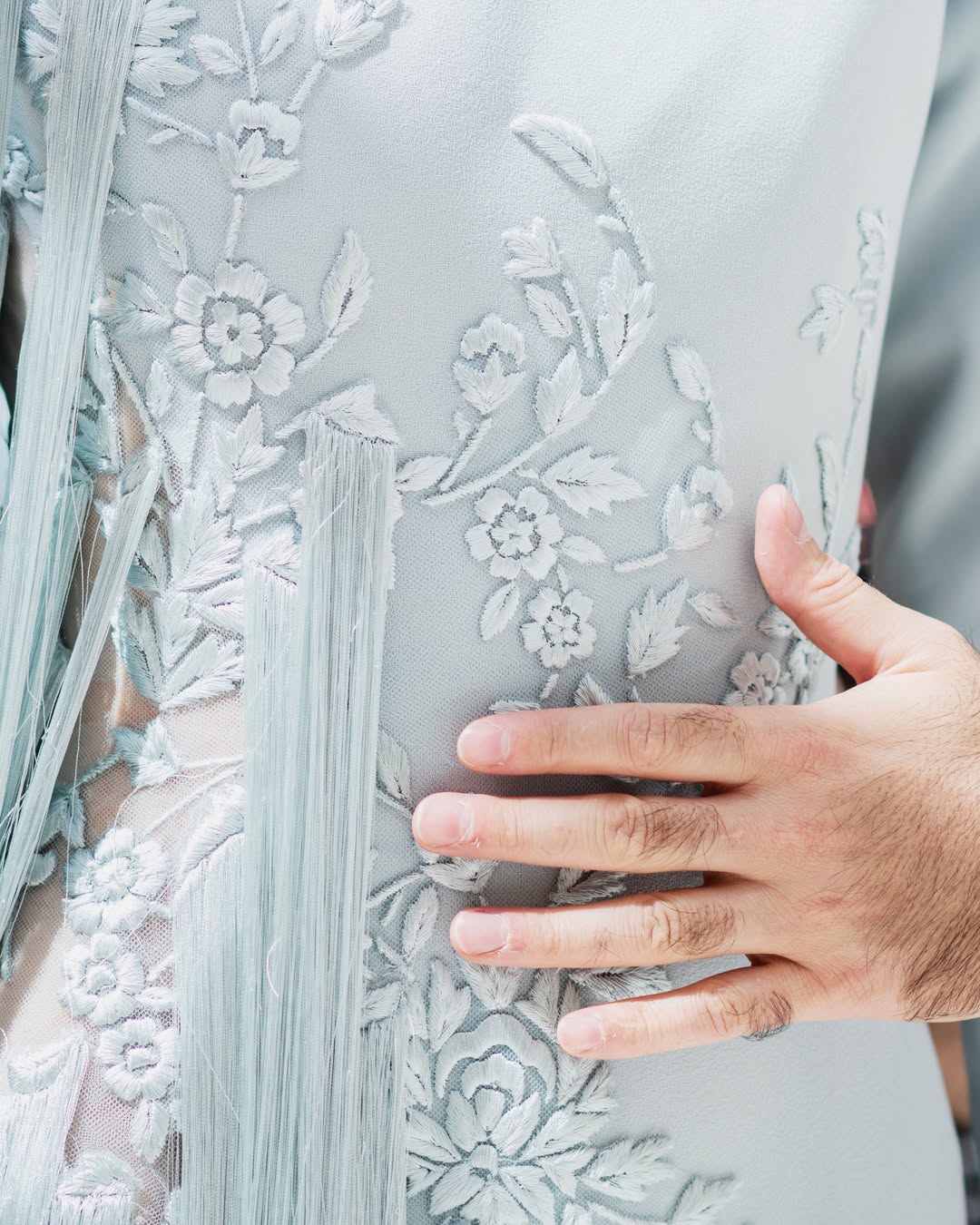
Both projects, in their own register, are seeking to bridge gaps and connect craft with other creative worlds and industries. SCC’s rebuilt knowledge base has already found its way into fashion, through a collaboration with Syrian couturier Rami Al Ali, whose Paris collection, created with the Council, translated ancestral motifs and architectural detail into sculptural silhouette rather than surface decoration. It’s the same instinct Alkuwatly is chasing from the workshop side: heritage handled with enough understanding to be moved, not just repeated.
The crafts scene in Syria is fragmented, and both initiatives are wary of the two most obvious ways to respond to that. One is to romanticise it into something untouchable, a museum piece frozen at the exact moment it stopped evolving; UNESCO recognition, ironically, can accelerate this, turning a living trade into a listed relic. The other is to assume that documenting it, photographing every motif, archiving every technique, is itself the rescue. It isn’t.
“At [SCC], we’re focused on the biggest problem of all: reproducing the knowledge that’s been lost around craft. Because if we just go and support craftsmen, in the end, what I’m doing is supporting a craftsman whose knowledge already has real gaps in it. It’s not enough to fund and help craftsmen, because then I’m repeating the same problem, not solving it. That support matters, and it has to happen, but the real focus has to be on rebuilding this knowledge tied to the craft, and that’s not the easy part, because we’re talking about knowledge that’s already lost, and was never documented in the first place.”
What both projects share, in the end, is a refusal to treat the craft scene in Syria as either a ruin to be mourned or a heritage to only be preserved and archived. These are ambitious, necessary initiatives, built on dedication and imagination, where governments have offered neither. What they’re rebuilding wasn’t lost overnight, so it won’t return that way either. “It is neither fast nor easy,” Alafandi admits. “But you have to start somewhere.”


