
News


Words_Dounia El Barhdadi
April 19, 1980, The Hague
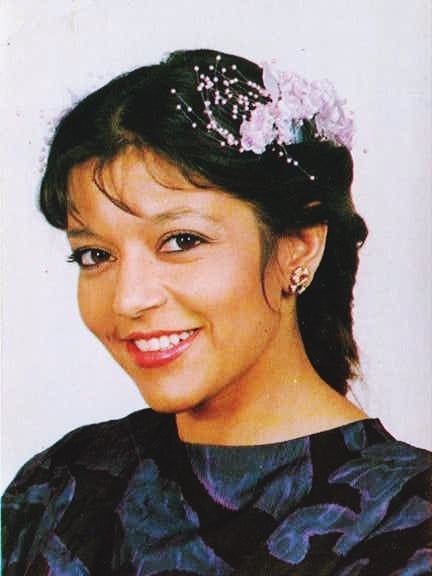
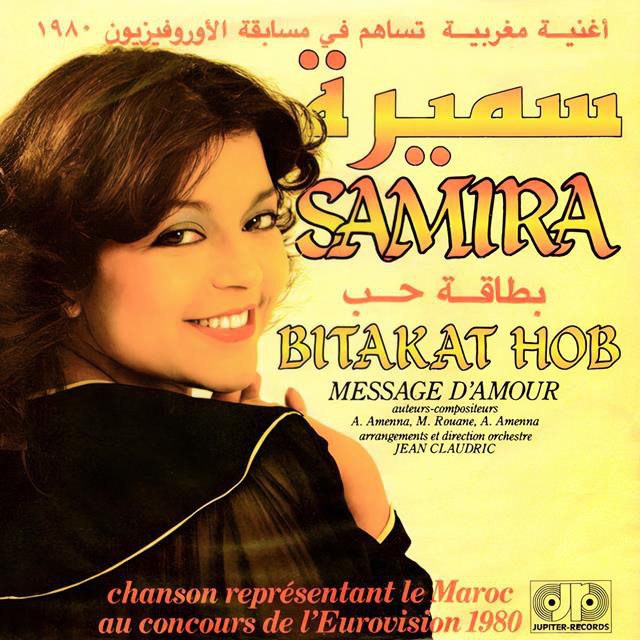
The lights rise softly as a conductor lifts his arms. A woman is standing on a big stage, accompanied by two men and two women, who sway gently behind her, but divert little attention. The backup singers are dressed to complement our protagonist, in suits with oversized lapels and pastel-coloured caftans. The camera zooms in on Samira Said, just 22 years old at the time. Before her meteoric rise with hits like “Youm Wara Youm” and “Aweeny Beek,” there was “Bitakat Hob” (Love Letter), an ode to hope and peace in the Arab world, and the song she chose to perform at the 25th edition of Eurovision.
There were no special effects, and no coloured lights. She dressed regally, in an embellished turquoise caftan, belted with a gold skali mdamma, with the kind of extra-wide sleeves saved for special occasions, and the kind of high neck that conveyed a desirable elegance in ’80s Morocco. Her hair is lightly coiffed, and she gesticulates delicately as she sings — far from the animated, glammed-up, assertive “diva” who later carved out her place among Arab pop icons.
“We are the children of the world
Asking for a life of peace and contentment
Where there is no greed and no fire
And no hostility between neighbours.
There is no difference in colour
We are all one, and we are all brothers
We don’t want war or pain
We want a life of total peace.”
Upon her final, swelling note, the audience breaks out into loud applause, but when the results come in, she finishes 18th out of 19 entries. Morocco has been awarded only seven points by Italy.
Perhaps the lack of theatrical embellishments read to the other nations as a lack of effort, or even a fundamental misunderstanding of the criteria for success. Perhaps, because she sang an Arabic-language ballad, written by Malou Rouane and composed by Abdelati Amenna, the profundity of her message was lost on them. Perhaps Morocco’s distance from the other European nations, geographically and culturally, prevented the judges from reasonably appreciating her performance as that of an equal.
In the absence of Israel for one year only, perhaps Morocco and Turkey offered a sense of dimension, of diversification. Or perhaps, ultimately, Morocco was welcomed for the novelty, as a dose of Orientalist intrigue, and maybe even as a baseline unit from which the European contestants could measure one another.
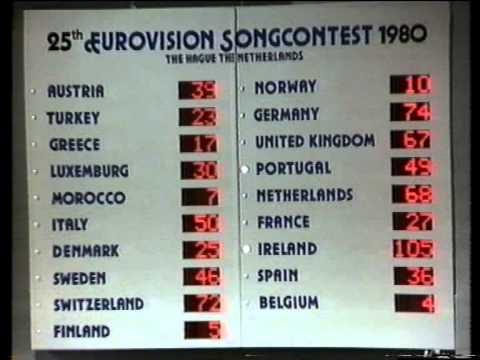
Morocco never competed in Eurovision again, and it is because of this that Said’s performance is ascribed an unusually complex legacy. She was the first African entrant, the first Arab entrant, the first to sing in Arabic, and she remains the only performer of a wholly Arabic-language song at Eurovision, and yet her story is nowhere near as mythicised as one might imagine. Strangely enough, very few seem to know that Morocco ever competed at all.
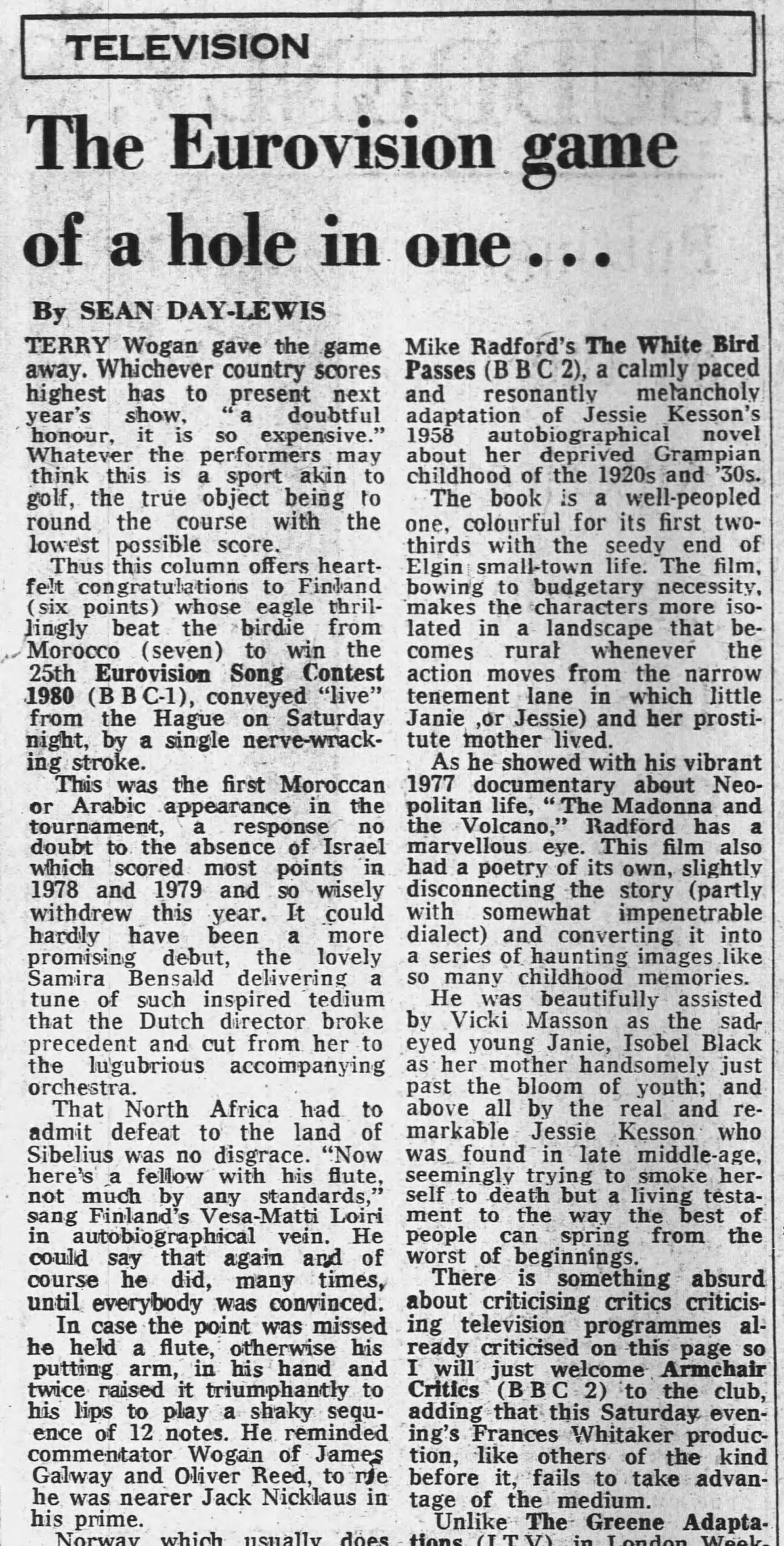
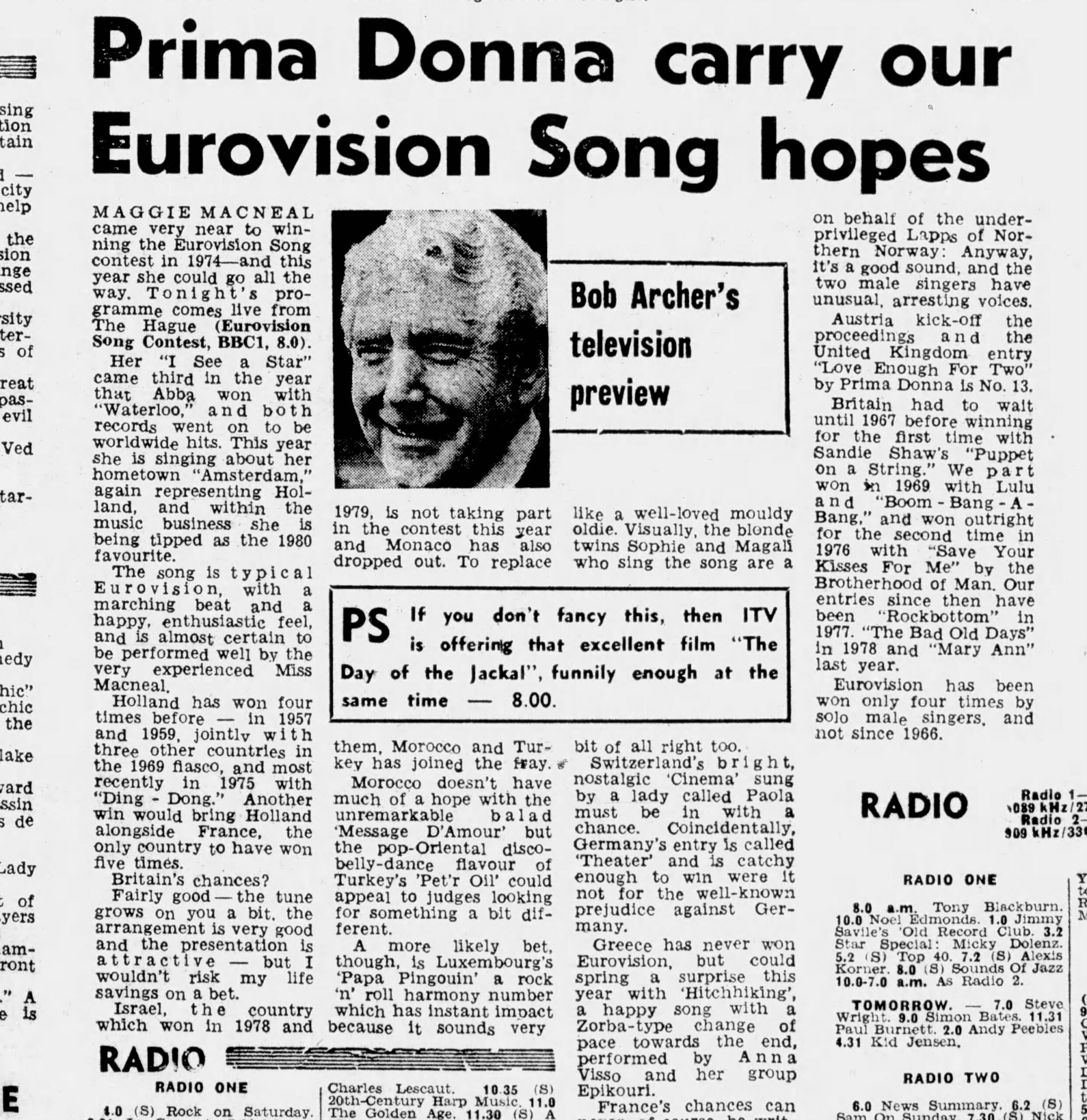
A real lack of digitised Arab coverage of Eurovision 1980 has muffled the legacy of Said’s ballad, with foreign news outlets dominating the archive even now. Derogatory comments were published by several British newspapers, dismissing the entry as an “unremarkable ballad” (Evening Star, 19 April 1980), and “a tune of such inspired tedium that the Dutch [broadcast] director broke precedent and cut from her to the lugubrious accompanying orchestra” (Daily Telegraph, 21 April 1980). The Daily Telegraph went on to add “that North Africa had to admit defeat to the land of Sibelius was no disgrace.”
Samira Said herself hasn’t mentioned her Eurovision performance in any interviews since, which begs the question: Why not? Despite filming an official music video for “Bitakat Hob” in Rabat and releasing a French version of the song titled “Les enfants de l’amitié,” it was 44 years before she performed it publicly again, at Mawazine 2024 with a Moroccan children’s choir. Afterwards, she gave a timely little speech about the rights of all to safety and dignity, but the song was probably only revived for its relevance in a moment of political PR, and perhaps she would have otherwise been happy to let us forget her Eurovision episode altogether.
Moroccan broadcaster Société Nationale de Radiodiffusion et de Télévision (SNRT) became a member of the European Broadcasting Union in 1978, making Morocco eligible to participate, and received an invitation to the annual Eurovision Song Contest two years later. However, Israel’s involvement in Eurovision — the sole reason why Algeria, Egypt, Cyprus, Jordan, Lebanon, Libya or Tunisia, though eligible, abstain from the competition — presented an obstacle.
In 1977, Tunisia was going to compete, but withdrew due to elevated Arab-Israeli tensions. In 2005, Lebanon also attempted to compete, but also withdrew over disagreements with the EBU about broadcasting regulations: as per Lebanese law, Télé Liban intended to cut the livestream when Israel performed, but the Eurovision showrunners stipulated a full broadcast in order to participate.
In 1980, Israel – winner of the ’78 and ’79 editions – withdrew to observe Yom HaZikaron, and Morocco seized the opportunity to take part without the political and cultural complications of being forced to broadcast Israel’s performance. Israel returned to the competition the following year, and Morocco did not compete again. However, I cannot be truly certain that, had we been awarded more points, or simply treated with the reverence of an equal nation, Morocco would not have continued to compete year after year, in spite of Israel’s presence.
Morocco is a nation that is dragged from one box to another, from one event to another, overwhelmed by twenty-odd identities, and the chasm between public opinion and official policy grows greater every year, especially on issues like Israel and football.
After a football season that felled an age-old fraternity between Morocco and Senegal and exacerbated the continental cracks that it was supposed to fill, I have begun to see Eurovision 1980 as an example – like AFCON 2025 and the approaching FIFA World Cup 2030 – of an attempt by Morocco to find its place in the world, as it continues to suffer from an untreated cultural and linguistic ‘schizophrenia’.
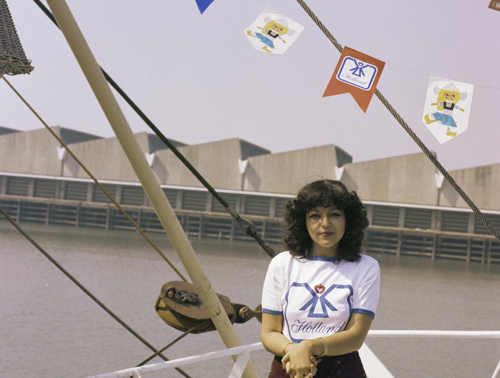
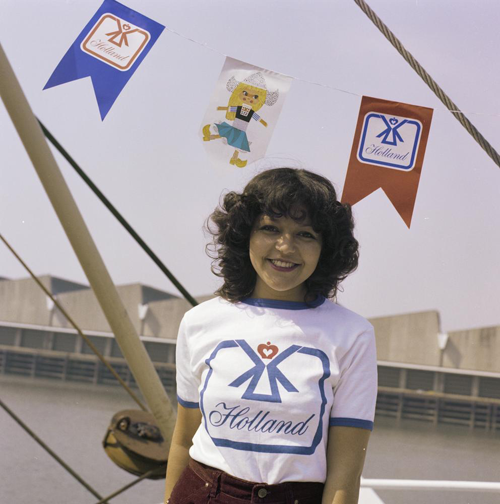
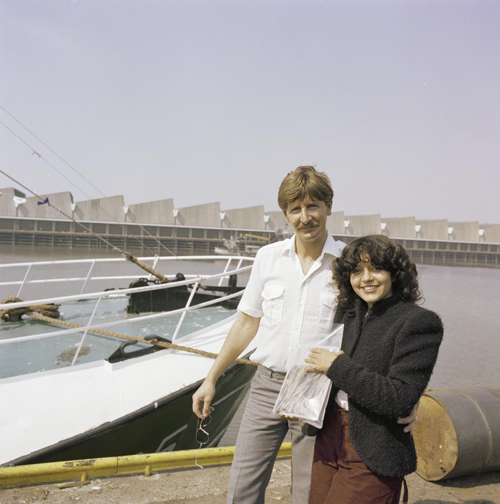
Samira Said in The Netherlands, April 1980. Courtesy of Nationaal Archief/Anefo
At Eurovision, Morocco’s complex identity was laid out on the operating table for public dissection – maybe for the first time since independence. Arab, Amazigh, African, Andalusian, Afro-Arab, Middle Eastern, North African, Mediterranean, Saharan, Maghrebi, Muslim, multifaith, Black, white, brown, Francophone, former-colony, third-world, developing country are all adjectives which Morocco is either forcefully ascribed or willingly ascribes itself, but rarely all at once.
Usually, three or four are selected for an event, like a pair of shoes and a matching handbag, and the rest are left in your wardrobe. And some complement each other better than others, but there are occasions when clashing characteristics are selected to make a statement about plurality.
In The Hague, Said sang in Arabic, with elements of both Moroccan Darija and Egyptian, which was authentic not only to her mixed heritage, but to the cultural landscape of Morocco at the time. Morocco’s choice, also, to participate only when Israel was absent despite prior eligibility can be read as a show of Palestinian solidarity, and of Morocco’s Muslim identity.
However, I do not believe that the intention behind participating was to project a Muslim, Arab version of Morocco onto a European stage. Rather, Morocco’s entry was an attempt to build fraternity with other Western nations and cultivate Morocco’s “European” personality. Morocco arrived as a “Mediterranean” rather than “North African”, and ‘Andalusian’ rather than “Arab”. It is surprising that Said didn’t perform the French version of her song, which would have also reaffirmed Morocco as ‘Francophone’.
Efforts were surely made to leave “African”, “Middle Eastern” and “Muslim” at home, but given the condescending critiques of the Evening Star and the Daily Telegraph, I suspect that the judges saw the words hovering above Said’s head, like phantom back-up singers, which further fuelled their disdain.
Said’s whole performance was two minutes and forty-five seconds, and using her voice, Morocco posed a tentative question to its European peers: “Could this be where we belong?” Seven years later, Morocco’s formal application to the European Union would be rejected, and four years later Morocco would leave the African Union amid dangerous agitation with the Arab League. “Bitakat Hob” was the unsuccessful elevator pitch.
Of all Morocco’s characteristics, ‘Mediterranean’ is the most confusing to carry, because in certain lights it can read like ‘European’, especially when considered in conjunction with its geographical position at the far West of the MENA region. Morocco knows, of course, that its territory does not lie within the boundaries of the European continent, but it might have been a political and economic comfort to be accepted – symbolically – as an honorary member.
By now, the government has stopped attempting to pick and choose specific identities for specific occasions, and has instead begun treating the question of national identity itself like a revelation, an epiphany where the obvious solution all along was a binding sense of national pride, guided by a green star — what we call tamaghribit. People do often comment on the shocking levels of sincere patriotism that Moroccans display, even, or perhaps especially, in times of discontent. But I wonder how it can be that we are so loud about our collectivity, when tamaghribit is a house built atop such delicate racial and historical fault lines.
In 2011, the diversity of Moroccan identity was, at last, encoded by King Mohammed VI into the preamble of the constitution: “A sovereign Muslim State, attached to its national unity and to its territorial integrity, the Kingdom of Morocco intends to preserve, in its plentitude and its diversity, its one and indivisible national identity. Its unity is forged by the convergence of its Arab-Islamist, Amazigh and Saharan-Hassanic components, nourished and enriched by its African, Andalusian, Hebraic and Mediterranean influences.”
Yet the prejudices inherited from conquest, precisely from the historical convergences described in the preamble, are rarely interrogated. History strategically pitted one group against another — Arab versus Amazigh versus Afro-Moroccan versus Andalusian — according to the whims and wants of colonial forces. Although that era is over, there are cracks etched into the earth where we have built our house, and we continue to organise our lives and our communities according to these prescribed divisions, even if we pretend that we cannot see them under the cover of tamaghribit.
Often, we make a point to specify what kind of Moroccan we are and are not, betraying the fact that though tamaghribit may be a binding force, it is certainly not an equaliser. Beneath constitutional recognition hides a hierarchy still, a ranking system bolstered by contemporary anti-migrant rhetoric, but derived from colonial anti-Blackness and a regime that once synonymised the words ‘Amazigh’ and ‘deviant’.
Anti-migrant rhetoric from Moroccans in Morocco is further complexified, sustained even, by anti-migrant rhetoric directed towards Moroccans in Europe. The double standard is exposed during flashpoints like the Ceuta crisis in July this year, when it became glaringly clear that pride in Morocco’s multiplicity is, in fact, hollow. Tamaghribit does not feed the hungry or employ the helpless, and Europe still shines as an unwavering beacon of opportunity. Morocco can rank sixth in the world for football, and football players will still drown trying to escape.
Since 2011, Amazigh has been integrated into official representations of Morocco, finally recognised as the indigenous minority. Yet years of relegation to the sidelines have created a reality where indigeneity is somehow Moroccan-adjacent, rather than Moroccan-default, and the character of the Arab(ised) Moroccan looms larger than any other.
Mohamed Chtatou, a Senior Professor in Education at the University of Rabat and one of the foremost ethnographers in Morocco, diagnoses the nation with a ‘linguistic schizophrenia’, though ‘schizo-affective disorder’ might be more correct. Morocco is plagued by its multiple personalities and alternating delusions, which betray a confused national identity.
The state uses Modern Standard Arabic to communicate matters of politics, royal affairs and religious discourse, but French is used to communicate developments in technology, science, economics and foreign politics. In everyday life, Moroccans communicate in regional variations of Darija, which are interspersed with French, Spanish and English words and only really represented in soap operas and popular music.
The delineation of linguistic suitability reveals an underlying distrust not only for Darija, dismissed as a casual language, but for formal MSA, where the state sees Arabic, even after decades of strategic post-independence Arabisation, as intrinsically inferior to French and too archaic to grapple with contemporary affairs.
What is more, since the recognition of Tamazight as an official language in Morocco, it has been added to road signs, underneath Arabic and above French. However, the script has been generated from multiple tribal dialects of Tamazight, and is not actually intelligible to any one native speaker — a performative addition for the purposes of inclusion. Language, then, seems to be another accessory that Morocco can select from the wardrobe when appropriate.
I can see, then, how Eurovision 1980 might have presented an opportunity for Morocco to finally choose a personality – the most beneficial personality – in the hopes that choosing one might then sedate the others. The singularity of Morocco’s participation, however, is surely just as much a result of a disappointing result as Israel’s return, because in spite of a disappointing result, repeated participation would surely, eventually have carved out its place in the European politico-cultural consciousness.
As it happens, I spent a lot of time explaining to my peers at British school that Morocco was not, in fact, a South American country, and perhaps if they had seen a Moroccan sing on their TV once a year, they would have known better. Or perhaps they would have mistaken it for a European nation, to the delight of the Moroccan government.
Morocco’s participation in Eurovision spelled the peculiar clashing of continents, identities and motivations, and its legacy is thus all at once shameful, nostalgic, and a genuine source of pride. Samira Said’s performance, first of its kind, still exemplifies the complex web of her nation’s identities, which all dangle precariously, only to clash against each other when there is turbulence.
THIS FEATURE WAS PUBLISHED IN THE 11TH EDITION OF ICON MENA PRINT MAGAZINE. ORDER YOUR COPY HERE.


