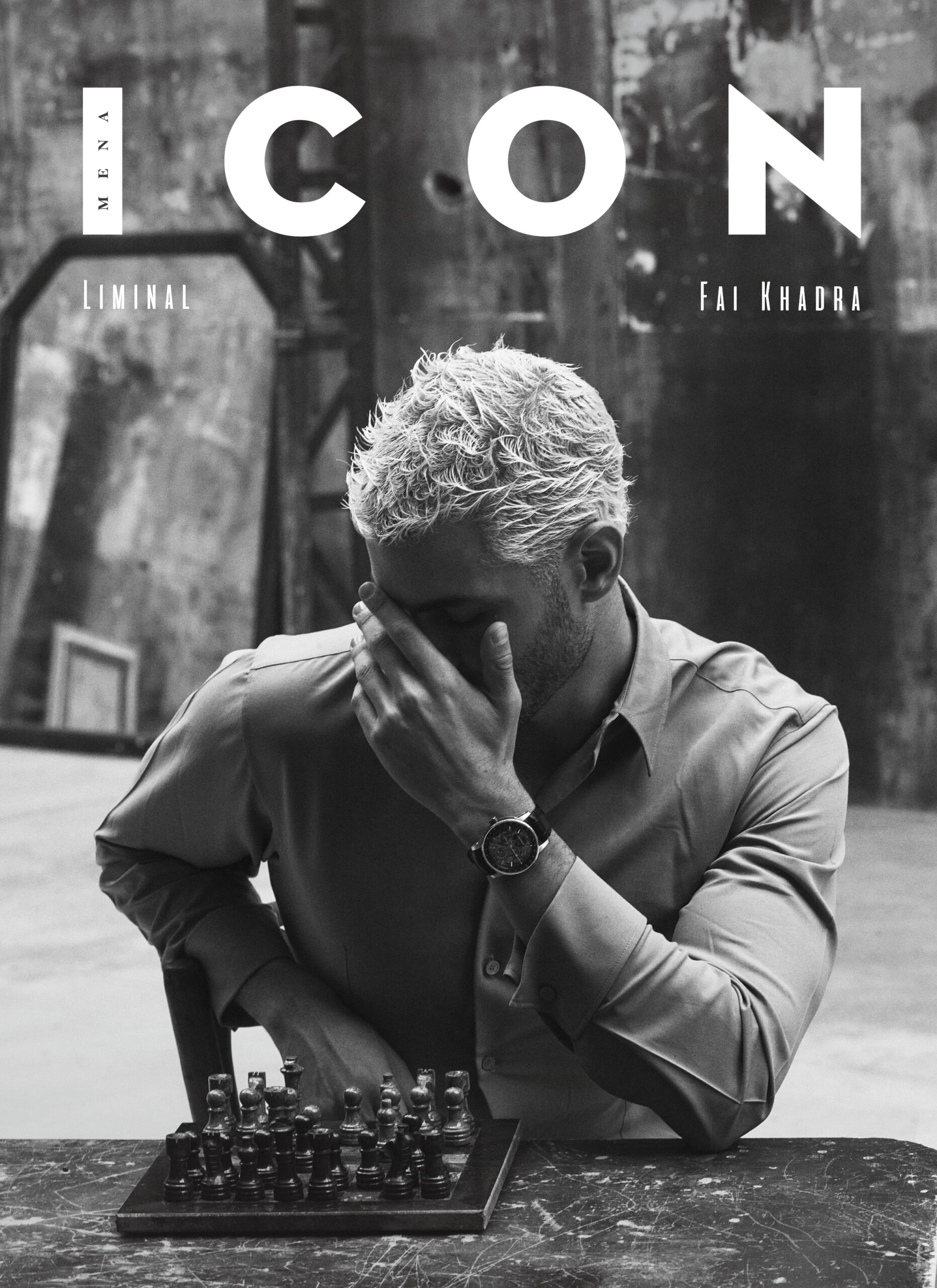
Raised between Riyadh, London and Dubai and at ease across every discipline he touches, Fai Khadra has learned to let things take the time they need. With Audemars Piguet, a house that has made patience its craft, ICON MENA meets him on the threshold
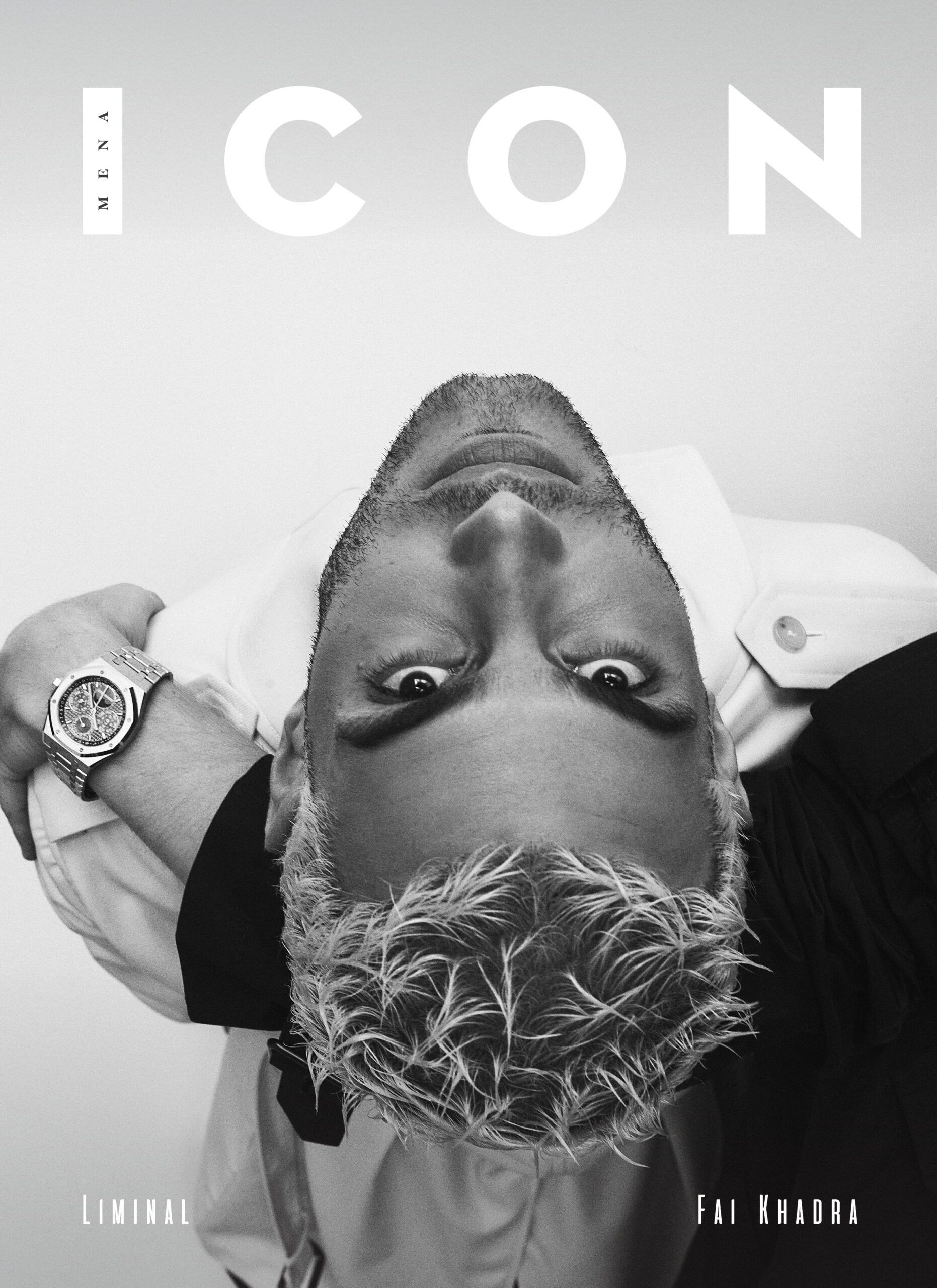
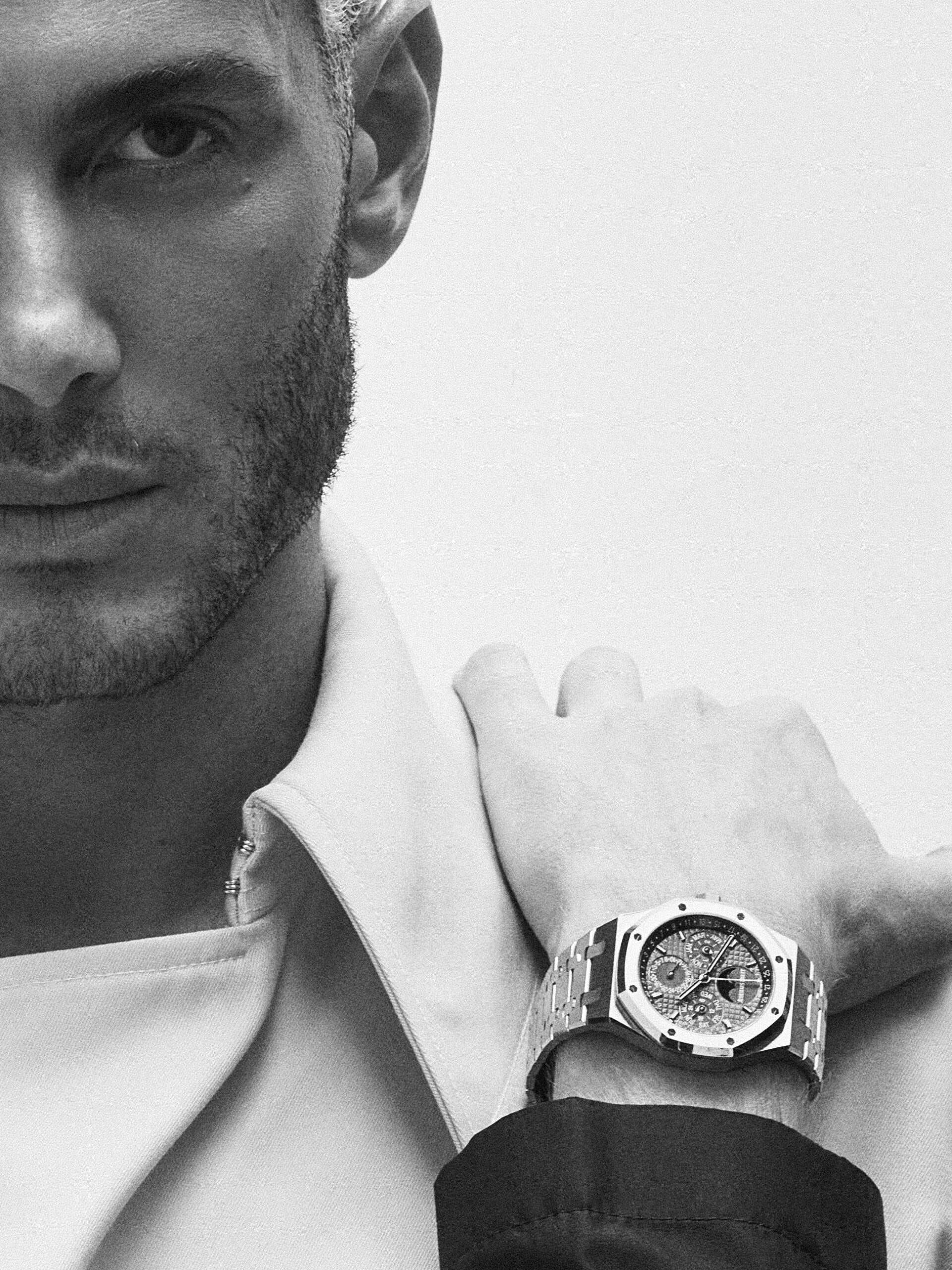
Coat, CELINE. Royal Oak Perpetual Calendar Watch, Audemars Piguet
“In-betweenness has become a kind of home for me.”
For many, to sit in liminality is to sit in discomfort. For others, it is a place returned to so often that it starts to feel like an old friend, the threshold of a home and about as close to one as it gets. Fai Khadra knows that doorway well. Born in Los Angeles to Palestinian parents and raised between Riyadh, London and Dubai, the third-culture kid has spent a lifetime being asked where he’s from and a career being asked what exactly he does. The answers have only multiplied since. Model, designer, songwriter, sculptor, creative director: he is all of them at once, and admits to feeling “slightly awkward” whenever he’s made to choose.
Whichever hat he happens to be wearing, he’s a fashion favourite. Khadra was on a roll at Paris Fashion Week’s Spring/Summer 2027 shows last month, moving from Dior and Saint Laurent to Isabel Marant, Schiaparelli and Elie Saab, and turning every arrival into its own runway. He has long been part of luxury’s inner circle, and brands keep coming back for more.
He has fronted Ralph Lauren’s Ralph’s Club fragrance, joined Dior Beauty’s Gris Dior Collective, walked Balenciaga’s Spring 2024 show in Paris and landed a place in JW Anderson’s sprawling Resort 2026 lookbook, with Moncler, Louis Vuitton, Alexander Wang and Bulgari also on his roster. When Oliver Peoples handed him the pen for a sunglasses collection, it marked the first time the eyewear house had ever collaborated with an individual. His architectural training has found its way onto the stage too, through sets for Summer Walker’s First and Last tour and The Internet’s 2019 Camp Flog Gnaw performance, alongside stage designs for Drake, Syd, A$AP Ferg and Buddy.
LINEA Asymmetrical Shirt Dress, RE-PULL. Striped Silk Tie, Paul Smith. Trousers, UNDERCOVER. Shoes, CELINE
Closer to home, his eye has helped shape Fashion Trust Arabia’s most glamorous moments, from the table he designed for the organisation’s London dinner with MATCHES celebrating its 2022 winners to the walkway he created for its 2025 awards ceremony at the National Museum of Qatar in Doha.
For someone so often caught mid-stride, Khadra speaks about time with unusual patience. He guards the hours when nothing is expected of him and trusts that the best work arrives once the process has had a chance to change it. It is a philosophy Audemars Piguet would recognise, a house that has spent more than 150 years in Le Brassus proving that the most considered things are rarely the fastest.
This issue is built around the liminal: the space between one state and the next. You’ve lived between cities, disciplines and audiences for most of your life. What’s your relationship with that kind of in-betweenness? What in-between states are you in now?
I think in-betweenness has become a kind of home for me. Moving between cultures, cities and creative disciplines, I’ve learned that different places bring out different parts of who I am. For a long time, I felt I had to make all of those parts legible to other people. I’m more comfortable now letting them coexist without explaining how they fit together. Creatively, that space is where I feel most curious. Something I notice in architecture might find its way into a fragrance, or a memory might become the starting point for an image. I like having enough distance from each discipline to approach it with a little innocence.
Right now, I’m somewhere between exploring and putting down roots. I still want the freedom to follow an unexpected idea, but I’m also drawn to staying with things long enough for them to deepen — a place, a collaboration, something I’m building. I’m figuring out what commitment looks like when curiosity has shaped so much of my life.
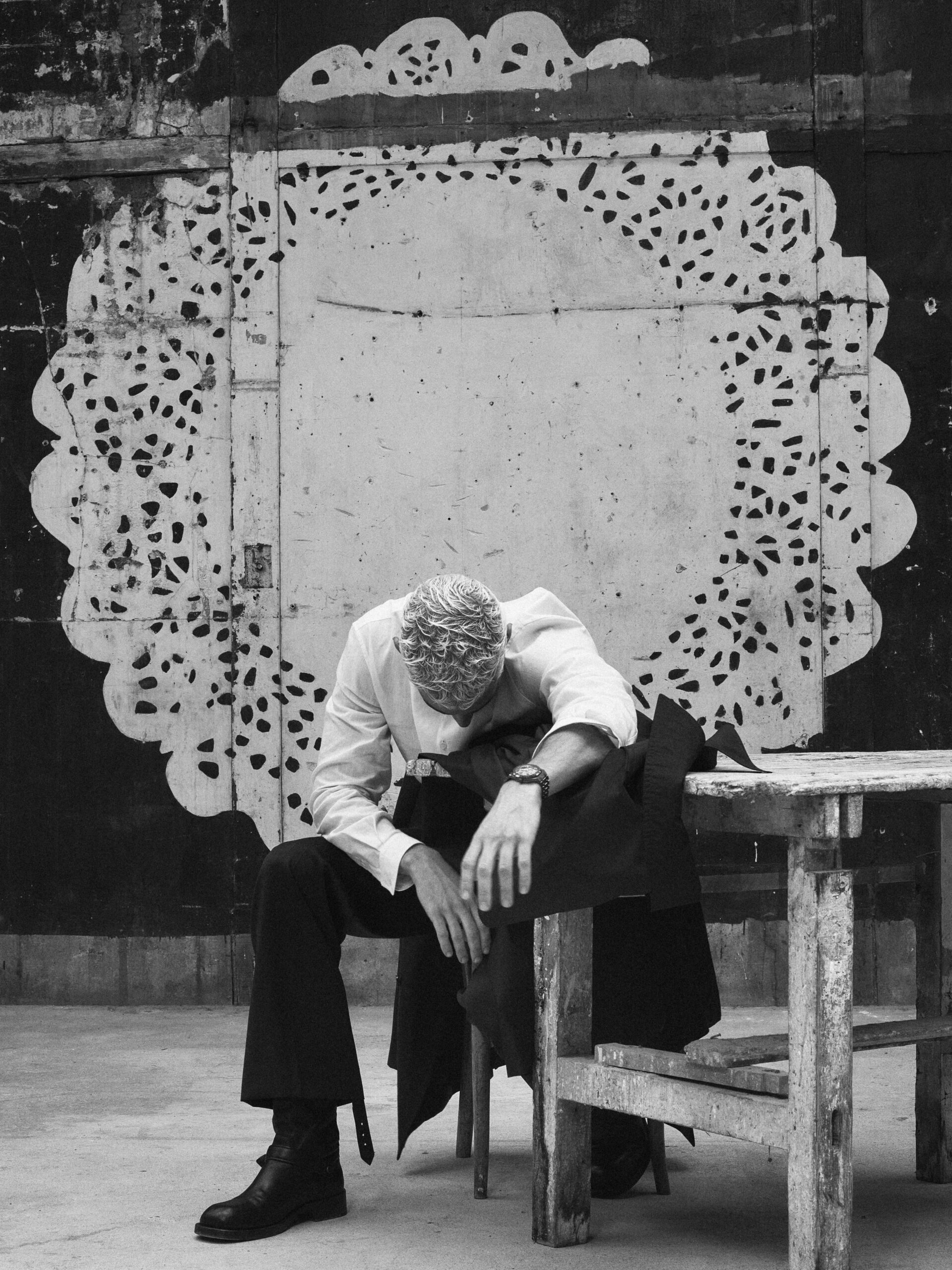
Shirt, Loro Piana. Navy Trench Coat, Navy Trousers, Zipped Leather Boots, Burberry. Royal Oak Double Balance Wheel Openworked, Audemars Piguet
Audemars Piguet is a house whose whole craft is the thoughtful measurement of time. Architecture works on a similar clock, with projects that take years. What’s your relationship with time and how has it changed as your career has sped up around you?
As my career has become busier, I’ve become more protective of the time when nothing is expected of me. A full calendar can give you a sense of momentum, but I’ve learned that some of my best ideas come when I have room to wander, look at things or sit with a thought. Architecture has deepened my appreciation for patience. You can have a very clear vision, but materials, people and places each have their own pace. The process changes the idea, often for the better, if you give it that chance.
Earlier on, I felt a greater urgency to make things happen. Now I think more about what deserves years of my attention, and what I’ll still feel connected to long after it’s finished. I’m still ambitious, but I’m more willing to let something take the time it needs.
What are you working on right now that nobody has seen yet?
Something great.
Shirt, Tod’s. Code 11.59 Starwheel Watch in White Gold and Ceramic, Audemars Piguet
What happens to the work you choose never to share? Is there an archive somewhere of unreleased music, sketches, unbuilt spaces, designs? And how do you know when something is finally ready to leave the room?
There’s an unofficial archive scattered across notebooks, hard drives and my phone. Some things are very finished; others are just a sentence I was convinced meant something at three in the morning. I like going back and discovering something I wasn’t ready to understand when I made it. I don’t think everything needs an audience. Some work helps you get somewhere else. But when I keep returning to something, and it still makes me feel something after the initial excitement has passed, that’s usually when I know it’s ready to leave the room.
You return to the word “accessible” often. You used it when talking about the label you were starting, and about your Sotheby’s sale curation, which you hoped would open the art world to a younger audience. What does accessible actually mean to you in practice? And why is it important to bring into fashion and art worlds that often feel exclusive to many?
To me, accessible means you don’t need permission or a particular education to connect with something. In practice, that means thinking about price, how something is presented, and whether the language invites people in. You should be able to love a painting before you know who made it.
Fashion and art have given me so much pleasure and curiosity. I want other people to have that first encounter without feeling they’re missing a password. You can have a strong point of view and still make people feel welcome.
Sunglasses, Parasite Eyewear. Blazer, Fendi. Striped Shirt, Tie, Paul Smith. Gloves, VAIN
Your references jump across centuries and registers: Robert Longo and Avedon next to Pamela and Tommy, Islamic art next to Warhol, Nauman and Ruscha. Where do you collect them? What are the best practices to train one’s eye in an era of visual and digital overstimulation?
I collect references quite instinctively. It might be a photograph in a book, a music video I remember from childhood, or a detail in a building I pass every day. I’m interested in why certain images stay with me, even when they seem to have very little in common. I think you train your eye by following your curiosity before checking whether something is considered good. Look closely, learn who made it and what came before it. And occasionally resist the urge to photograph everything. There’s something useful about discovering which details your memory chooses to keep.
I think training your eye takes a willingness to look beyond your own taste. Spend time with something you don’t immediately like. Ask yourself why one image holds your attention and another doesn’t.
You grew up around a mother who collects. What was the first work at home that stayed with you? Do you collect?
Growing up, what stayed with me was the way she lived with the things she loved — the attention she gave them and the stories behind them. I think that shaped my eye before I was conscious of it. I do collect, quite instinctively. I’m drawn to things I want to live with and keep discovering over time. There’s something intimate about slowly building a collection; it becomes a portrait of you without your quite intending it to.
Tavolozza Crewneck, Malo. Trousers, CELINE
Model, architect, musician, set designer, curator. How do you feel about labels? Have some felt closer to you than others at different stages of your life?
I understand why labels are useful, but I’ve always felt slightly awkward choosing one. At different points, music, design or image-making has taken up more of my life, so naturally one description has felt closer than another.
Usually, I’m following an idea and figuring out what form it needs to take. The difficulty comes when you’re expected to keep being the version of yourself people first encountered. I like having room to surprise myself.
You co-wrote and sang on several songs by other artists, and have quietly put your own songs on SoundCloud. Music seems to be a discipline you return to, despite never releasing a full project under your name. Is this something you’d considered at all?
It’s something I’ve considered and remain interested in pursuing. While studying architecture, I was making music with friends, and that interest eventually led me to designing tours for artists. Tour design became a meeting point between the two disciplines: an opportunity to explore how space shapes the experience of music.
Coat, CELINE. Royal Oak Perpetual Calendar Watch, Audemars Piguet
For many in the diaspora, Palestine is a place carried more than a place lived in. What does being Palestinian mean to you day to day? And how has that changed in recent years, as being visibly Palestinian in public life has come to carry a different weight?
Being Palestinian is part of how I understand home, family and belonging. It lives in everyday things: the way we gather, the food, the stories, the importance of hospitality. Growing up in the diaspora, those things give you a relationship to a place beyond your own experience of living there.
In recent years, that belonging has come with a deeper sense of responsibility. There’s grief, and a heightened awareness of what it means to speak publicly. I feel a responsibility to be visible and thoughtful, and to remind people of the fullness of Palestinian life — our culture, creativity, humour and aspirations. Those deserve to be seen and carried forward, too.
“Being Palestinian is part of how I understand home, family and belonging.”
Arab families are famously close, and yours moves through many of the same worlds you do. What’s it like to share those worlds with your sisters?
It’s lovely having people around who know you beyond whatever room you’re in. We get to share some incredible experiences, but usually it’s the laughing on the way home that I remember most.
You’ve just come out of a full SS27 season, and you’ve been on both sides of the runway for over a decade, either walking and modelling or sitting front row season after season. How has fashion changed in that time? And with designers now expected to deliver constantly, does the industry still leave room for ideas to mature before they’re shown?
Fashion’s relationship with time has changed. A collection is now expected to function simultaneously as design, entertainment and content, with its cultural significance assessed before the designer has taken their bow. We’ve become remarkably efficient at forming opinions.
Ideas still need time to mature, even if the calendar suggests otherwise. The challenge is preserving space for experimentation within a system that expects constant resolution. Occasionally, the most productive thing a designer could do is miss a deadline.
The Havana Parka Jacket, The Tintore Leather Pants, Jacquemus. Royal Oak Selfwinding Chronograph, Audemars Piguet
With Arab designers on the Paris calendar and initiatives like Fashion Trust Arabia backing designers from the region, how do you read the place of Arab designers in global fashion right now? Is it real change or a moment?
I’m optimistic, though visibility and lasting influence are different things. The talent has always been there; what matters is whether designers have the backing to build sustainable businesses and develop their work beyond a few celebrated seasons.
I’d hope we’re moving towards a point where Arab designers can have distinct, even contradictory perspectives without being expected to represent an entire region. That freedom, alongside sustained investment, would signal real change. A moment gets attention; a career needs infrastructure. An enthusiastic front row is lovely; it isn’t a business model.
EIC & Creative Direction: Kevin Breen
Photography: Jake Terrey / Heart & Co Producer: Steff Hawker Styling: Barnabé White Grooming: Claire Gil On-Site Producer: Sofia Potapova Project Manager:Erin Steel 1st Assistant: Sebastian Rolland Digital Technician: Jozue Anthony Set Assistant: Andréas-Saül Champagne Words: Sami Abd Elbaki Talent: Fai Khadra Talent Management: Best Presents
Top Banner Image: Sky Blue Cotton Shirt, Tailored Wool Trousers, Prada