
News

Words_Jeremy Tavitian
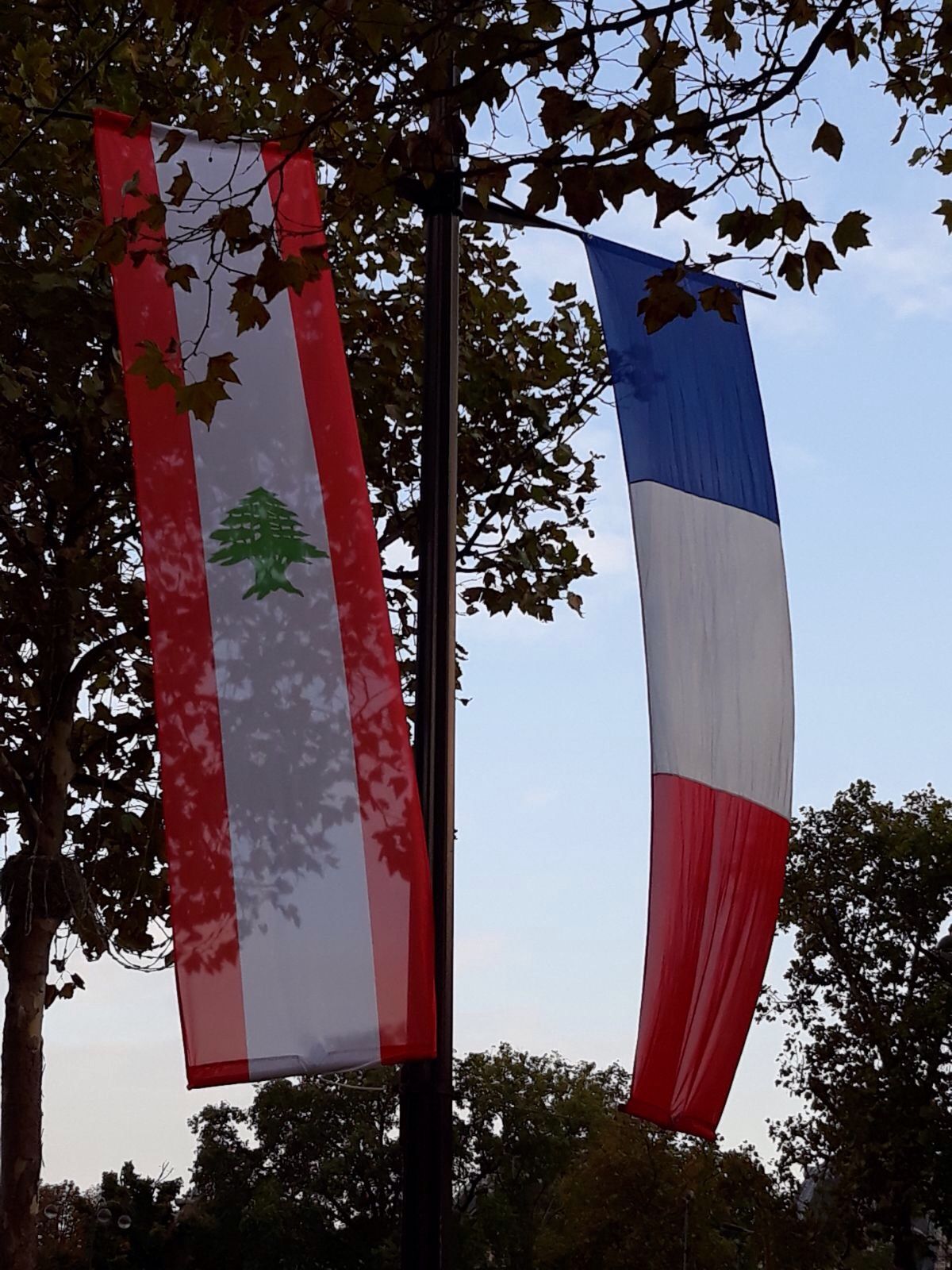
It starts with the name. As soon as I was baptised Jérémy, with two accents aigus, my social fate was decided for me. Such names are fairly common in certain pockets of Lebanon. I have lost count of the number of Pierres, Serges, and Elies I’ve met in the past. To hold a name of this nature is to carry a certain social identity, to embody a particular segment of Lebanese society. If you have a name like mine, you may have already been called a Frenchie.
In the Lebanese context, a Frenchie is a person born and raised in Lebanon who displays a francophile and franco-centric habitus. Their mode of existence and identity is centred around the French language, culture, and politics. They attend or have attended private schools accredited by the French Ministry of Education, where they focus on French history, civics, and humanities. The Frenchie is happily detached from the national environment and context, enjoying a conspicuous bourgeois lifestyle. They live in their own bubble and almost exclusively socialise among themselves. In order to do so, they aggregate in specific neighbourhoods of Beirut (namely Achrafieh), and refuse to step out of the geographic perimeters of their communities.
“To me, Frenchies are people who are unable to step outside their own microcosm, who never venture beyond it, and who feel neither the need nor the interest to discover anything beyond what they already know.”
Sarah
“At home, the television was always in French. My parents hardly ever watched Lebanese television, not even the news. It was always the French news.”
Carole
Perhaps the most identifiable trait of the Frenchies is their way of speaking. Despite having no material ties to France, their mother tongue is French. At home, school, or with friends, the Frenchies exclusively speak to each other in French. Arabic is actively rejected, as it is associated with the uneducated masses (who are often referred to by the Frenchies as Nawré).
“Speaking Arabic simply wasn’t something I could do. To be a Frenchie is to refuse to speak Arabic and to distinguish oneself through that refusal. I’ve even heard people say, ‘I don’t like the taste Arabic leaves in my mouth.’ That’s someone who is still committed to remaining within that circle of other Frenchies.”
Lynn
“Frenchies are a social group which use the French language, first and foremost, as a sign of distinction, a code to depreciate the Arabic language and culture. They see Arab identity as an antipode of their upbringing and capital. They often don’t even know how to speak Arabic, and this is deliberate.”
Jad
They have a particular way of speaking French: the bourgeois, old-school, Parisian dialect is intertwined between Lebanese tonalities and semantic borrowings from Arabic.
“It’s also the French shaped by idealised clichés about France, its culture, its cinema, and, more broadly, the traditional aura of French cultural prestige. As far as I know, it evokes an image of an old-fashioned France more than anything else.”
Serges
“To be a Frenchie is to speak with a strong French accent, adopt a particular intonation, and use the same expressions that make no sense in standard French—for example, quitter to mean that someone is setting off or leaving, or veiller to mean going out partying.”Elie
I have been called a Frenchie thousands of times. But can I really blame those who make such assumptions? I was raised in a French-centric environment and spoke French as my first language for most of my childhood and teenage years. I exclusively consumed French media as a child. I only found out what Spacetoon was in adulthood. As a kid, the only thing on my TV was Bob l’Eponge and the French weather. My Arabic level was so subpar that my school had to put me in a class for “special” cases. If I have so much in common with the Frenchies, how can I describe my aversion to them? Why can’t I enjoy the chic lifestyle of the francophile? Why does writing this paragraph make my skin crawl?
According to a study by the Institut Français, Lebanon counted more than 275,000 francophone students in the private sector in 2021. Only 20 per cent of those students were enrolled in schools accredited by the French State. Such schools are the ultimate agents of francophile socialisation. However, not all francophones are francophiles, and not all those who were raised francophiles are Frenchies.
Being enrolled in a private school and speaking French is not sufficient to be a Frenchie. I was a middle-class scholarship kid attending a school built for the country’s elite and bourgeoisie. As a child, I aspired to be like them. Now that I am an adult humbled by Lebanese capitalism, I’ve come to a point where I can have an honest conversation about the ideals I was raised to reach towards.
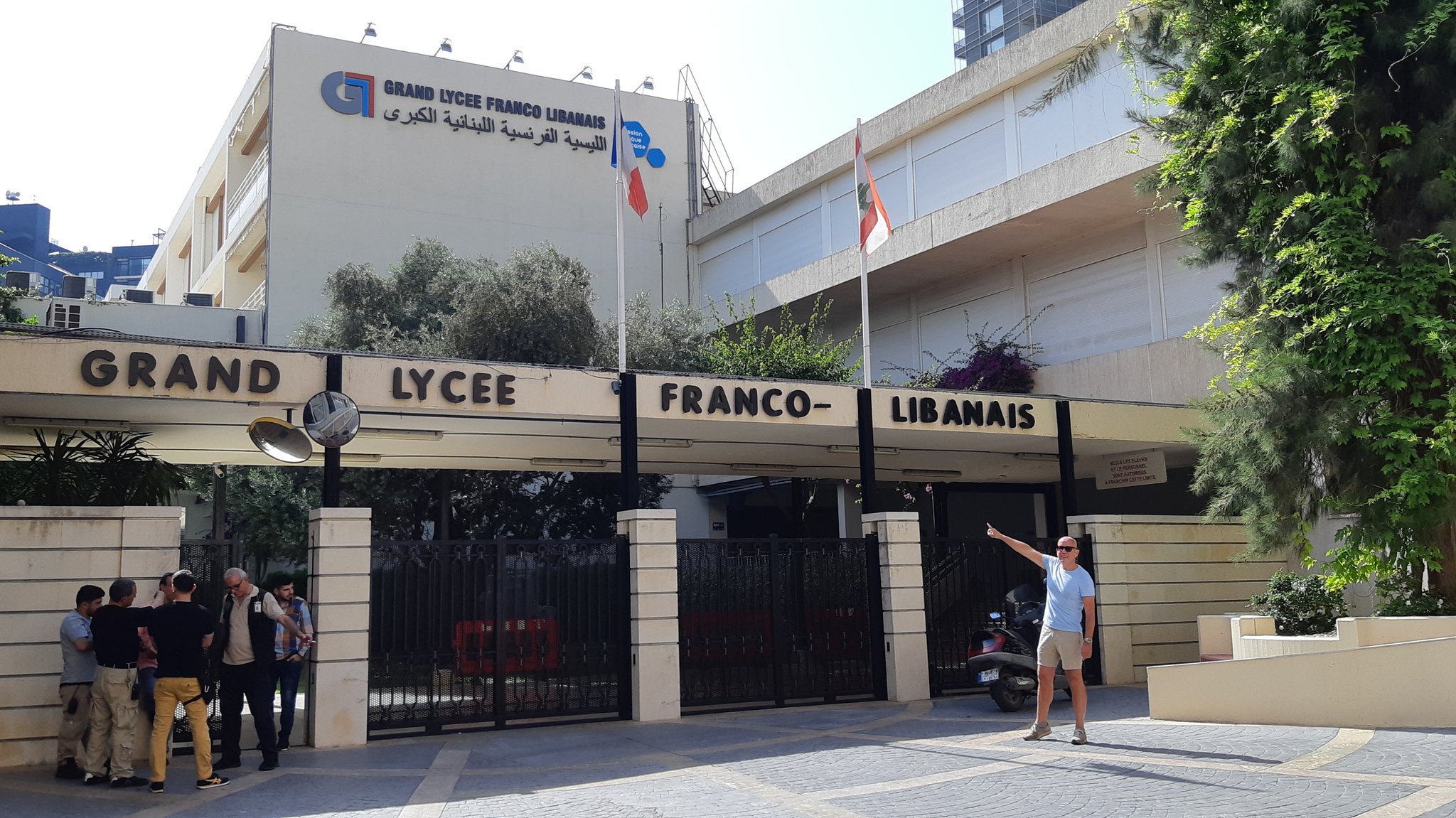
“I did not have the ‘codes’. I wasn’t feminine enough. I didn’t have Golden Goose shoes or the latest iPhone. I didn’t go to ATCL or Faraya.”
Sarah
Frenchies are a product of bourgeois culture. Their francophilia is a marker of their social class. They disengage from their local environment because they are financially able to do so. To be raised a francophile without those economic privileges fosters a sense of dissonance: possessing the cultural capital of the francophile upper class, yet being grounded by a gap in economic, social, and symbolic capital. There is a growing sentiment of disgust towards Frenchies from people who were raised in such contexts. This disdain is coupled with an interest in reappropriating a Lebanese identity freed from the restrictive nature of francophilia.
Parallels can be made with the diasporic mode of existence. Much like a Lebanese person living in France, the self-critical francophones I interviewed for this article inhabit a liminal cultural space, navigating the lines between the habitus fostered by a Western(ised) upbringing and the Lebanese field. However, unlike immigrants and members of the diaspora, this sentiment is fostered within the home country. Therefore, I propose the term ‘In Vitro Diaspora’: defined by inhabiting a dual cultural space, developed while being physically present in the homeland. The Frenchies aim to assimilate to a foreign Western ideal, while the In Vitro Diaspora aims to expand their Lebaneseness by critically engaging with their environment and francophile upbringing.
| Lebanese Frenchie | In Vitro Diaspora | |
| Socio-economic class | Upper class bourgeoisie | Middle class
(To some extent) Progressive upper class |
| Language of choice | French, little to no Arabic | French and (in adulthood) Arabic |
| Education | Private education, accredited French schools in Lebanon | Private education, accredited French schools in Lebanon |
| Relationship to Arab identity and Arabic | Active rejection and disdain, Phoenicianism | Growing acceptance and embrace |
| Lebanese politics | Either:
|
Post-sectarianism, critical of foreign interventionism, solidarity with other arab nations (i.e. Palestine) and fellow citizens (i.e. South of Lebanon) |
| Relationship to France | Idolatry | Critical, growing disdain |
| Relationship to Lebanon | Detached
Hierarchisation of cultures and peoples |
Inhabiting a liminal cultural space |
In order to understand these nuances and social mechanisms, it’s important to understand the Frenchie mode of existence through the political imaginary. They draw a clear dichotomy between the two countries and their citizens. On one hand, Lebanon is seen as a failed state whose corruption is enabled by the low intelligence of the masses. On the other hand, France is depicted as a beacon of democracy and French citizens as educated and respectable.
“My grandma used to watch Question Pour Un Champion and tell me: ‘Look at the French! They know everything. History, literature, Latin… And look at the Lebanese. Nothing in their brains! One day you will move to France, and you will finally be among intellectuals.’”
Lynn
This discourse is essentialist and fictitious; the Frenchies do not necessarily have any direct experience with French people, nor do they encounter Lebanese individuals outside of their social perimeters. These evaluations are based on a fantasy manufactured by French soft power. The Frenchies correlate cultural capital to civility, and civility to development. By doing so, their consumption of French media, their usage of the French language, and their upbringing allow them to situate themselves above fellow citizens. They, who read Émile Zola and watch Star Academy France, are students of true, legitimate, and high culture. Fantasies of the French ideal therefore contribute to the social reproduction of the elite within Lebanese society while pushing for disidentification with the country’s cultural fabric.
It must be mentioned that the Frenchieness is transmitted from one generation to another: if you meet a Frenchie, it is likely that their parents and grandparents are Frenchies too. It is a classic case of primary socialisation and social reproduction. Francophile identity building begins at home, if not at birth: parents give their children a French name, enrol them in French schools, speak exclusively in French at home, and expose them to French media from a young age (i.e. through French TV channels for kids). As shown by Lynn’s example, Frenchie parenting utilises cultural elements and exports to inculcate a particular vision of Lebanese society, to confirm their hierarchical positioning within said society, and to embody a francophile fantasy which is internalised by their children.
What does one make of these fantasies? The middle class and the class defectors of the In Vitro Diaspora dwell on the liminality of their cultural space, simultaneously bound by the country’s material conditions and the cultural baggage of their francophile upbringing. Meanwhile, the Frenchie bourgeoisie enjoys a mode of existence which legitimises their detachment from their own country. They assimilate to the French ideal and, naturally, disaffiliate from Arab identity:
“This hyperfixation towards France is mainly used to distance themselves from other Arab countries. They claim that Lebanon is a Phoenician country. That’s what I was taught at school!”
Lynn
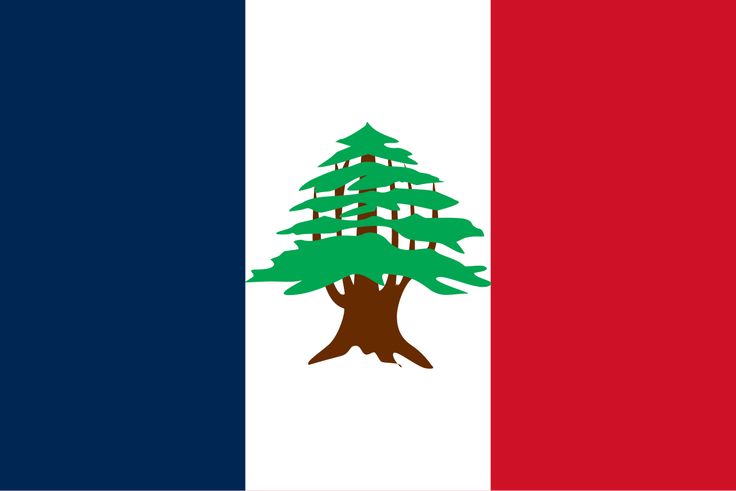
Lebanese francophilia is intimately tied to sectarianism and, particularly, to the politicisation of the Christian identity. The story dates back to the Crusades. In 1250, during a visit to Lebanon, Palestine, and Cyprus, French king Louis IX granted a charter to the Maronite Christians of Lebanon:
“We are convinced that this nation, which we find established under the name of Saint Maron, is a part of the French nation […]. For ourselves and our successors on the throne of France, we promise to grant to you and to all your people our special protection, just as we grant it to the French themselves.”
Under Napoleon III, Paris dispatched a naval expeditionary force to come to the rescue of the Christians massacred during the 1860 civil conflict in Mount Lebanon. Four years later, and alongside other European powers, France actively pushed for the establishment of the semi-autonomous status of Mount Lebanon. In 1916, the Sykes-Picot agreement between France and Britain defined the borders and spheres of influence in the post-Ottoman Levant. This laid the grounds for the formation of Greater Lebanon in 1920, the French Mandate over the country, and its sectarian political system. France maintained its influence in post-independence Lebanon through Christian militias. For instance, members of the French far-right party Front National have joined the ranks of the Lebanese Phalangists to defend “Occidental Christianity” against “Marxism”.
France still enjoys a strong political and economic presence in Lebanon. It deploys hundreds of French soldiers in the South of Lebanon as part of UNIFIL (United Nations Interim Force in Lebanon), and provides logistical support and financial aid to the Lebanese Army. The French company TotalEnergies, present in the country since 1951, is involved in gas exploration in Lebanese waters. The Franco-Lebanese logistical giant CMA CGM manages more than 40 per cent of the country’s container terminals in Beirut and Tripoli. French soft power allows this presence to be legitimised through cultural exports and by fostering a francophile community. The French Institute (l’Institut Français), managed by the French Ministry of Foreign Affairs, funds and organises film festivals, book fairs, performances, and other events to sustain France’s position as an “advocate for culture”. This is coupled with development programs. Financed by the AFD (Agence Française de Développement, the French foreign aid agency), these initiatives aim to “improve access to education, promote governance, and support economic and financial reforms”. These programs often reflect the clientelism of the French state and its desire to sustain its special relationship with the Christian sect. For example, in 2022, Macron announced a €4 million aid program targeting Catholic schools in the “Orient” (namely, Lebanon). This relationship is also an electoral one: to this day, the term “Chrétiens d’Orient” comes up in every French presidential election, specifically from right-wing candidates. French politicians develop close partnerships with Lebanese Christian parties and ex-militias. In 2020, for instance, Laurent Wauquiez (President of the Regional Council of Auvergne-Rhône-Alpes region and of the right-wing Republican party at the time), greenlit subsidies to the Lebanese NGO Nawraj, which is headed by a former leader of the Lebanese Phalangists.
To be a Frenchie is to (proudly) operate in continuity of France’s imperial history by actively participating in sectarian discourse. Christian identitarianism cannot be separated from the social fabric of Frenchie networks, as attested by the testimonial of Carole, who was raised in a francophone yet secular household:
“I definitely felt judged by my peers at school. They were raised to be divisive, Islamophobic, even sexist. My parents taught me the opposite, which is why I think people at school were so judgemental towards me.”
Carole
The ongoing war with Israel is illustrating how colonial imaginaries and sectarian worldviews continue to structure political subjectivities within Lebanese Frenchie circles.
“In regards to the war and the displacement of people from the South of the country, there is a mix of apathy and contempt. They accuse the victims of the war of ruining the image of a quasi-western Lebanon imagined to be insulated from the woes of the Third World.”
Jad
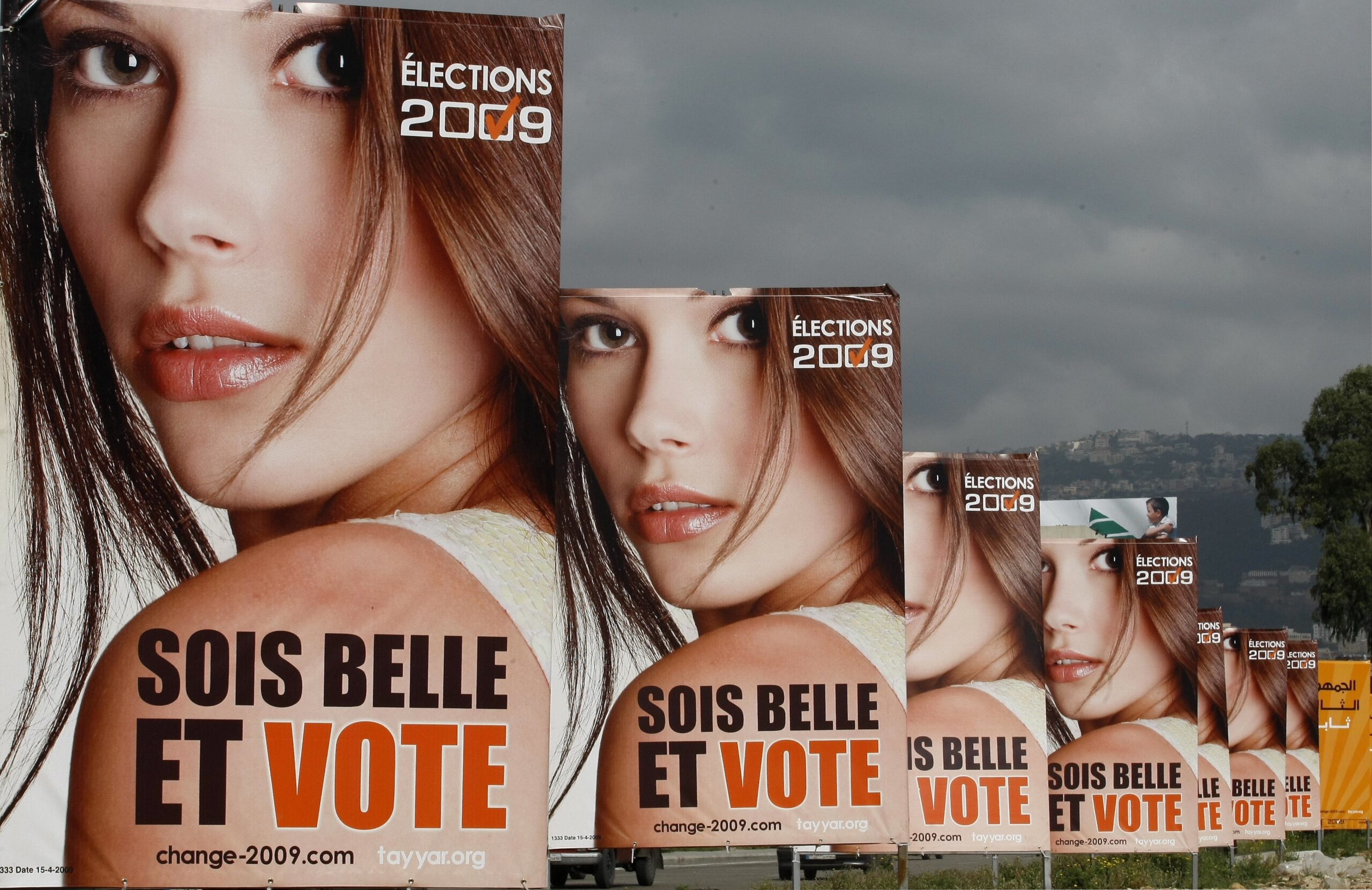
The image is everything — Beyrouth est le Paris du Moyen-Orient ! Political positioning is, sometimes, just a simple question of aesthetics: the tents set up by the displaced who had to flee to Beirut are ugly and, therefore, must be removed. The perimeters of their Liban is well-defined: clean, affluent, “educated”, and Christian. The war disrupts this fantasy and image, which Frenchies try to safeguard through exclusionary and reactionary politics. In contrast, the In Vitro Diaspora expresses solidarity with victims of war. Influenced by Western leftist parties and public figures (i.e. Jean-Luc Mélenchon), they express disgust and frustration towards the political identity of their surroundings:
“My disgust towards Frenchies really reached a peak with the war, and how they reacted to Israel’s invasion. This guy who I went to school with went on television calling for Israel to open an embassy in Ashrafieh. Beurk.”
Lynn
“The crazy things people would post about the war and the crisis, the nationalism, the pro-western sentiment, the “this is not our war.” Obviously I disagree, but it didn’t shock me. Likely things for them to think.”
Carole
Colonial nostalgia is a muscle which spasms in times of crisis. On August 5, 2020, a little less than 24 hours after the Beirut Port explosion, a petition calling for the return of the French mandate gathered more than 60,000 signatures. Political desperation and a complete lack of trust in national politics were, naturally, prominent. However, for those signatories, colonial nostalgia is a salient part of the political imaginary. The violence, paternalism, and divisive logic of colonial rule are eclipsed by an idealised image of administrative efficiency and stability.
The mandate’s mythology is carried and sustained by a fatherly figure: the French president. Two days after the port explosion, Emmanuel Macron made a public visit to the neighbourhood of Gemmayze in Beirut. He was met with a mixed crowd. Some found in him a beacon of hope (“Sir, please, we need a future,” “There is no other way than for you to take over,”) while others used the opportunity to express their frustration towards him and France’s policies (“You are sitting with war lords!” “Georges Abdallah!”). However, public opinion aside, his visit was a carefully constructed political performance. With his sleeves rolled up, he walks through devastated streets, embracing victims, and addressing Lebanese citizens directly. This comes at a time of great political confusion and distrust towards the local political class. With citizens having no local figure to find solace in, and no person of power willing to take accountability, Macron locates a political opportunity and embodies the image of the attentive and benevolent leader. His performance did not respond to existing colonial nostalgia. It participated in reproducing the very imagery upon which that nostalgia, and therefore Lebanese francophilia, depends on.
“I would argue that their demands, regardless of the crisis at hand, tend to adopt a neoliberal orientation and frequently gravitate toward seeking support from France, personified by whichever president happens to be in office, regardless of their political agenda or foreign policy. There is a peculiar uniformity in this relationship that I do not identify with at all.”
Jad
The national crisis is an arena of heightened political emotions, just as it is one of sharpened social positionality. The Lebanese economic collapse, which became progressively apparent starting in 2019, severely deepened socioeconomic inequalities. Hyperinflation, currency devaluation, and the widespread restrictions on access to bank deposits blurred the boundaries between the middle and lower classes.
Many experienced a sharp downward social mobility and struggled to make ends meet, while the bourgeois elite was largely insulated from the crisis. Some even benefited from the economy’s dollarisation: those with access to foreign currency, overseas income, or substantial non-financial assets were able to preserve or accumulate their wealth and maintain access to a conspicuous lifestyle that became increasingly unaffordable for much of the population. To say that such inequalities were not present prior to the crisis would be misleading, as the country has long been characterised by its significant socioeconomic disparities.
However, the financial collapse has made these divisions more visible and, for some, has facilitated a growing class consciousness. The previously aspirational middle class became increasingly deprived of the means to emulate or identify with a bourgeois lifestyle. This is reflected in a growing disgust towards the Frenchies amongst the younger generation. To adopt the Frenchie lifestyle, as a pillar of Lebanese bourgeois culture, entails detaching oneself from the average citizen. To have the capacity and willingness to sustain this, while the country accumulates crises one after another, is a form of symbolic violence. The “middle class”, which previously aspired to integrate such circles are reminded of their economic positioning and their inability to fully access such bourgeois circles:
“[Before the crisis], I was ready to do whatever it takes to integrate these circles, to be able to exist amongst them. Today, I go out of my way to avoid them.”
Sarah
The crisis, regardless of its nature, simultaneously perpetuates and destroys the colonial imaginary. On one hand, the Frenchies cling to an idealised image of a foreign state in order to sustain their prestige and positioning in Lebanese society. On the other hand, the In Vitro Diaspora becomes progressively disillusioned with fairy tales of colonial benevolence, their storytellers, and their elitist, exclusionary logic.
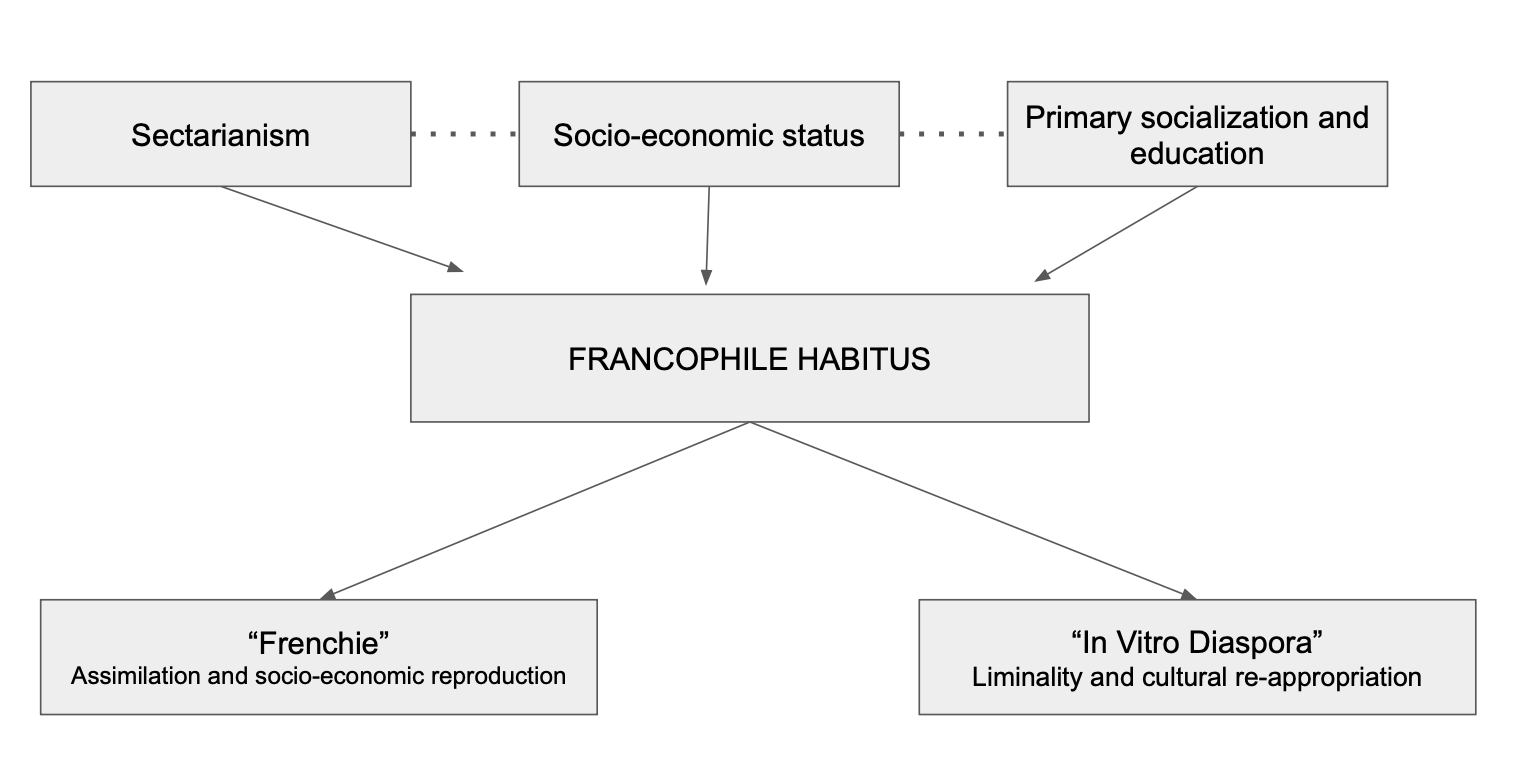
That being said, we cannot shake off our upbringing. I cannot pretend like I have not personally benefited from the system I grew up in, nor will I try to emulate being something that I am not. To be a part of the In Vitro Diaspora is, firstly, an acknowledgement of a particular positionality: semi-privileged, yet marginalised by the structural forces of our childhood. If we refuse to assimilate to a bourgeois ideal we cannot reach, must we suppress our past? The liminal space is one of creative political imagination. We make use of our liminality and resources to reinvent ourselves. If the Frenchies look to the past, we look inwards and, therefore, forward.
THIS FEATURE WAS PUBLISHED IN THE 11TH EDITION OF ICON MENA PRINT MAGAZINE. ORDER YOUR COPY HERE.


