
News

Words_Rawaa Talass
Among the young generation of creatives emerging from the Gulf region, and there are several of them, the Saudi artist Hawazin Alotaibi is one to keep an eye on. Based in London for the past 13 years, Alotaibi hasn’t shied away from observing, understanding and lightly critiquing the conservative yet consumerist society she comes from. She may be known for her cool and vibrant paintings, noticeably marked by dreamy shades of pop pink and purple, but Alotaibi, who was born in the United States, grew up with a non-conforming mindset in Riyadh. As a child, making art was a powerful form of escapism.
“I think ever since I could remember, I started drawing at the age of three,” Alotaibi told ICON MENA. “I was always doodling and drawing. They were drawings of a three-year-old, but I’ve always been passionate. I did not start with paintings, but with comic books, manga and graphic novels. I wanted to be an animator and tell stories. It’s an imaginative world where anything can happen, and you can make your own rules.” That sense of constraint was felt in several ways during her years in the strict system of public schools, where some of her drawings were confiscated. “I was not allowed to draw faces in school, and the school books’ pictures did not have eyes and noses — even with animals,” she explained.
As soon as we began our conversation, Alotaibi admitted right off the bat how life in her country was pretty complex. “But at the same time, it was a type of difficulty that I wasn’t thinking about in the sense that this is just only difficult for me. It was expected and accepted for girls,” she added. “It was never focused on our innocence. As a kid, I was nervous about growing up and experiencing womanhood. When I was in the US, I would see a lot of girls being excited about growing up, wearing makeup and having more freedom, but I did not necessarily feel that way.”
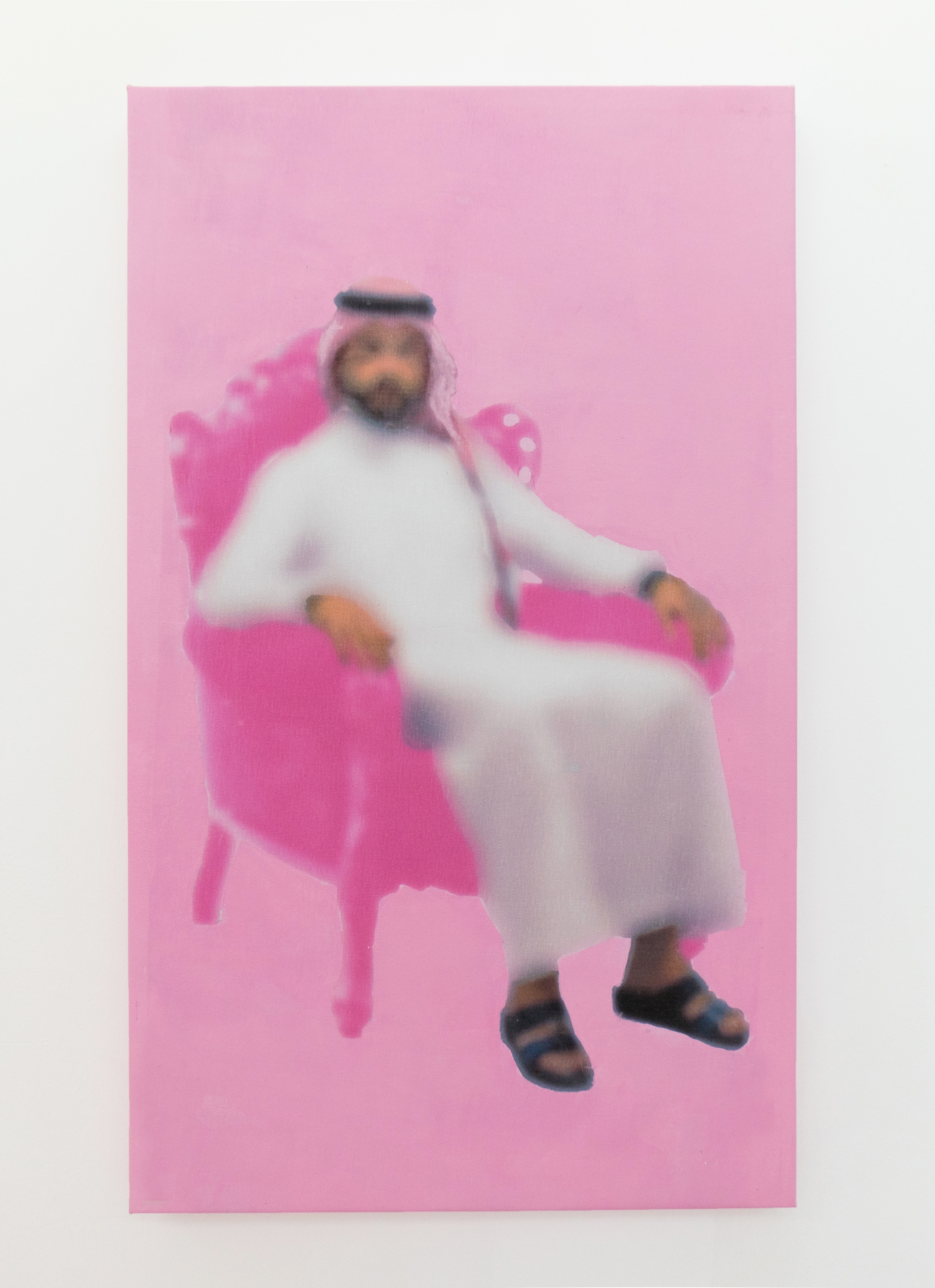
Although Saudi society has drastically transformed over the past decade, where women today have more social and cultural liberties, that wasn’t the case with Alotaibi, who was born in 1993. She was nevertheless able to develop her own character. “I almost feel, and this is me generally speaking, that people just glossed over the past and moved on, and that was it,” said Alotaibi. “This is not to say that I’m against what is happening, but I still think it needs to be unpacked and addressed together. But, from a personal point, I need to also unpack it within myself, understand it and play with it, as it has influenced my experience a lot growing up and now found its way to my practice.”
Alotaibi’s paintings, which were recently on view in a group exhibition at Taymour Grahne Projects in Dubai, challenge certain notions of Khaleeji society, addressing vanity, self-image, masculinity, and gender in a light-hearted yet honest manner. “It’s both critique and observation,” she said of her practice. “I like my work to feel light and warm, even when it engages with complex themes. I want it to retain a sense of playfulness and beauty.”
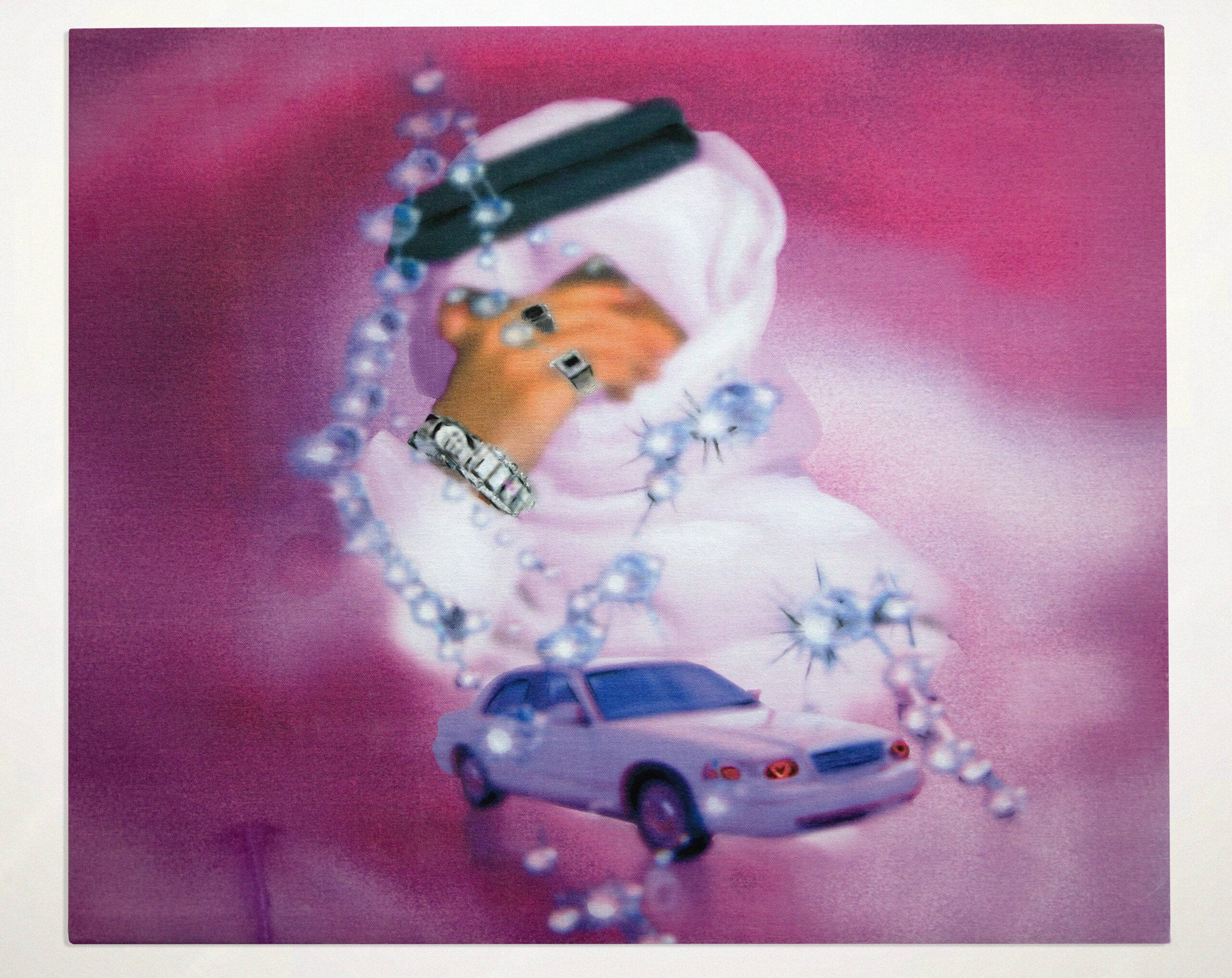
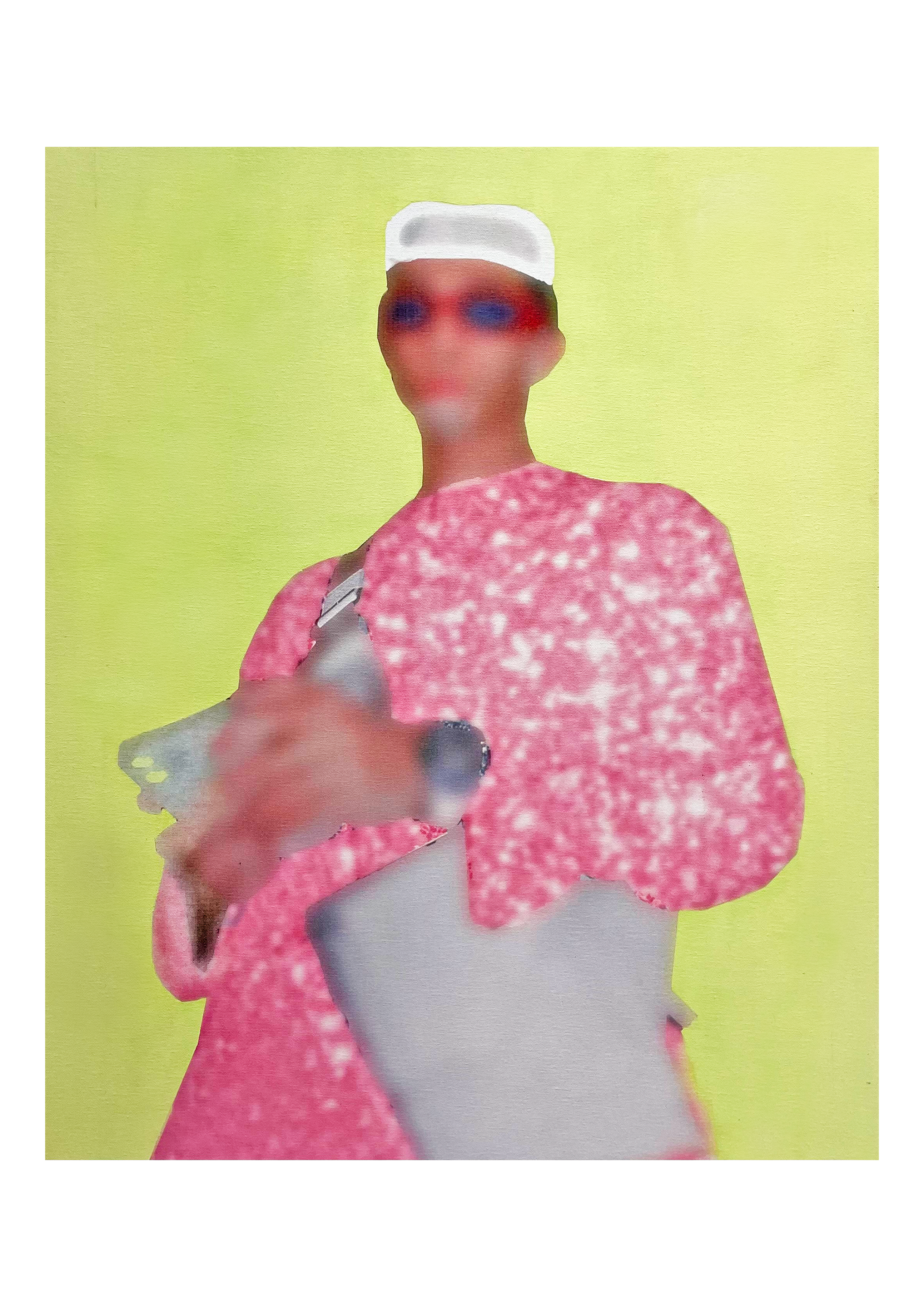
Most of Alotaibi’s art features Khaleeji men, portrayed in a gentle, soft way, a departure from the macho, controlling figure that men have come to project themselves as. As seen in her blurry and pastel-toned works Shy Guy (2026), Closer (2023), Beach Boy (2024) and Mirage (2022), one of the men is wearing a glittery pink top over his white traditional thobe, while another sits in a car with two large pink flowers looming over him. In another image, a man covers his face, wearing his shiny accessories. She does this to soften a man’s image.
“I have a lot of fun doing it, because this is the authoritative figure that we are taught to shelter to as our protector,” she elaborated. “If it’s not your father, then it’s your brother, and if it’s not your brother, it’s going to be your husband or your eldest son. You’re being passed on, basically. This figure will always be shadowing me. Using these colours and visual language, however simple they may seem, is my way of exploring and playing with ideas around masculinity and, in doing so, finding a sense of healing. It’s my way of sort of understanding it by stripping away its aggressive power and making it cute and accessible. I also think that a lot of men also struggle with male-related expectations, so I hope they can relate to the work in their own way.”
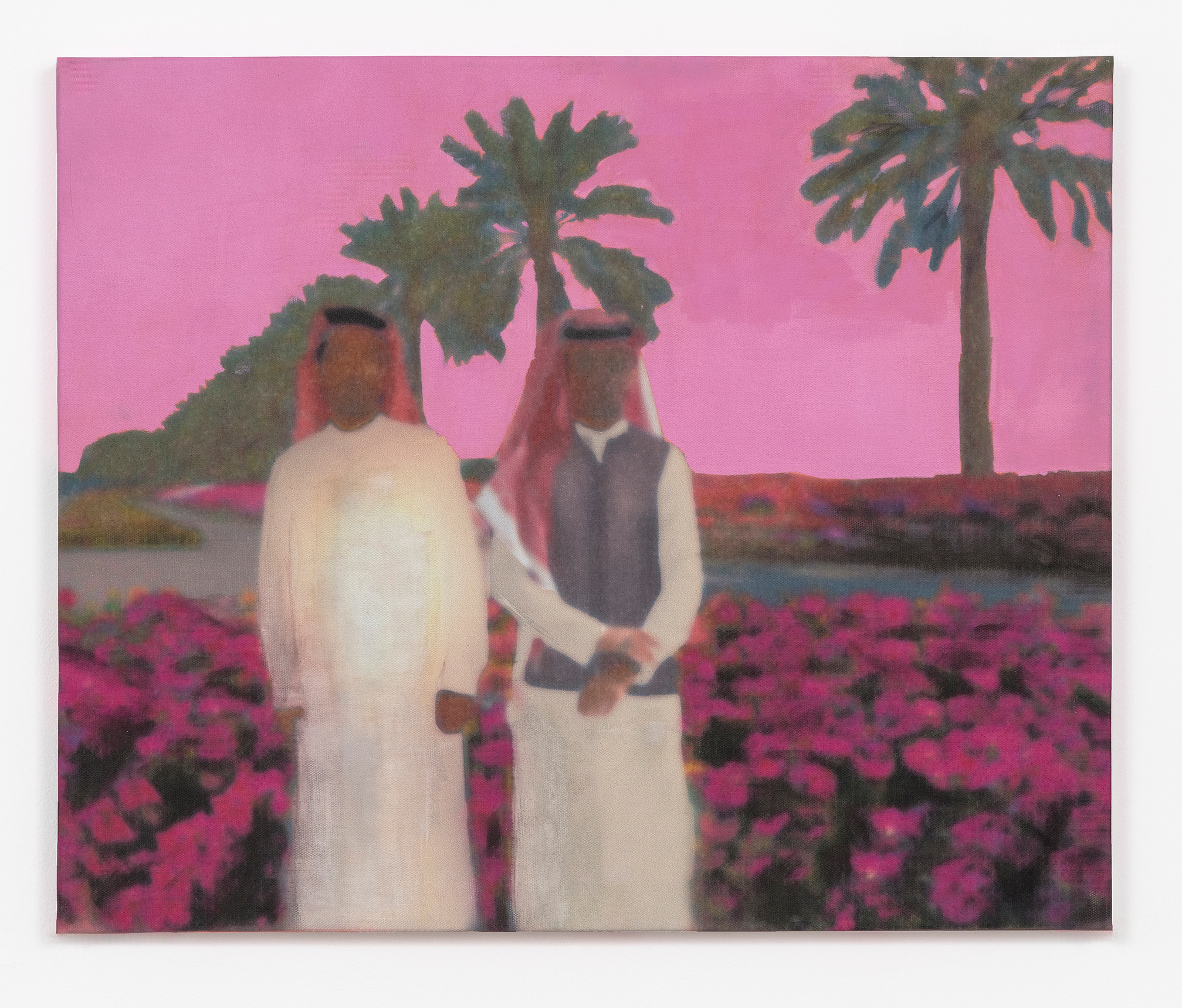
Alotaibi’s unique choice to employ a dreamy colour palette is instantly appealing, but it also aims to challenge preconceived notions of gender. “If you’re a girl, you’re dressed in these colours, and if you’re a boy, you’re dressed in those colours. It was an intentional choice in my work to kind of break that image of visual languages of masculinity and femininity, and to play with it, blur the lines, merge them together and see what happens when they are merged together and how flexible and non-constrained it can be,” she added. “When I was young, I recall wanting to avoid pink as much as possible sometimes, especially growing up with four brothers, but it’s funny that ever since I started using this colour palette, I have been more drawn to these colours and shades. I think pink and floral, soft images are the most powerful.”
Another major topic that Alotaibi has explored in her work relates to how extravagant luxury items, from jewellery to watches and cars, represent an extension of one’s identity. Their power goes beyond adornment. While there is an element of status, show and display, there is also an underscore of wanting to be accepted by society, Alotaibi believes. “Vanity and our preoccupation with how we are seen by others have only become more pronounced in an increasingly connected world, particularly through social media,” she said. “It’s certainly nothing new, but these ideas of self-image and perception are also themes that I explore in my work as they are things you grow up around in an Arab society.” She suggested that perhaps one of the main reasons that Khaleeji and Arab society functions in a materialistic system was because members of society have not pursued individualism, focusing on ways to find their uniqueness.
Inspired by the notion of technology driving social change, which has its positive and negative sides, Alotaibi produces her work through a number of experimental ways, giving the overall work a digital yet nostalgic feel. She started using desktop printers, playing with images that she collected online, editing them in Photoshop, and finally printing them out. The works are then touched with acrylic paint or airbrush to give a lively effect.
For the critically minded Alotaibi, and some of her female and male viewers, her art has a kind of healing element, allowing for confrontation and discussion of matters that perhaps could not be openly talked about before. The artist, who is currently completing a Master’s degree in curating and aims to split her time between Saudi Arabia and the UK, looks back on her past with her head quietly held up high despite the bruises. “I was someone who was always looking for ways to change things or just get what I want,” she concluded. “That’s something that I learned when I was young, which allowed me to continue until now as an adult. I still question things, and I’m definitely proud of that.”
THIS FEATURE WAS PUBLISHED IN THE 11TH EDITION OF ICON MENA PRINT MAGAZINE. ORDER YOUR COPY HERE.


