
News


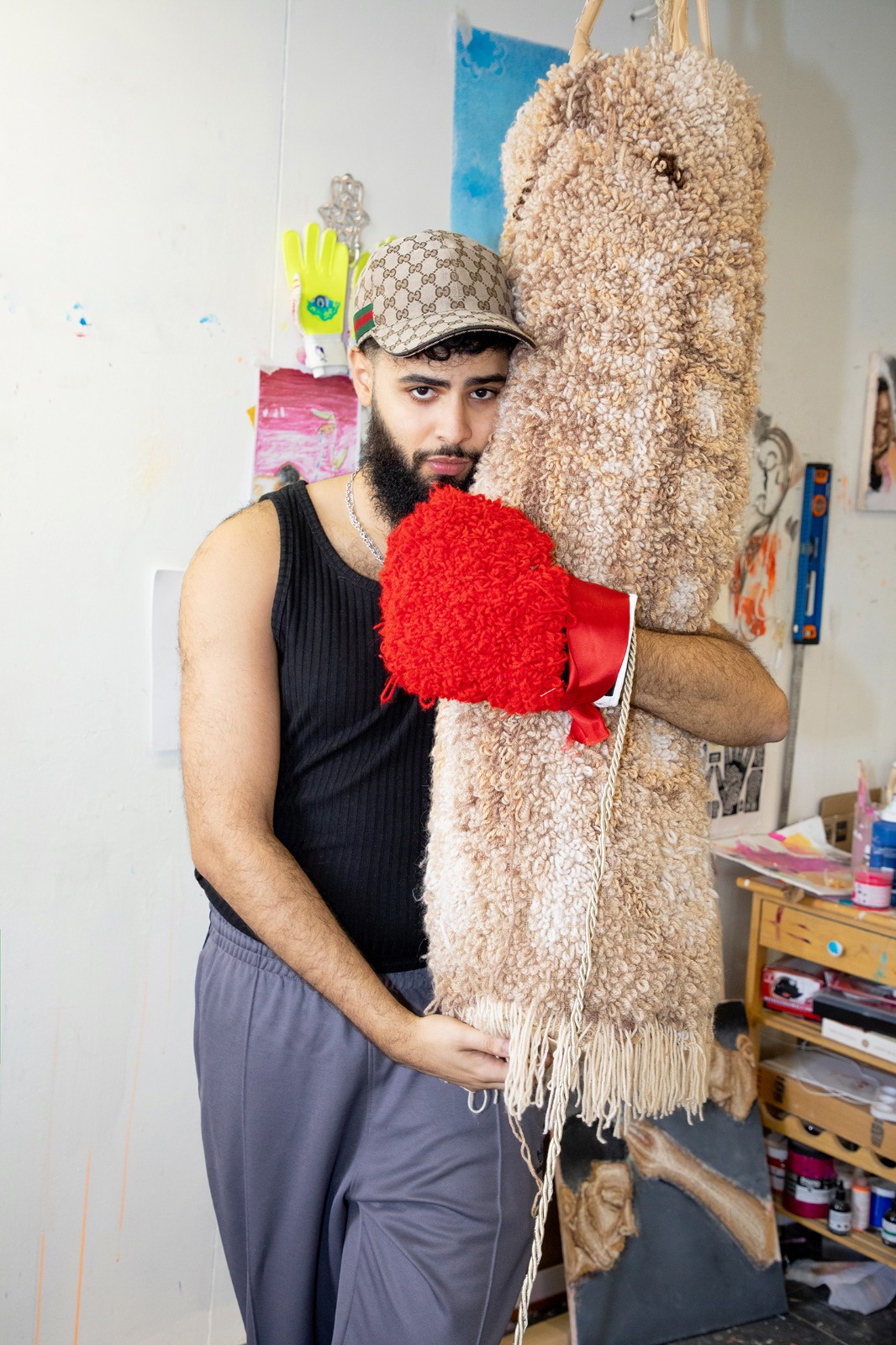
Habki calls in from his studio: drawings pinned up behind him, pale pink yarns on the table, sewing tools within reach, a Rococo-esque sketch for an upcoming show in front of him. Scrolling through our phones at the same time, sharing poetry references, drawing techniques of hairy chests and memes. We spoke in French, because it lets certain social textures land with more precision than English, a way for us to also stay as close as possible to the nuance in his work.
Habki was born in 2000 in Nantes, France, and now lives and works in Paris. He graduated with honours from the École nationale supérieure d’arts de Paris-Cergy in 2024, and presented a first solo exhibition at Centre Pompidou-Metz that same year. Since then, his work has appeared in group exhibitions in London, Paris, Tangier, Stockholm. This fall, he is opening a new solo exhibition, My Desire Is My Compass, at Galerie Kamel Mennour.
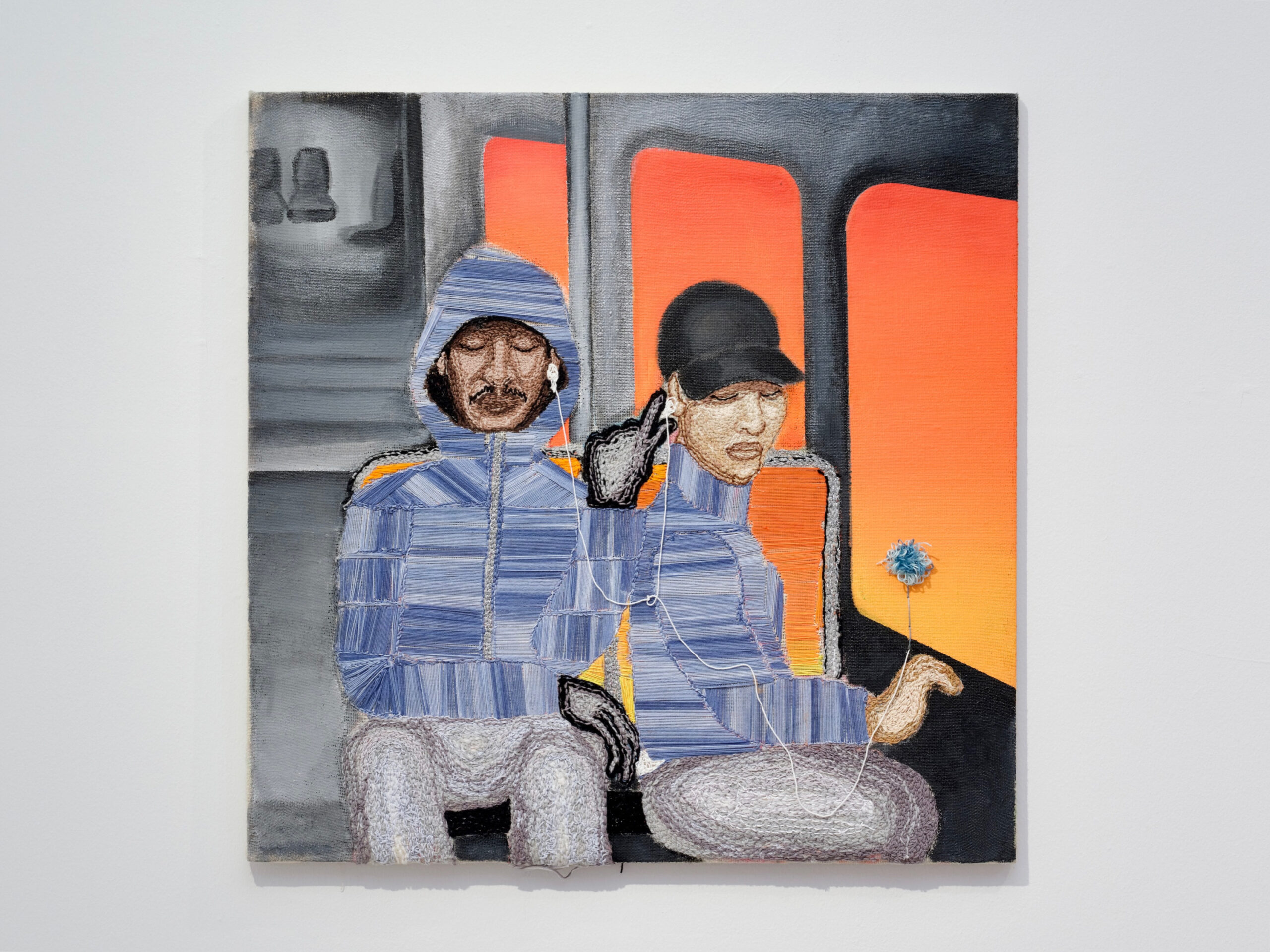
The title of one of his most recent works, Please Mind the Gap returns throughout our conversation, first as a painting, then as a poem he wrote, then as a way to speak about what his work insists on holding open. Habki turns a phrase repeated mechanically in transit into something social, emotional, and political.
“I don’t know if the pressure will crush me or turn me into a diamond,

On the A15, my feet are glued to the asphalt.

I reach the périphérique. I begin to see the Iron Lady.

The light of her eye blinds me.

She mocks me with her shimmering dress…

Please mind the gap between the train and the platform.

Please mind the gap between you and me.

Please mind the gap between your privileges and our fights.

Please mind the gap between your desires and my limits.

Please just mind the gap.”
The poem refuses the comfort of a clean arrival. Paris dazzles, but it also mocks; it demands constant negotiation. Habki’s images often begin with scenes that could be dismissed as incidental: a glance exchanged, a hand resting, a man asleep at the back of a car. They are not the spectacular images social media trains us to chase.
Please Mind the Gap is based on a scene Habki witnessed on public transport. Two men, seated, sharing earphones. “I found it incredibly romantic and thought maybe they were listening to Lana Del Rey or something romantic,” he says. The work stays faithful to the specificity of that moment, but it does not pretend to document it. In the image, the figures sit within the depth of a corridor: large black painted planes flatten and deepen the space at once, you sense the architecture of a metro passage without being given a literal photograph. Behind them an unreal gradient opens like a sky, a luminous shift. In real life, the earphone wire was only the practical line between two listeners. In Habki’s composition, it stretches to a flower. “The flower represents something deeply romantic,” he explains, and it also becomes a kind of hinge between bodies of work: the title of his earlier exhibition, I Will Stitch All the Flowers of Your Garden, and the compass of the next one. The flower remains, but it does not settle into a single meaning. It drifts between ephemerality and an everyday tenderness, a care we too often forget to give and to ask for.

Public transport returns in Habki’s work because it offers a specific kind of movement: the body travels while remaining seated. “I love the aesthetics of movement through a journey where you are passive, seated,” he says. “You are in contemplation.” The RER, the Parisian commuter rail, has accompanied him through many moments,“surprises, encounters, crushes, life things,” and it is here that we lingered on a word that refuses smooth translation: banlieusard.
In medieval French, it meant someone from the zone just beyond the city walls. In the postwar decades (especially from the 1950s onwards), it refers to someone from the suburban belt around big cities, especially the dense, high-rise peripheries shaped historically by working-class migration. The terminology has since become less a simple address than a social tag, carrying a stigma tied to class and race. For Habki it is simply not geographic. It is social, emotional, and political, a condition of proximity and distance at once. “There is a real complicity in being a banlieusard. There’s a dissociation, a cultural dissonance within a 30-kilometer scale.”
Habki’s work describes how the city is experienced from its edges: the long commute, the minor humiliations of class, the constant recalibration of belonging. When he repeats please mind the gap, he is not only pointing to the physical space between train and platform. He is naming a wider infrastructure of separation: “Between people. Between desires and what’s possible. Between what is promised and what is lived.” The phrase is repeated mechanically in transit but the moment you really listen, it becomes charged.
The work does not try to resolve that charge into a single argument. Habki resists the idea that the image should arrive at a tidy conclusion. “I don’t want to resolve them. I want the work to stay open.” That openness is not vagueness, but rather ethics of refusing simplification. Part of that refusal has to do with how he is read. “I don’t like being labeled or essentialised. In a way, it is less interesting.” I agree. He is not disavowing his lived experiences but rather revealing how pushing back against the way labels flatten a practice into a ready-made interpretation, or turn a body into a category.
To explain what is at stake, he returns to theory, to a text that shaped him: Jack Shaheen’s Reel Bad Arabs: How Hollywood Vilifies a Civilization (2006). Habki describes watching films as a child where Arab men were cast as beasts, savage, hypersexual, while white heroes carried the moral centre. “Watching those films as a child created a sort of internalized racism. I identified with white heroes while Arabs were always the enemies.” He also mentions studying, with researchers linked to the CNRS, the pictorial mechanics of villainy: how the villain is constructed in painting for instance through placement, posture, stripping, staging. The question becomes: how do you do the opposite without producing a new stereotype? How do you restore complexity to bodies that resemble yours (psychological and poetic) without turning them into symbols?
Repair, in Habki’s practice, is not a heroic operation. It happens in the tiny decisions of composition, in the distribution of tenderness, in the choice to let a gesture remain almost invisible. He speaks about making “immersive worlds” through surrealism and romanticism, not as historical costumes, but as strategies to let a body be warm, intimate, and contradictory without being reduced to stereotype.

It would be easy, at this point, to reach for the big nouns: masculinity, identity, diaspora. These themes are present, but Habki keeps them from becoming headlines. In My Desire Is My Compass, for example, he departs from an archive of expeditions: Crusades in painting, maritime journeys, the mapping projects of empires. “All this imagery of movement is often framed in a heroic register, a register of conquest,” he says. He is drawn to movement, but “in a more passive way, more as wandering rather than conquest,” and he explicitly frames that shift as a counterweight to the masculinist version of the epic.
He mentioned cartographer Al-Idrisi (c. 1100–1165) to move through these references: an explorer, but not a conqueror. Habki is also drawn to “cruising”, and he widens the word carefully beyond it’s intimate register as cultural cruising, when one is searching, navigating between different seas, between different lands, in order to understand oneself, not in a logic of odyssey.” In the same breath he shifts the epic away from heroism and towards waiting: “to create a focus on those who wait during journeys, especially Penelope, who waited for Ulysses to return from his odyssey.” The compass points less to arrival than to detour and suspension.
The interval, the in-between, is precisely where his work stands. “Movement creates thinking,” he says. “When you are displaced, when you are between two places, something opens up mentally. I think a lot of my work comes from that suspended state.”
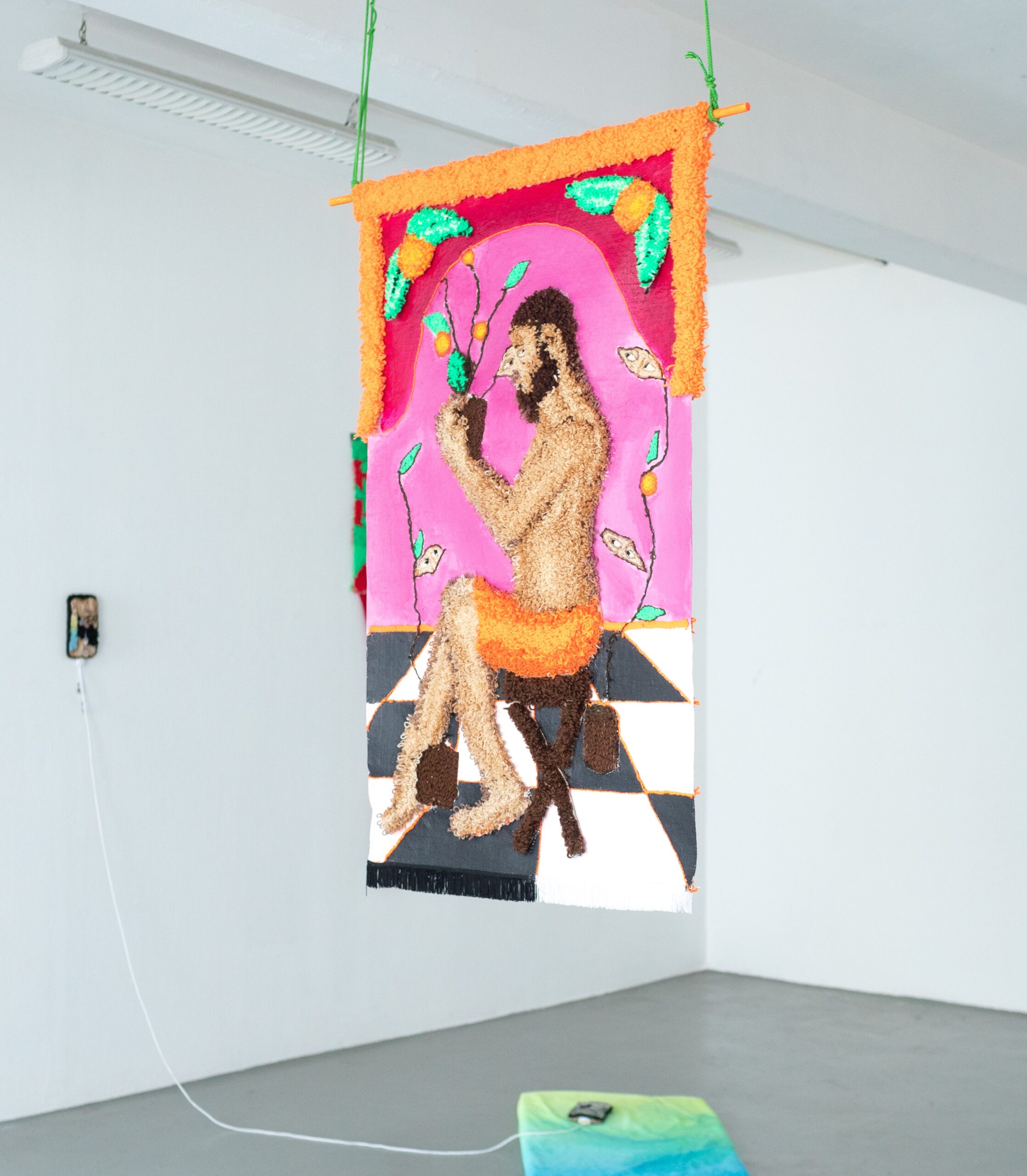
Suspension also names his technique. Habki works between drawing, painting, and embroidery, using stitch not as decoration but as a way of pulling bodies forward in space. “Technically, I often embroider the protagonists to bring them into the foreground. Then I paint behind them,” he explains. “It started with a desire of mine at university to give relief to my drawings, and embroidery became the way. I have a strong attachment to pictorial composition.”
He learned the technique alone. At first he tried a tufting gun, but abandoned it. “The gesture was too violent, too automatic. I didn’t like the distance between the canvas and my fingers. It felt too industrial,” he says. He chose a punch needle, even though “it takes longer”. He began with thick needles on jute canvas, then moved to finer needles and applied the method to unconventional supports such as football nets, boxing shorts, lace. In the “laboratory context” of his school, he says, nobody told him he was breaking rules. That freedom mattered, but it also meant that technical knowledge arrived through time, failure, and repair.
If his technique is rooted in touch, his visual language is rooted in things that can be held: objects, patterns, domestic fragments. We both reminisce about our rich grandparents’ interiors, the Berber carpets at his grand aunt’s, the embroidered Palestinian cushions at my teta’s. “I am a third-generation immigrant,” he says. His father arrived in France at six months old; his mother was born there. “My parents did not transmit the [Arabic] language. My way of feeling these conversations included the objects and setting around me, in a sensorial connection.”
That sensorial closeness later becomes research. “I wanted to understand my identity: what is North African, what isn’t, why Arab, how one is Arab,” he says, adding that his mother is also Yemeni. He describes learning to recognise specific schools of embroidery, Tangier, Rabat, Fez, through library visits, conferences, and trips to museums such as the V&A in London, and through conversations with diasporic friends. He calls it “reappropriation”: a way to take what was present as atmosphere and make it legible as knowledge, without turning it into a rigid origin story.
Habki’s images often arrive as pairs. Sometimes the figures come as duos; sometimes the composition folds into symmetry; sometimes motifs repeat like tiles. Asked about this, he returns to the logic of pattern itself. “Symmetry is the origin of motifs,” he says. “Two elements, then four, then repetition forms mosaics, landscapes.” For him, the duo is not only a romantic structure. It is a way of speaking about “impossible relationships, prevented identities” and about absence: “missing bodies… an aesthetic of lack.” The two figures complement each other without binarity, inventing a new grammar for closeness.
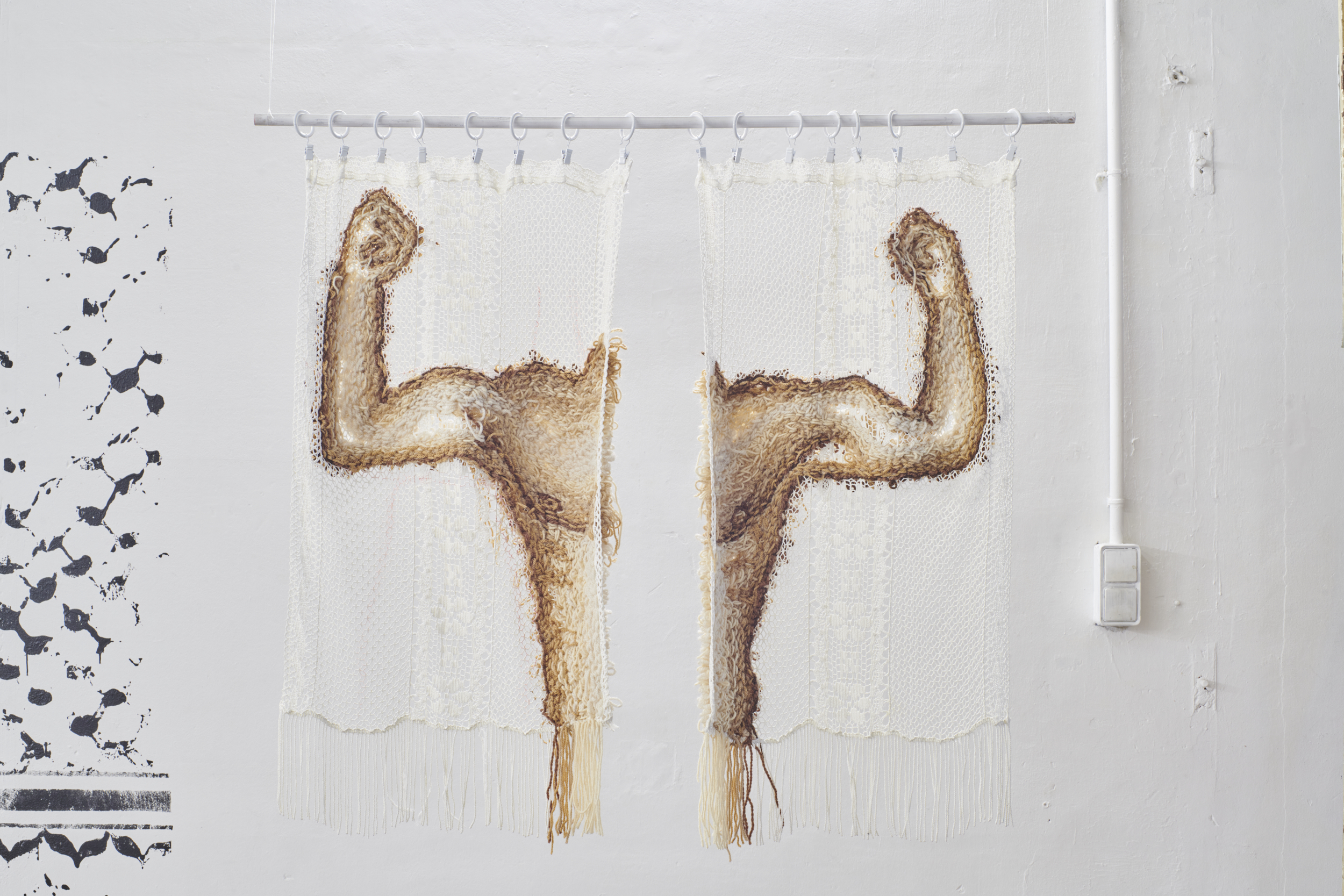
Ornament becomes another way of thinking about bodies without reducing them. “Floral motifs resemble bodies,” he says. He is drawn to the grotesque, proto-surreal, punk, historically treated as decorative rather than central. He also asks a question that lands as both playful and serious: “Is the human body not ornamented too?”
His references, like many of us today, are without hierarchy. He moves from ornament to punk, from Renaissance to memes, without apology. Habki is working on a piece where a man’s chest hair becomes ornament, shaved into patterns. Habitat, he says, is an extension of the body; arches resemble anatomy. He mentions the Beauty and the Beast, the moment when objects become human, as a way to think about how forms shift between categories.
Disneyland, in his telling, is a lesson in proportion.“The castle, you feel it’s huge, but you reach the top and your body doesn’t even fit. It creates realism and fiction.” He wants to work with this scale shift: metro bars rendered smaller; giant books, bodies held by structures that complicate how we measure ourselves against the world.
Near the end of our call, I ask what he has been ‘scrolling’ through recently. His answer is disarmingly specific: “Bromance pages. Two scouts listening to a Britney Spears soundtrack.” Habki’s practice is built from these very small fragments. Please mind the gap is, finally, not only a warning. In Habki’s hands it becomes an invitation to listen harder to what is repeated until it disappears into background noise, and to notice the tenderness within us all.


