
News


Although humans have possessed the capacity for spoken language for more than 130,000 years, writing arrived much later, emerging only after the invention of pottery. The first written words were found etched into clay tablets by Sumerian scribes around 3500–3200 BCE in the ancient city of Uruk, in Mesopotamia—what is now Warka, Iraq. From these early markings, symbols gradually evolved into cuneiform, a logosyllabic script that marked the beginning of written communication. How lucky we are that these ancient systems of language unfolded as they did, offering us the means to communicate, to reach into one another’s inner worlds—across time, across the corporeal, and even across lives long past. Language is the tether that affirms our realities, binding us across histories, cosmologies, and ecologies. It is also what situates us, precisely and fleetingly, within place and time.
At Ishara Art Foundation’s current exhibition Urdu Worlds, curated by Hammad Nasar, we are invited to step into the works of legendary printmaker Zarina’s body of work and two decades of artist Ali Kazim’s practice. Urdu Worlds explores how language becomes the very tool through which we construct and inhabit our internal worlds, while raising the question of how one might inhabit or co-habit a sense of ‘place’ without borders, without boundaries, without the imposition of limits on the imaginary. The exhibition spans three galleries across two floors—Shared Places, Jugaar—and ends with a Reading Room on the second floor.
Urdu was born in 1027; its birthplace was Lahore, its lineage tracing back to Old Punjabi, with Old Khari Boli as its step-parent tongue. Zarina (who preferred her given name) often described herself as an ‘Urdu artist.’ She felt she was ‘too Muslim for the US and India, and too Indian for Pakistan’. In Urdu Worlds, Zarina and Ali Kazim meet and part across borders, destinations, through conduits of faith and devotion. The Urdu language emerges as a connective tissue between her and Kazim, the ‘island’, a beating pulse of light in a sea of Kazim’s work, as described by Nasar.
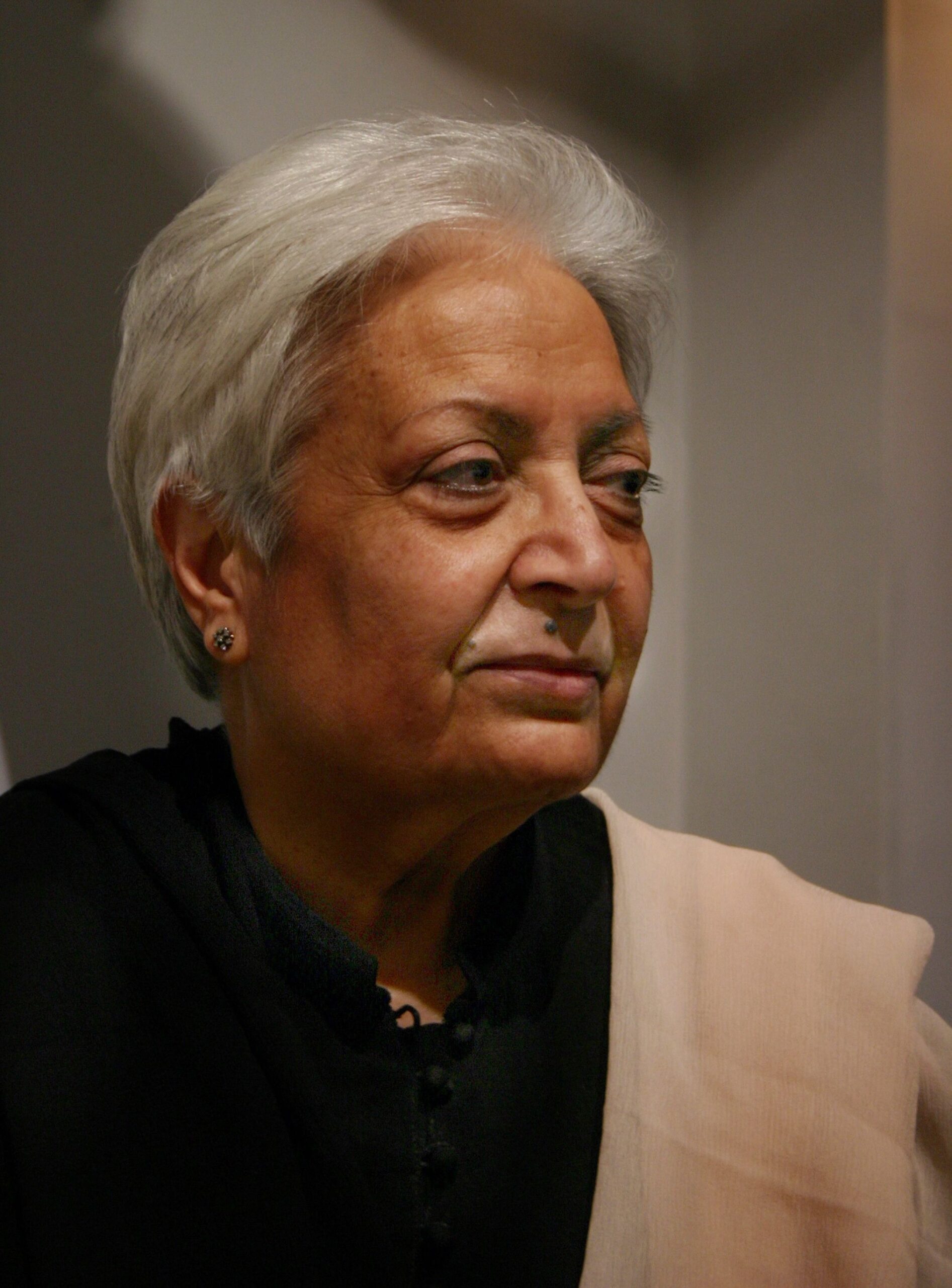
Zarina was born in 1937 in pre-Partition India, in the town of Aligarh, the youngest of four children, raised in a home filled with books and flowers—an environment shaped by her father, a history professor, and her mother, and one that she returned to in her work often with fondness and grief. In the late 1950s, her family moved to Pakistan. By then, Zarina had completed a degree in mathematics and married Saad Hashmi, a diplomat, whose postings took her across Bangkok, Paris, and Bonn. A polyglot, she continued to move across countries before eventually settling in New York in 1976, producing much of her work in a place where the Urdu script often went unrecognised.
Zarina’s oeuvre was often described as ‘minimalistic’. One could not be more wrong. Western education finds familiarity in attempting to assimilate through resemblance, always privileging what is known to them rather than seeking to learn, to look beyond the confines of a language deemed ‘foreign’. Zarina’s work is a journey through space and time; whichever tongue you speak, her images strike a chord in all, especially in those of us displaced from our homelands.
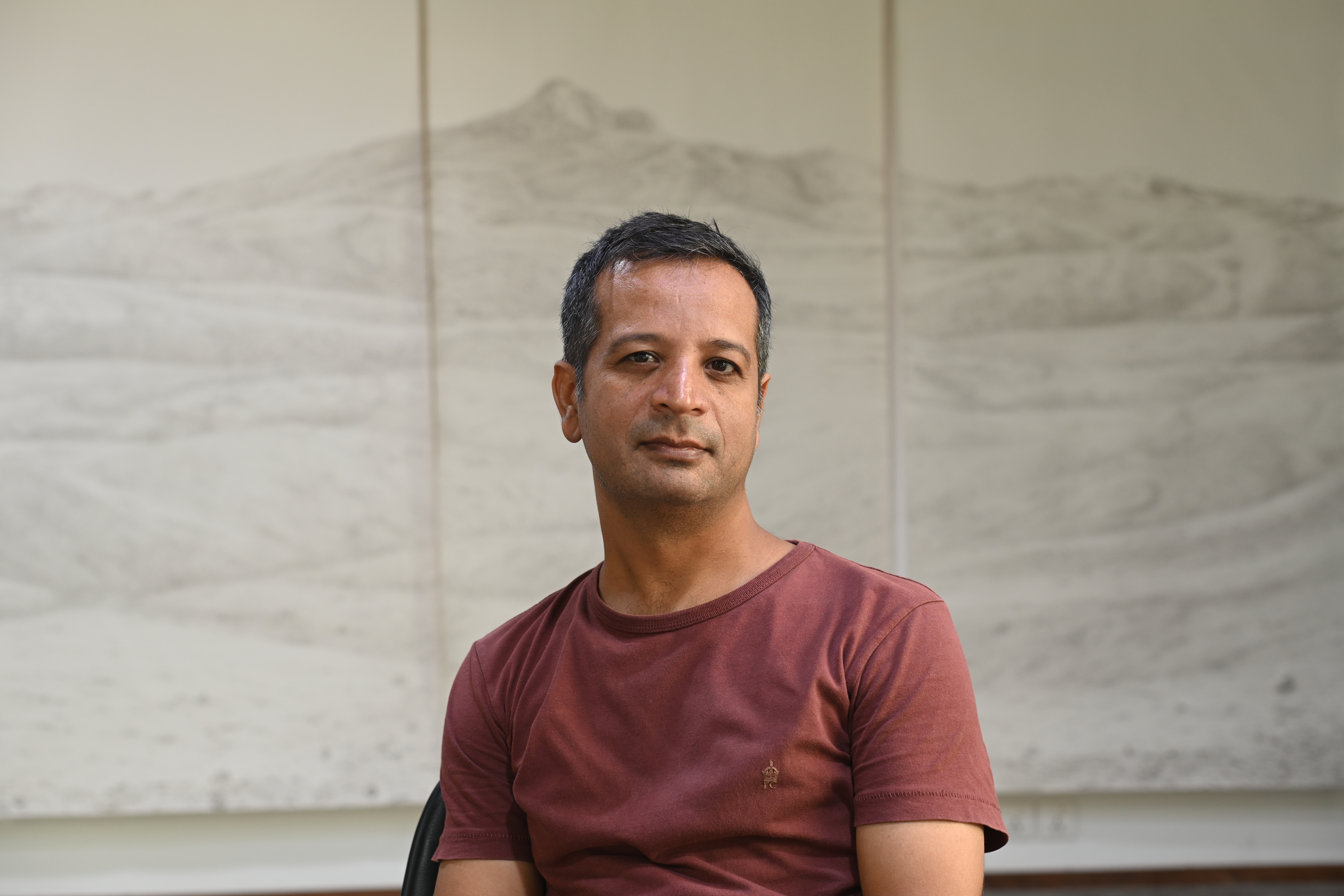
In contrast, Ali Kazim was born in post-Partition Pakistan, in his ancestral village of Pattoki. He later moved to Lahore for his undergraduate studies and now calls the city his home. Kazim resists containment; his practice, much like his subjects, moves fluidly across mediums, forms, and techniques. Seventy-seven of his works are presented in this exhibition, ranging from large-scale paintings to intimate portrait series, from video installations to pottery, and even sculptural installations formed using hair and hairspray. Together, their works do not merely sit on the walls; they engage in conversation with one another, inviting the viewer into their rich inner worlds.
As one walks into the space, located in the warehouses of Al Quoz, “Tteela” (2025) is what initially catches the eye. Stretching across four large-scale panels, the watercolour on paper immediately situates us within a time and place distinctly South Asian. Kazim’s ancestral village, Pattoki, sits near the ruins of the Harappan civilisation. An almost mythical landscape, one you might accidentally walk into. Imaginary mounds are depicted, rising like echoes of a forgotten topography, while terracotta shards lie scattered among the ruins of a civilisation and a people long gone. All that remains are their creations, their pottery.
“I was curious about the past and tried to make sense of the remnants of the pottery shards I encountered during my visits to the ruins. I found myself drawn to constructing a narrative, a collective portrait of the people who might have once lived there. I wasn’t really interested in the landscape itself; I was more interested in the people. In a way, I jumped into the past, reflecting on what existed before Partition and what we lost after it,” Ali Kazim shared with ICON MENA.
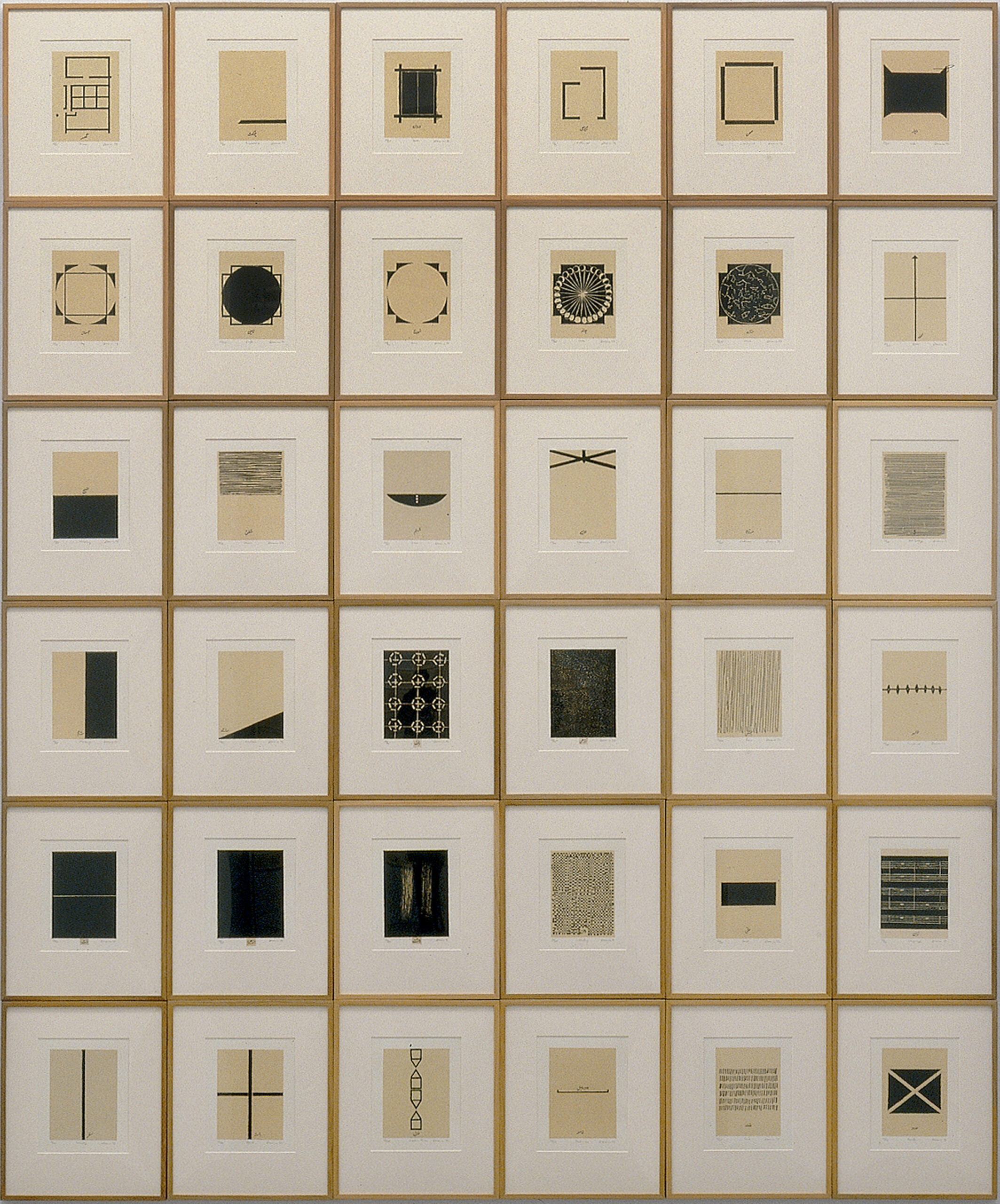
On the other hand, much of Zarina’s work situates her world-making distinctly within the Urdu script. “Home is a Foreign Place”(1999), consisting of thirty-six woodcuts, which Nasar described in his curatorial essay as the ‘most expansive articulation of her Urdu worlds’. Zarina guides us into what meaning we might each possibly make with language. Each print pairs a spare, almost abstract form with a single Urdu word, forming something like a personal lexicon of home—moving between the concrete and the celestial, from the architecture of ‘Door,’ ‘Wall,’ ‘Entrance,’ to the atmosphere of ‘Rain,’ ‘Dust,’ and ‘Hot Breeze,’ and further still into states of feeling like ‘Silence’ and ‘Despair,’ or the political themes that were much imbued in her life of ‘Border’, Language’, and ‘Nation’. Depending on who is reading, the meanings of these words fluctuate in feeling. The opening folio presents a floor plan labelled ghar—a word that holds within it both ‘house’ and ‘home.’ Conscious of this slippage, Zarina leans into the latter; the diagram returns us to her childhood home in Aligarh, a space she often revisits fondly in her work.
Zarina often combined text and image in her practice, noting that the words came first, followed by the image. The words become memory triggers, each carrying the weight of something lived and something lost. The home she returns to through language is no longer entirely hers; in many ways, it has become foreign. Yet it is precisely through language that she can return to it at all. For Zarina, home was Urdu. “Urdu is home,” she famously declared, while also acknowledging that home need not be fixed or permanent. “It is an idea we carry with us wherever we go. We are our homes.”
Moving on, Urdu Worlds is not just the curatorial framework that binds the inter-generational artists’ works together, but is also viscerally present in the works being produced, not only across Zarina’s life, but across the span of this exhibition. Ali Kazim’s Urdu Qaida (2026), developed in collaboration over several years with curator Hammad Nasar and published by Ochre Books, launched in the UAE on 17 May.
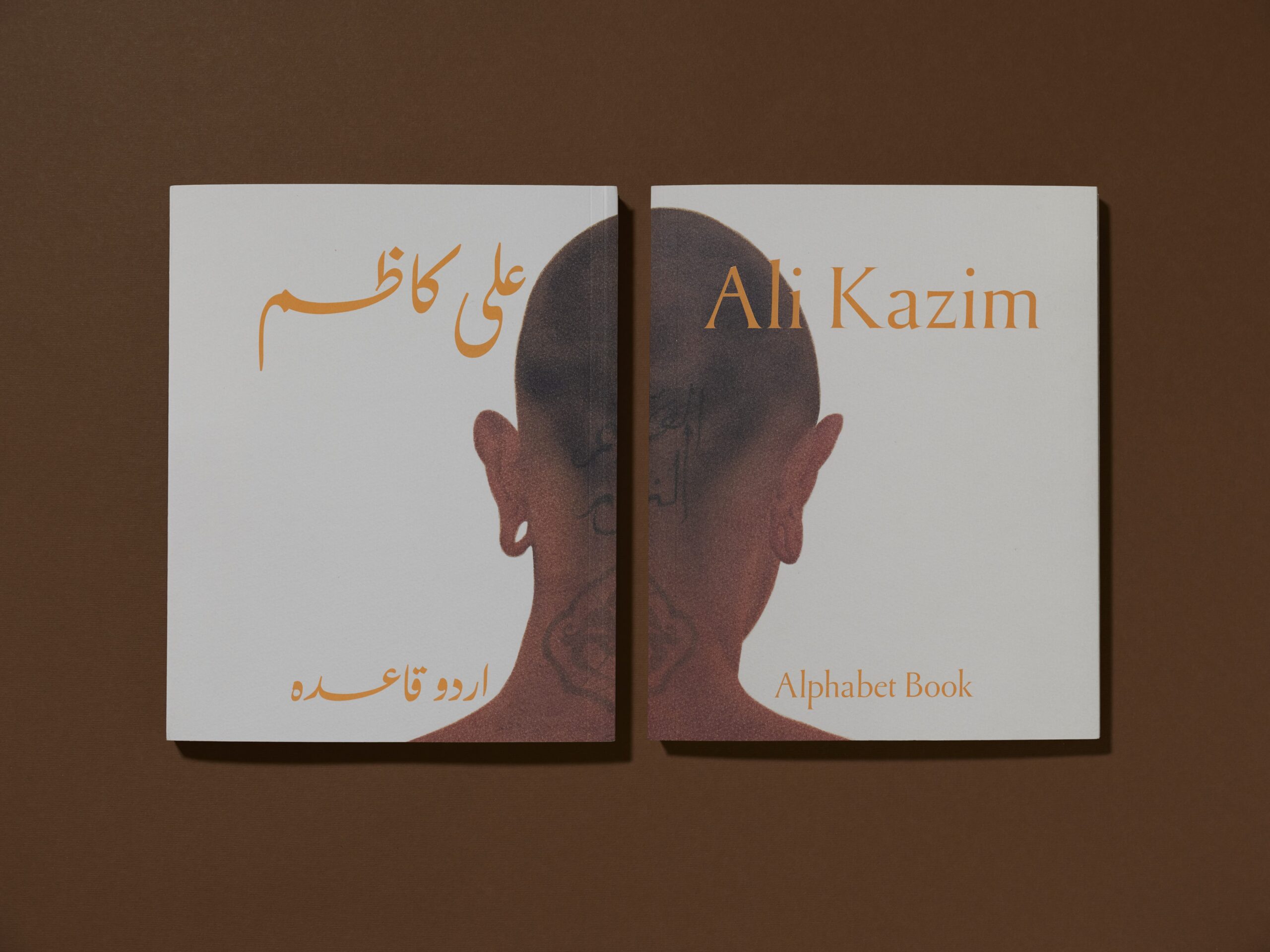
Nasar has voiced his frustrations with the commercially available Qaidas, finding them to be a lacklustre introduction to the Urdu language. Qaidas essentially serve as foundational textbooks used to teach the Urdu alphabet, pronunciation, and basic vocabulary to beginners and children, often sitting quietly in the schoolbags of millions across the subcontinent and its diaspora. Kazim’s book reimagines this familiar form, providing an alternative introduction to the language, opening up the Urdu alphabet for both English and Urdu readers alike.
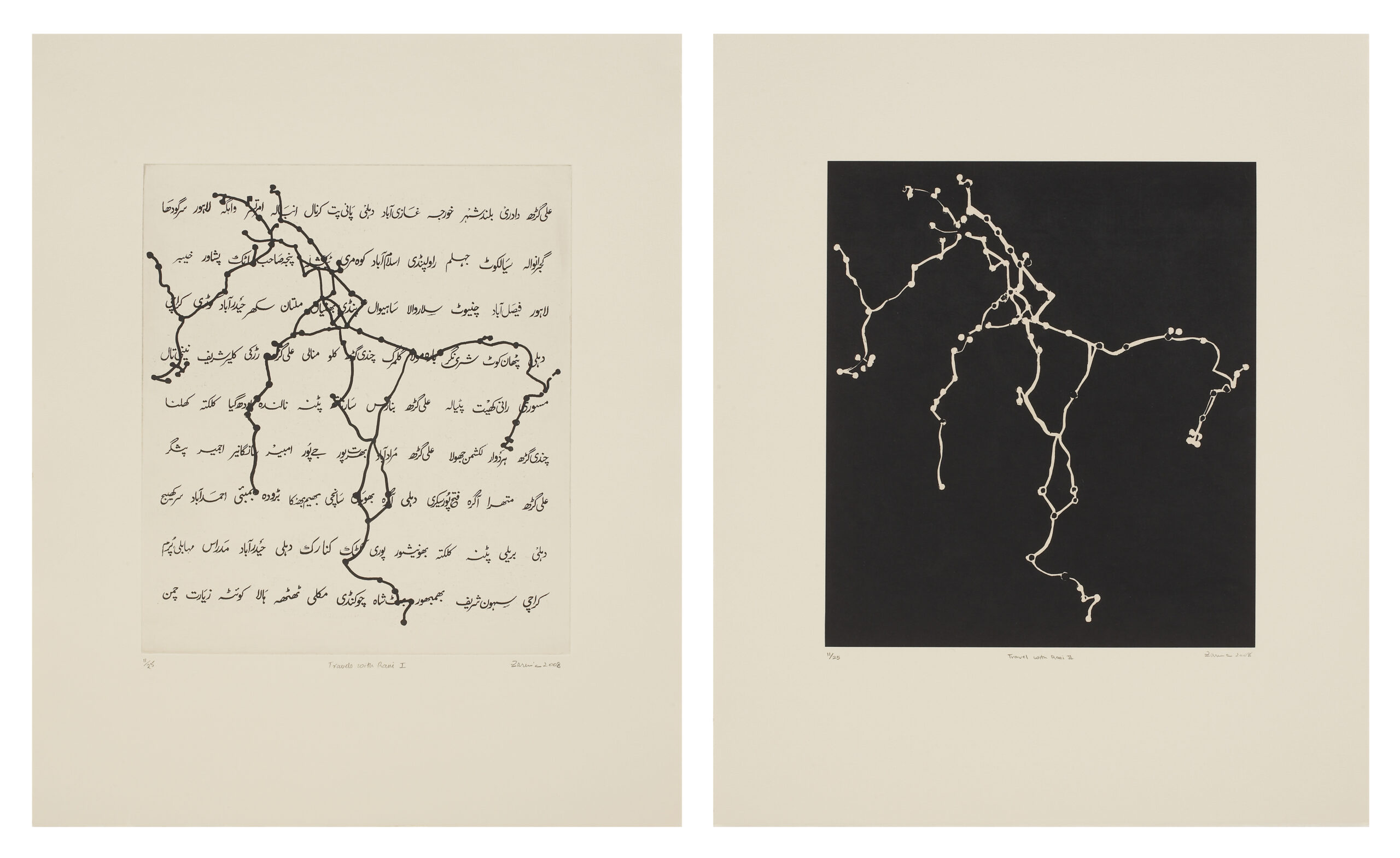
Zarina’s Urdu bazaar-bound book, Urdu Kay Aik So Aik Mahavray (1991), often gifted to parents raising children in the diaspora, including Hammad Nasar, would go on to directly inspire the Urdu Qaida. A collaboration with her sister Rani, who lived in Karachi while Zarina travelled globally, the book brings together one hundred and one Urdu proverbs compiled by Rani and punctuated by ten delicate woodcuts by Zarina that act as visual abstractions of these sayings. Inscribed within the book is Rani’s dedication: “For my grandchildren, so their connection to the Urdu language is maintained.” Rani remains a prominent presence throughout Zarina’s work, appearing again in “Travels With Rani” (2008), a diptych of imagined, abstracted railway maps tracing journeys across the subcontinent that the two sisters once took together.
Kazim’s work lines the walls of the space while Zarina’s is the beating pulse of the exhibition. Urdu Kay Aik So Aik Mahavray (1991) lies next to the Urdu Qaida (2026) enclosed in a glass display. “Travels with Rani” (2008) faces “Home is a foreign place” (1999). “Tteela” (2025) situates you in imagining a portrait of a time long gone in South Asian history, while “Travels with Rani” (2008) helps further create an abstraction of an imaginary map, tracing Zarina’s journey with her sister across Aligarh, Delhi, Karachi. In the woodcut, the shape of the subcontinent can be faintly discerned, as the sisters’ journeys extend from Aligarh in the north to the southern reaches of the country. Zarina based the woodcut on a map of Indian railways, tracing the design onto a woodblock in reverse, carving it by hand, and then printing it in etching ink. The cities read like stops on a railway line that exceeds political borders.
Within the island’s inner walls, one encounters “Santa Cruz” (1996) by Zarina, a portfolio of etchings produced during her years teaching printmaking at the University of California, Santa Cruz. Bearing a misra by Faiz Ahmed Faiz, each print is divided in half by a line implying a horizon. In the final work, the horizon is created by a single line of text in Urdu.
کئی بار اس کا دامن بھر دیا حسن دو عالم سے
مگر دل ہے کہ اس کی خانہ ویرانی نہیں جاتی
‘Many a time I filled its lap with the beauty of both worlds,
But such is my heart that its desolation never goes away.’
Zarina often incorporated poetry from Faiz, Mirza Ghalib, and Muhammad Iqbal in her work, while Kazim drew inspiration from the writings of Naiyer Masud, Gopi Chand Narang and Muneer Niazi. “Hudhud” (Conference of the Birds) (2022), for example, draws on the figure of the hoopoe—the guiding bird in Conference of the Birds by Farid ud-Din Attar—who leads the birds of the world toward self-discovery and enlightenment, urging them to confront and move beyond their own human frailties.
The piece began as an installation at the Lahore Biennale 2020, where Ali Kazim created 3,000 clay birds, all sun-dried rather than fired. Installed outdoors, they slowly dissolved in the rain. “Only thirty birds reach the last destination. But when they started the journey, there were thousands of birds of all kinds that took flight together. What happened with the rest of the flock? Many died on their way. I made around 4000 clay birds and placed them in an abandoned brick factory for a couple of weeks. So after a few days, those birds melted back into the soil. I wanted to acknowledge those who never reached the final destination.” Kazim is asking us to remember everyone, including those we lose on our journey, those who do not make it to the end.
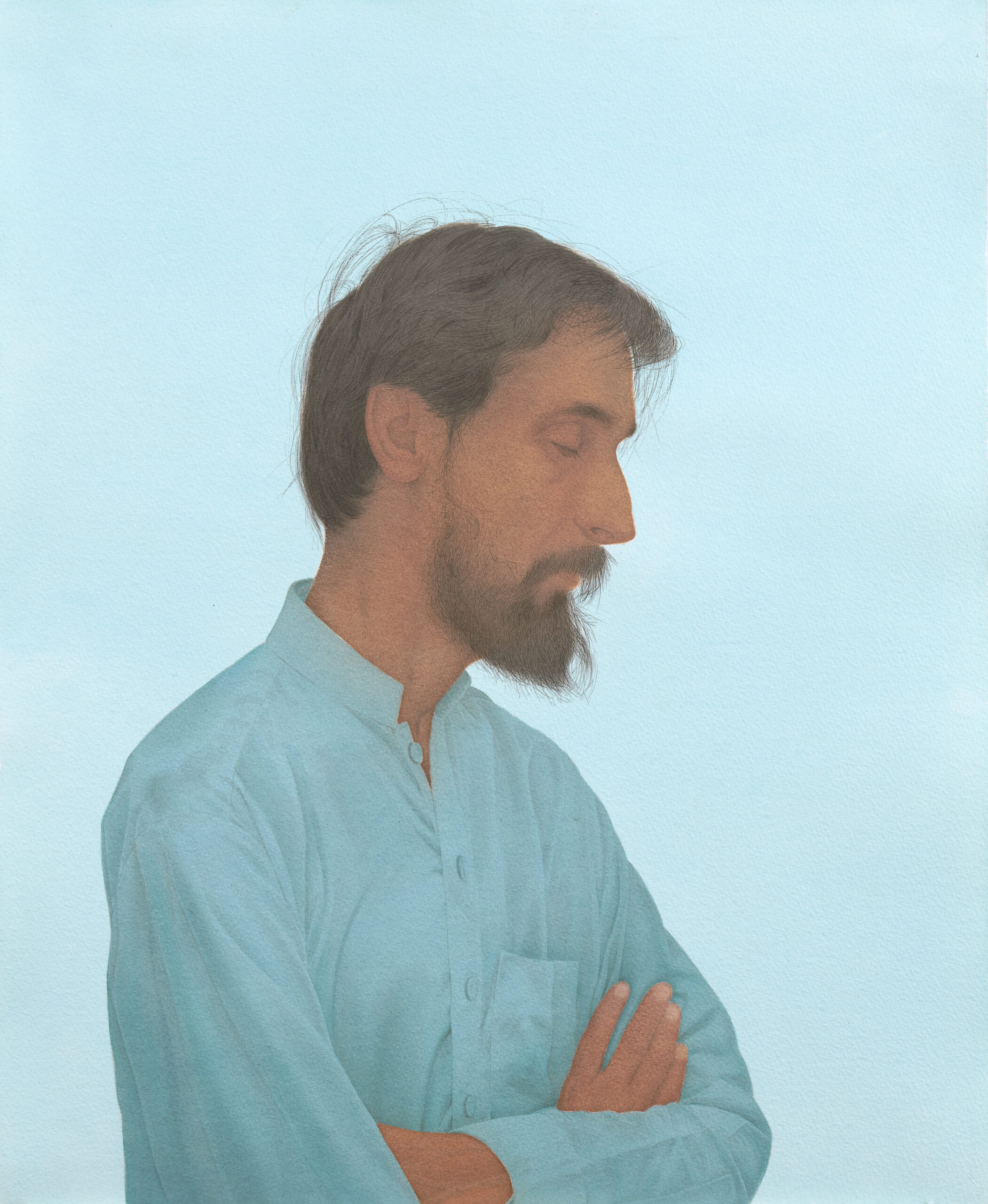
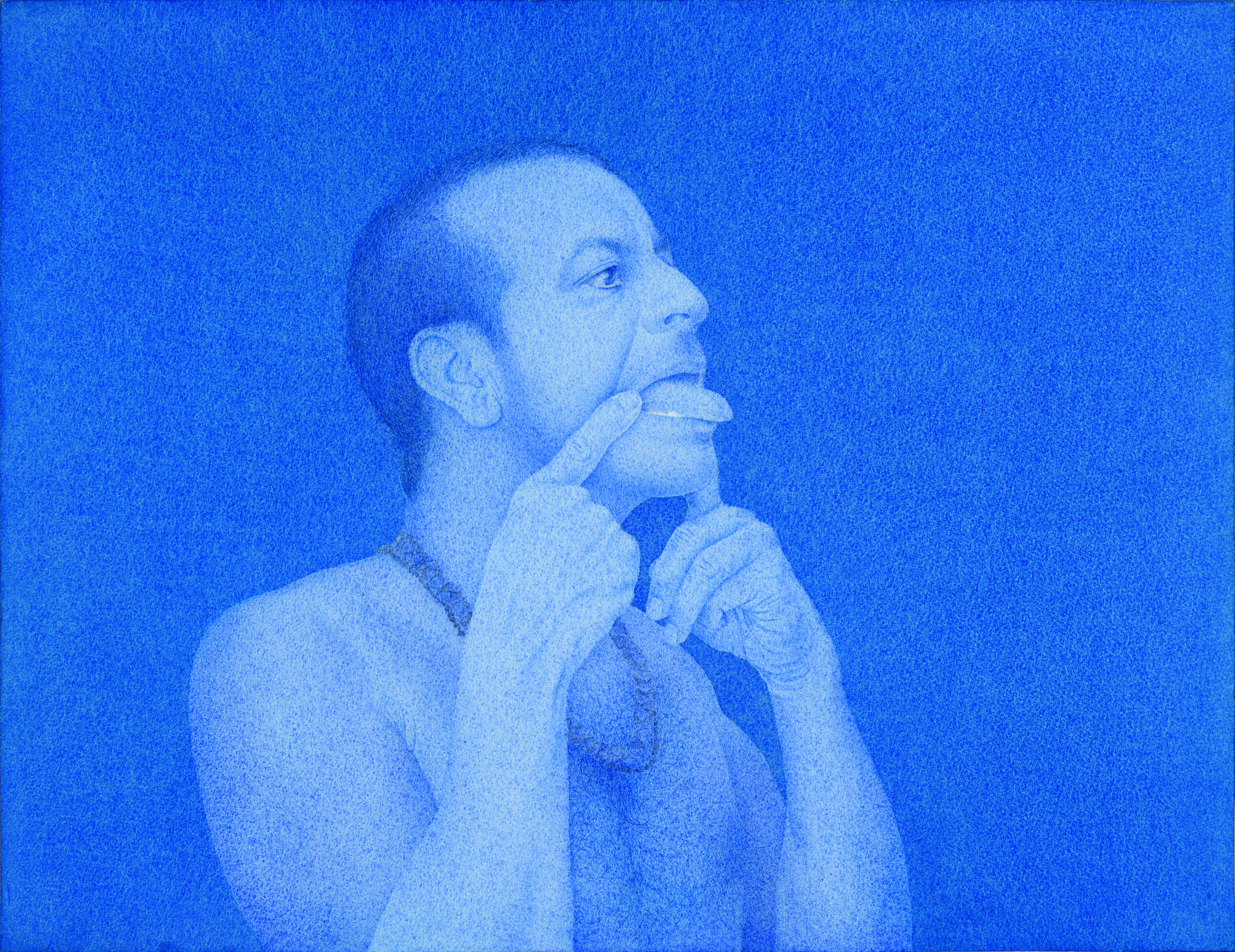
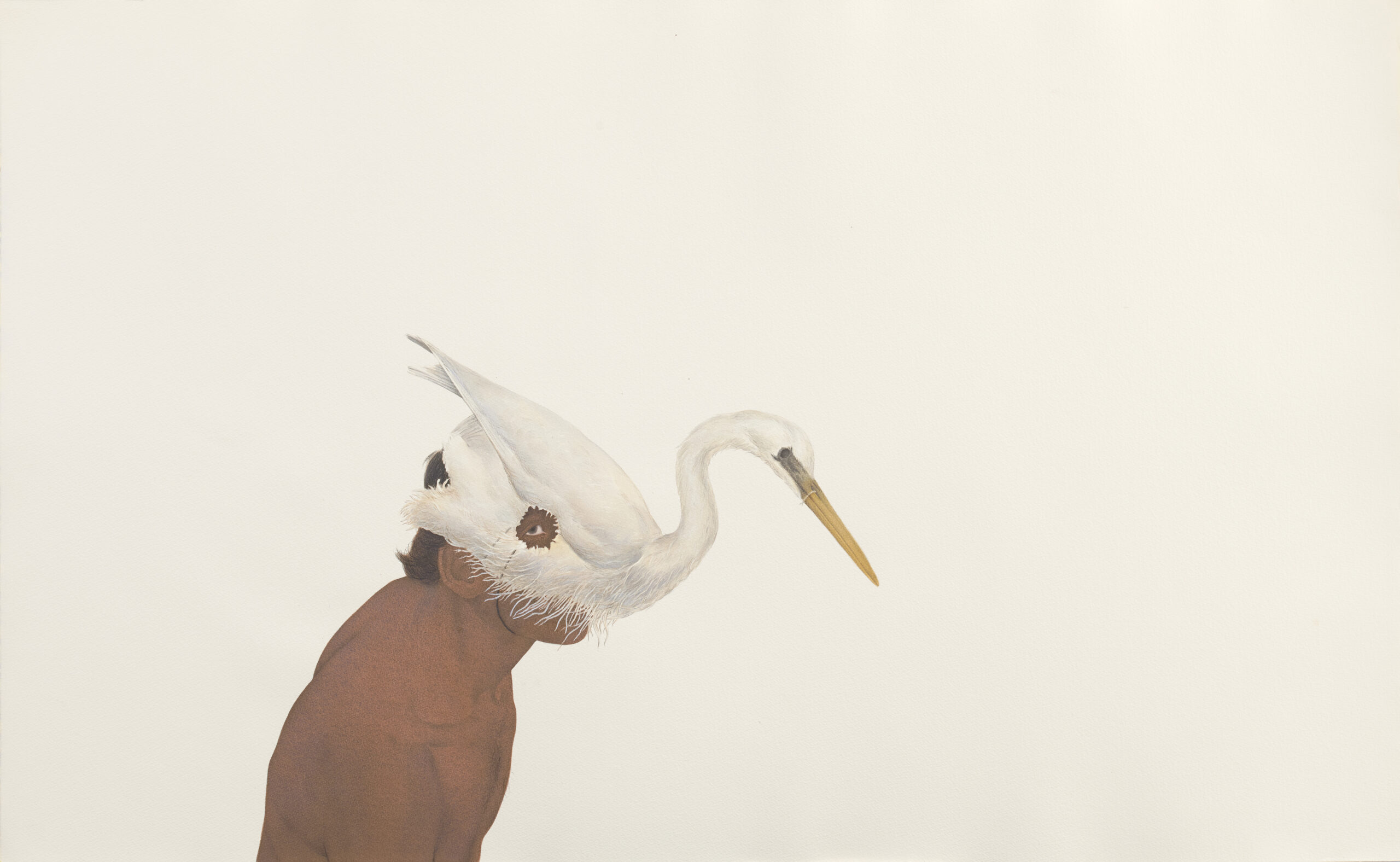
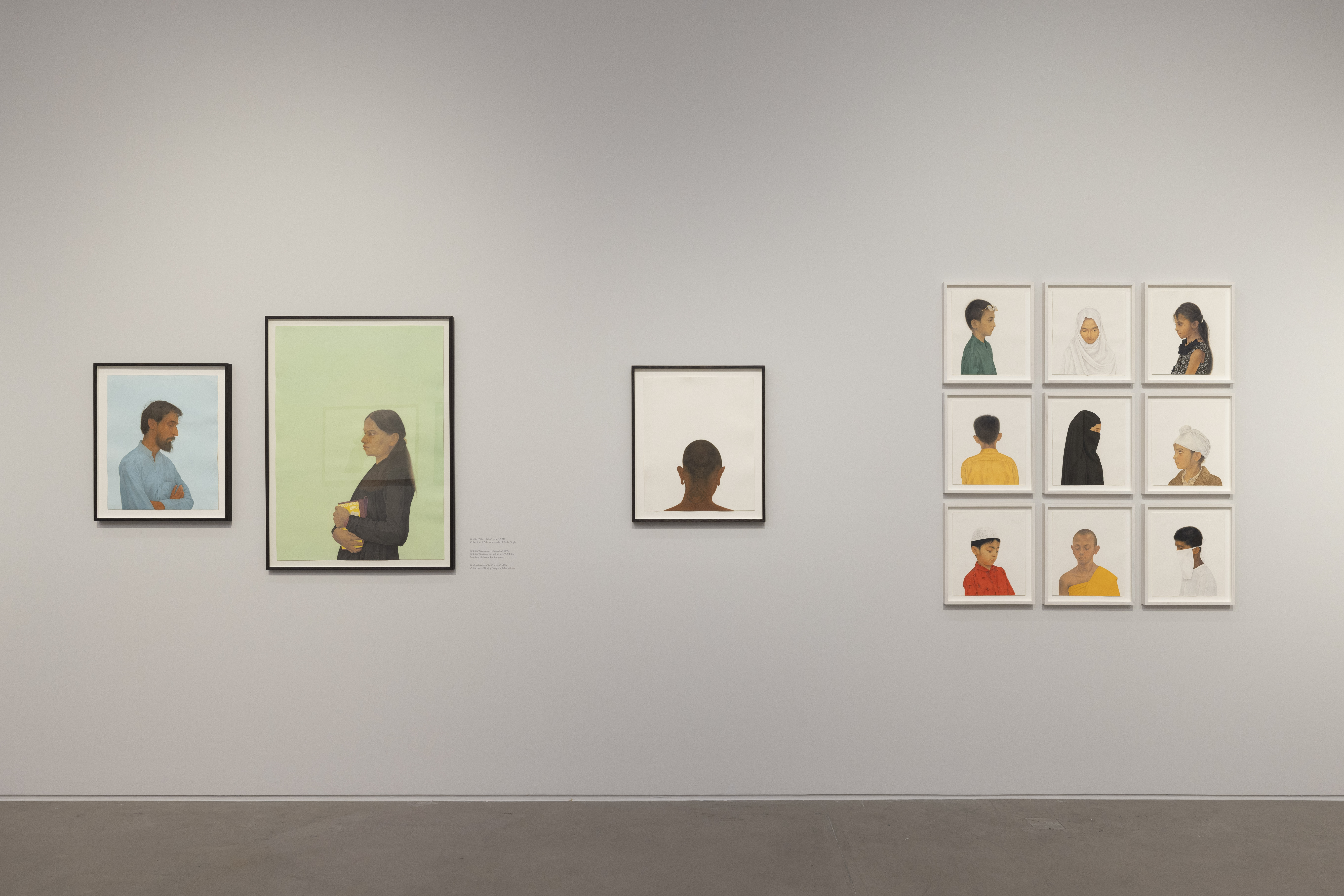
Much of Kazim’s work explores faith, devotion, and ritual through acts of worship as conduits of the body. In the “Untitled” (Man of Faith series) (2019) and “Untitled” (Children of Faith series) (2024–2025), the portraits appear in close-up fragments of figures, often cropped at the torso, their bodies angled away from the viewer. They never return our gaze. It feels as though one has stumbled into a private, almost imperceptible moment of devotion, a scene so quiet it could be missed in the blink of an eye. These are not moments staged for observation, but gestures of faith between the self and belief. Kazim renders them in watercolour with an extraordinary delicacy, without intruding into the interiority of his subjects. The surfaces invite close looking, where skin, texture, and detail become visible in high intimacy, yet no eye contact is ever made. The ritual remains withheld. These moments of worship belong only to the figures themselves; they are not ours to enter, only to witness at a distance.
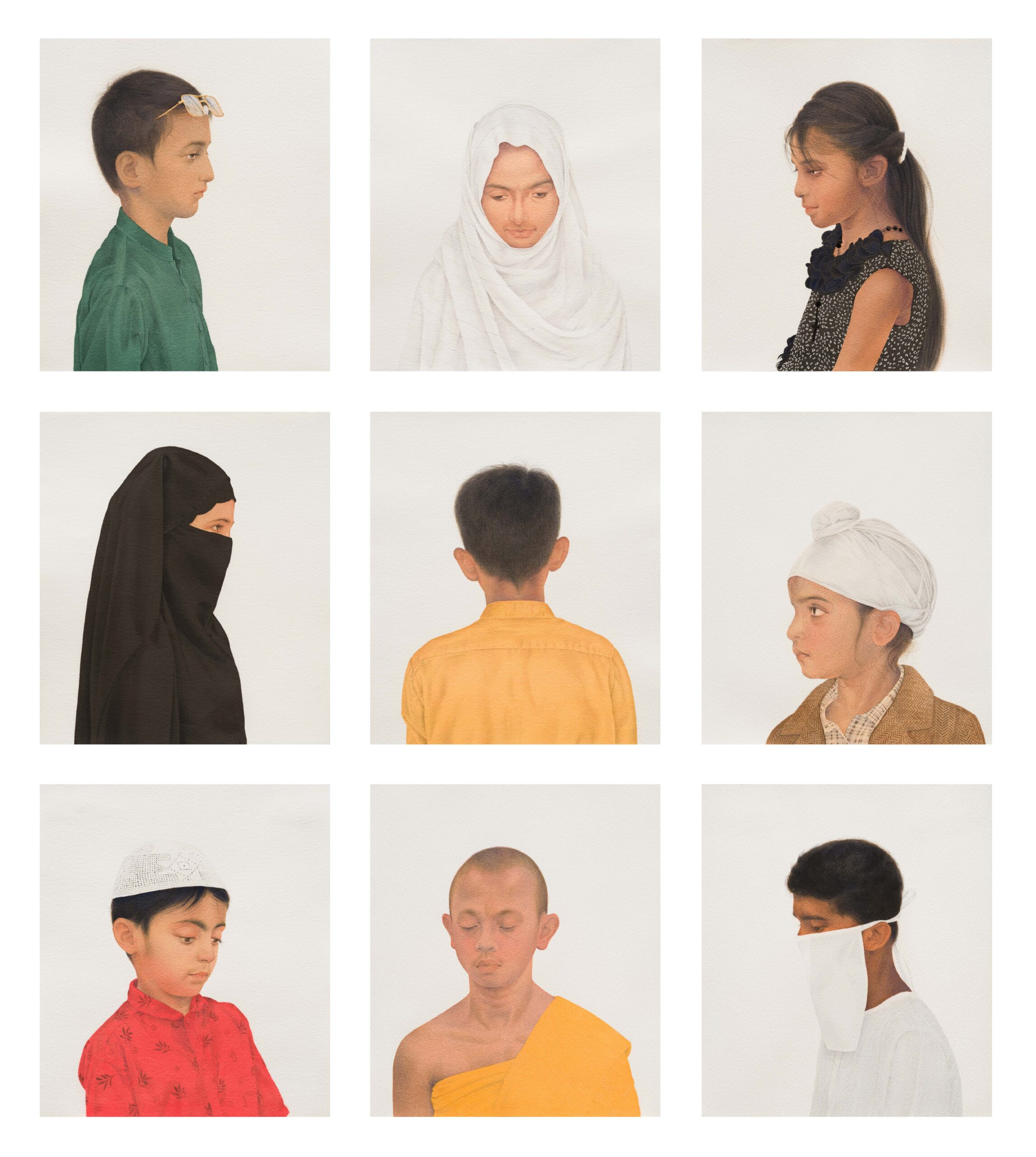
At the same time, Ali Kazim subtly positions these figures through markers of religious identity, particularly through dress. In “Untitled” (Children of Faith series) (2024–2025), these portraits are stripped of context, drawing attention to how belief begins to shape outward appearance from childhood, and how identity becomes legible through the gaze of others. Reflecting on this, Kazim recalls encountering a student at National College of Art Lahore, where he teaches, carrying a translation of the Bible in her hands: ‘We don’t teach any religious books, so it was surprising. The idea of trying to hold onto your identity through your dressing. When children are growing up, they are often dressed in accordance with their religious beliefs.’ In states where one group is in the majority, discrimination against minorities is often enacted at every level across the personal, public, and bureaucratic registers; the simple act of holding on to one’s beliefs becomes, in itself, a site of resistance.
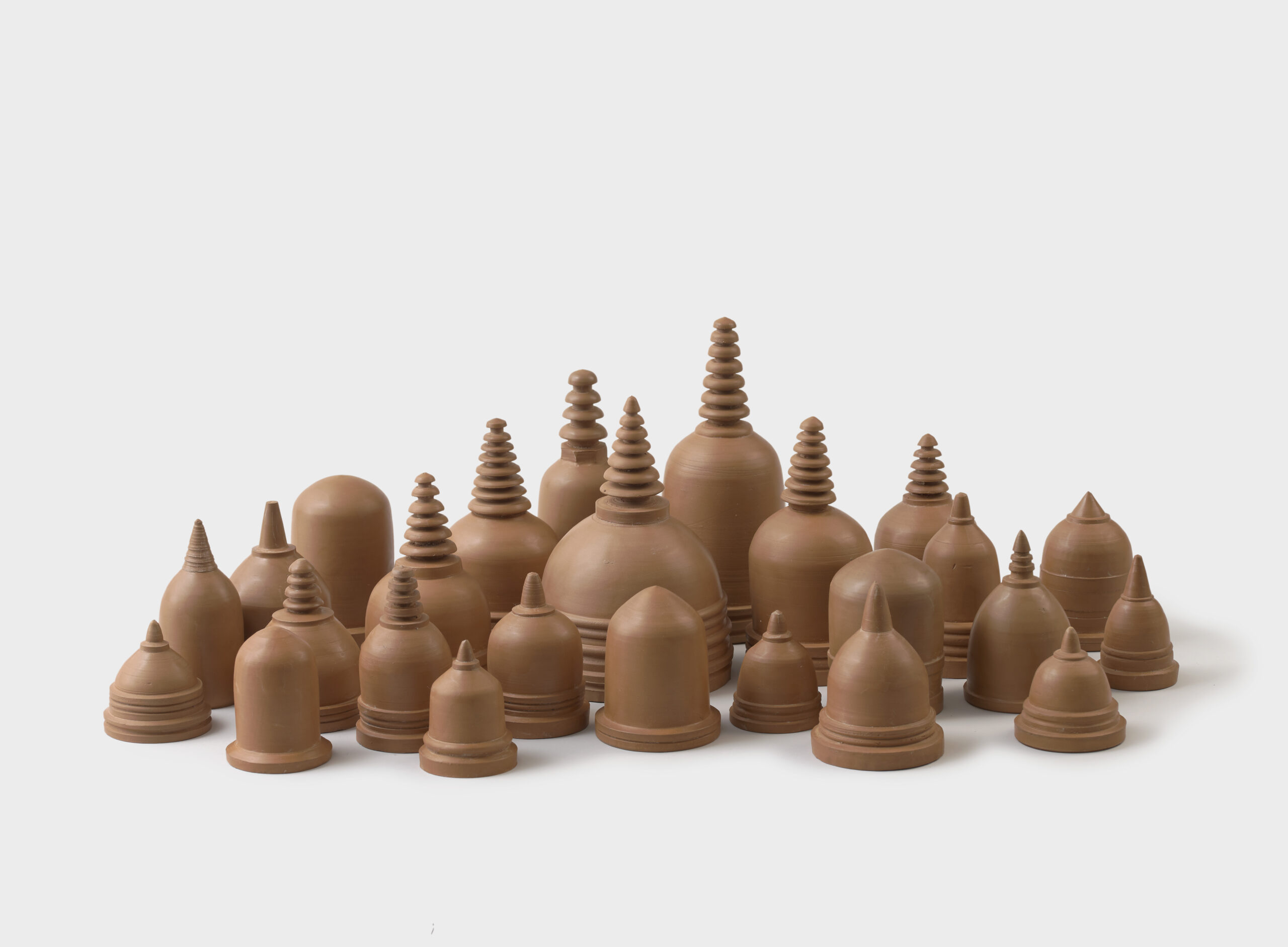
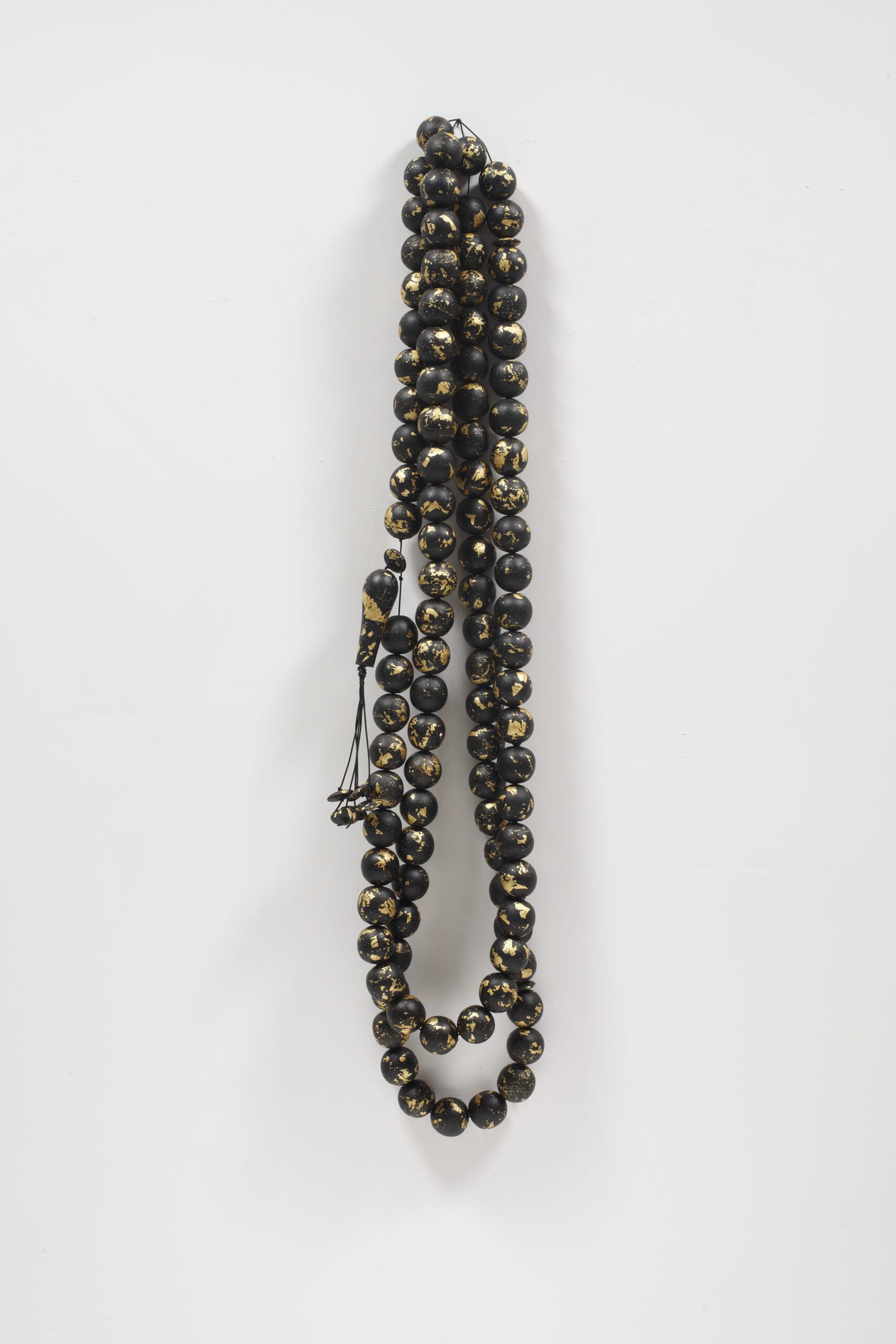
Furthermore, Kazim’s “Ghusal” (2011) reflects his own process of making. As he describes it, “I am washing my self-portrait with my own hand by removing excessive black pigment from the surface,” a gesture that mirrors the wash technique used in his paintings. Accompanying Kazim’s “Ghusal” (2011) hangs Zarina’s “Tasbih” (2011), maplewood stained with sumi ink, covered with specks of 22-carat gold leaf and strung with oxidised steel wire. The tasbih becomes a conduit for devotion, where one recites acts of worship ritualistically, beginning anew with each bead, marking a sacred exchange between the body and belief. Beneath the large-scale tasbih, Kazim’s “Untitled” (Votive Objects) (2022), terracotta forms inhabit the space. Each creation feels reminiscent of the same sacred cycle, where one begins again each time a word of worship leaves the breath. Akin to ghusl, where the body is washed of dirt and returned to a state of purity, each form gestures toward a quiet form of rebirth.
The terracotta forms begin to echo the pottery shards uncovered after monsoon rains at the Indus Valley ruins, where all that remains of a people is their creation. In the same way, the residue of painting, the fragments of ritual, the stillness that follows acts of devotion, begin to take on a similar weight. These works move away from the spectacle of worship and instead sit with its afterlife, the trace, the imprint, the repetition. Across both practices, devotion and creation collapse into one another. A grand act, whether of worship or making, leaves behind something quieter, a fragment, a surface, a mark. What remains is not the act itself, but its residue.
Gallery Two, titled Jugaar, centres on the improvisational ingenuity embedded in daily South Asian life. Drawing from across traditions—East Asian wash techniques, South Asian miniature painting, and European etching. Kazim resists fixed categorisation, slipping in and out of drawing, painting, printmaking, and sculpture. Most notably, a site-specific installation composed of discarded hair collected from salons, rolled into sheets, bound with hairspray, and suspended by a near-invisible thread. Kazim explains: “In all religions, there is something to do with hair. Whether when Muslims go to Mecca to perform Hajj, they have to shave or cut their hair, or Hindus go to the Ganga for holy baths, they wash their hair. In Orthodox Jewish traditions, when women get married, they cover their heads with wigs. If we go further back, especially in Europe, lovers used to exchange jewellery made of human hair. That was the most physical part of someone that one could carry while travelling. In Kashmir, for example, there is a dargah associated with the Prophet’s hair. I became addicted to hair as a material. I wanted to make it very lightweight, a sculpture in space. I was more interested in creating organic forms. To me, it resembles some sort of internal body structure.” Whether it is a curatorial coincidence or by religious association, the sculpture ultimately resembles the fluidity and curvature of the Urdu script.
The Reading Room on the second floor offers perhaps the final, and most intimate, way of entering Ali Kazim and Zarina’s Urdu worlds. Grounding the exhibition within literature, the space brings together books by and about both artists alongside texts in English and Urdu that have informed and shaped their thinking. Together, Zarina and Kazim beckon us into their Urdu worlds, inviting us to imagine alternative ways of gathering across time and space. As James Baldwin once wrote, “Literature is indispensable to the world,” while Toni Morrison reminds us, “We die. That may be the meaning of life. But we do language. That may be the measure of our lives.” In Reading with Zarina, a text composed of exchanges between Zarina and her studio manager, Sarah Burney, where the two discuss books and exchange recommendations, Zarina asks Sarah not to translate certain Urdu passages into English, telling her simply, “No, they can Google it.” Urdu, here, repositions itself within her pictorial lexicon without translation, refusing the need to constantly make itself legible to others. Zarina’s island gives way to Ali Kazim’s sea. The boundaries of our home become the boundaries of our sea. As Ludwig Wittgenstein famously observed, “The limits of my language mean the limits of my world.” Or, as Ingeborg Bachmann writes, ‘Keine neue Welt ohne neue Sprache,’ no new world without a new language.


