
News


The first international family vacation I went on was to Lebanon. I was a teenager and went with my parents. We ate our way through the country. What I remember most viscerally is being overwhelmed not just by the food, which was extraordinary in a way that bore no comparison to Lebanese restaurants I had tried elsewhere, but by the hospitality. The generosity felt almost insistent, as though feeding you is a form of argument, but also felt intimate and genuine.
Ordering at a restaurant, the waiters would take liberty telling us at length about the history of the food, sharing meals with family and friends who would insist on crafting me the perfect bite and feeding me from their hands, restaurant managers would fill the table with fruit on the house after we were done with our meals, and so much more. But underneath all of it, you could feel the residue of compound wounds. Lebanon, like many countries in the region, carries its history in its built environment, in the distribution of its neighbourhoods, and in the very way people talk about getting from one part of a city to another.
On our first day in Beirut, my father hailed a taxi. The driver must have been in his late seventies, but he immediately and enthusiastically started speaking with my father about the political happenings in the country and the wider region. He agreed to be our guide to Lebanon for the week, driving us across the country, and telling us stories that were sometimes incomprehensible, chain-smoking for the entire trip despite my mother’s complaints and explaining the spatial politics of the country with the fluency of someone who had watched it arrange and rearrange itself across decades.
He would tell us which checkpoint used to be here, which neighbourhood had changed hands and tongues, and what a particular building’s wounds revealed about political strife in the area. He took us to his favourite restaurants, oftentimes small buildings on the side of a mountain you couldn’t find on Google Maps. He spoke to everyone with both anger and a warmth that confused us about whether he knew them personally. I have thought about him many times since.
Travelling (and eating while travelling) is incredibly political. Politics is often overlooked to make way for the consumable value the tourism industry rides on. This, I think, is what Bourdain understood that most food television doesn’t: that eating with someone is not a neutral act, it is a form of testimony. The driver was not offering me Lebanese cuisine; he was offering me Lebanon, on his own terms, in the only medium that was fully available to him at that moment.
I think many of us implicitly understand that food is very much tied to land and belonging, and that in talking about food and engaging with it so intentionally, we can reaffirm their right to (home)lands we’ve been physically or metaphysically cut off from. Embedded in food are lineages and histories of resistance, of domestic love and communal care, and a care also for the land that feeds us. Food is beyond food, and those who understand that often want to share it.
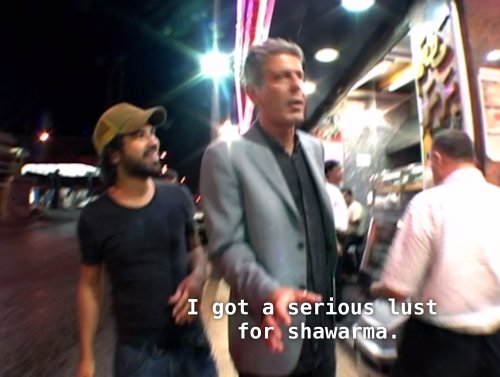
American food critic and television personality Anthony Bourdain spent his career trying to create the conditions for that kind of exchange on camera. How well he succeeded and what it cost the people he filmed is a more complicated question. Either way, his very public strife with the political nuances of travelling, food journalism and narrating travel offers something rich.
Throughout the years, Bourdain had developed a reputation for being a bad boy, foul-mouthed, adventurous, witty, and deeply empathetic person, approaching travel through deep curiosity and care. But it was a trip to Beirut that transformed him and his outlook on his work forever.
In July 2006, Bourdain and his crew arrived in Beirut to film what was intended to be an episode of No Reservations, a food travel show structured around meeting people of various professions, backgrounds, worldviews and positionalities at ordinary tables.
He invited street vendors, grandmothers, musicians, journalists, and late-night shawarma crowds and let the food do what he perceived diplomacy to be unable to do: bridging people from worlds apart. The show aimed to transform the restaurant or kitchen table (or cart, bar, farm) into a site of understanding the places he visited in a deeper, more intentional, and often more nuanced way than the typical food show format would allow.
The show captures something true about what travelling actually feels like: oscillating between the heavy and the weightless, the beautiful and the ugly, the mundane and the electric, the uncomfortable and the expansive.
But I also believe the show tried to portray how to travel with empathy and care, especially when a camera is capturing and broadcasting “unpopular” places to Western audiences. This comes into focus for Bourdain and his crew when, within two days of arriving in Beirut, Israel launched what would become a 34-day war on Lebanon, displacing over 1 million people. The episode ends abruptly.
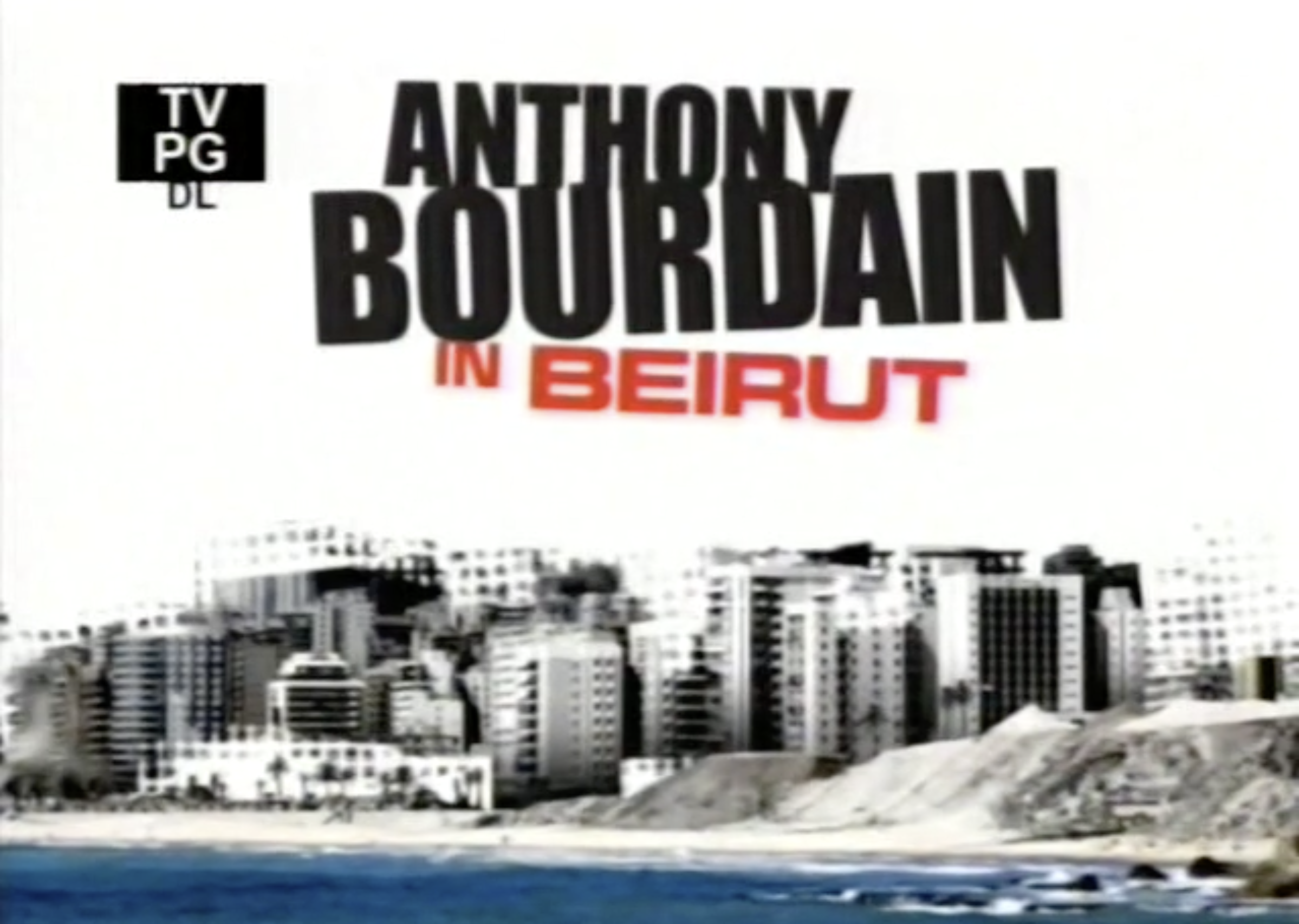
The 2006 episode never became the show Bourdain came to make. He arrived, ate for two days, was easily charmed (as everyone is) by the speed at which Beirut opens itself to you, and then the attacks on the beloved city started.
What remained were 9 days stranded in a hotel overlooking a city coming apart and an evacuation by US Marines. Their last meal in Lebanon was tuna noodle casserole on the USS Nashville. Bourdain said it had never tasted so good. He also said he didn’t want the footage to air.
What aired, against his wishes, was something television hadn’t quite produced before: a food show that had run out of food, narrated by a man trying to locate the correct moral response to watching a city he’d just fallen in love with get bombed as he tanned by a hotel pool.
“We are not making a show out of this,” he told Larry King. The Travel Channel disagreed. The episode was nominated for an Emmy, its own kind of verdict on what American audiences wanted from it. Not the mezze, not the arak, not the grandmothers and the late-night crowds, but the spectacle of a Western man confronting the limits of his own framework. While many read the Emmy nomination as a radical reckoning for Western audiences, to me it reflects something far more problematic: the appetite for Arab tragedy aestheticised into award-worthy television, suffering made consumable precisely by removing the hand that causes it.
First, I should admit something. Despite loving the show and despite being Arab, I avoided watching the episodes filmed in the Arab world for a long time. They feel like a form of Groundhog Day: an uncanny, cyclical return to the same wounds, the same footage of the same rubble, the same Western voice trying to make sense of the same catastrophe. The overexposure of Arab pain, the decades of it, the sheer accumulating volume of documentation that has left the world largely unmoved toward action, makes it genuinely difficult to engage with, even when the intentions behind the camera are good.
The episodes and their portrayal of Beirut are not without critique. They indulge in familiar orientalist tropes, repetitively exceptionalising the presence of mosques beside churches, women in hijab walking past lingerie shops, nightlife districts abutting religious neighbourhoods. This framing paints Beirut as a place of exotic contradiction where Islam and liberal imaginaries of freedom somehow coexist, where Arabs wear bikinis and drink imported beer, where Haussmann-style facades echo Paris before giving way to bullet-pocked walls and Hezbollah murals. The implicit logic is that Beirut is surprising because it refuses to be what the Western viewer expects the Arab world to be. Which raises the question: surprising to whom?
Lebanese critics were vocal about this. After the 2015 Parts Unknown episode aired, Blog Baladi published a widely shared response that captured a frustration that Bourdain, despite his evident love for the city, had reduced it once again to a catalogue of its traumas: refugees, ISIS, Hezbollah, the 2006 war, the civil war, and suicide bombings. The food was almost incidental; the author claimed that a Lebanese person watching would recognise very little of their daily life in it. The episode was, in this reading, made for an American audience that needed the conflict foregrounded to find the place legible, and Bourdain, consciously or not, gave them that.
Folklorist Lucy Long defined culinary tourism as “the intentional, exploratory participation in the foodways of an Other,” a definition broad enough to include not just the traveller eating abroad, but the television audience (and in today’s context, the social media user) consuming a place vicariously through their screen. Long is arguing that the very format of food travel shows others these destinations by using food. It introduces these dishes of other countries as complete anomalies, alien to one’s own eating culture, and that only through conversation and narration by an American accent can that bridge be drawn.
We see this often in the recent, perhaps well-intended portrayals of the ongoing war. Lebanon has children like yours, women like your sisters, hipsters with glasses like the ones in Brooklyn, clubs like the ones you frequent, and food that has inspired your favourite tiny dish restaurants. This is the messaging you find on social media when it comes to Arabs and how they have been made casualties of war, as if our humanity can only be proven if we are first made legible to the Western gaze. No Reservations was always, in this sense, a culinary vehicle of this: Bourdain was the tourist, but his American audience was the real market. And the selection of what gets shown, which dishes, which families, which streets, which contradictions is, as Long argues, an act of power. Who gets to decide what represents a cuisine? Whose definition of a culture is the one that travels?
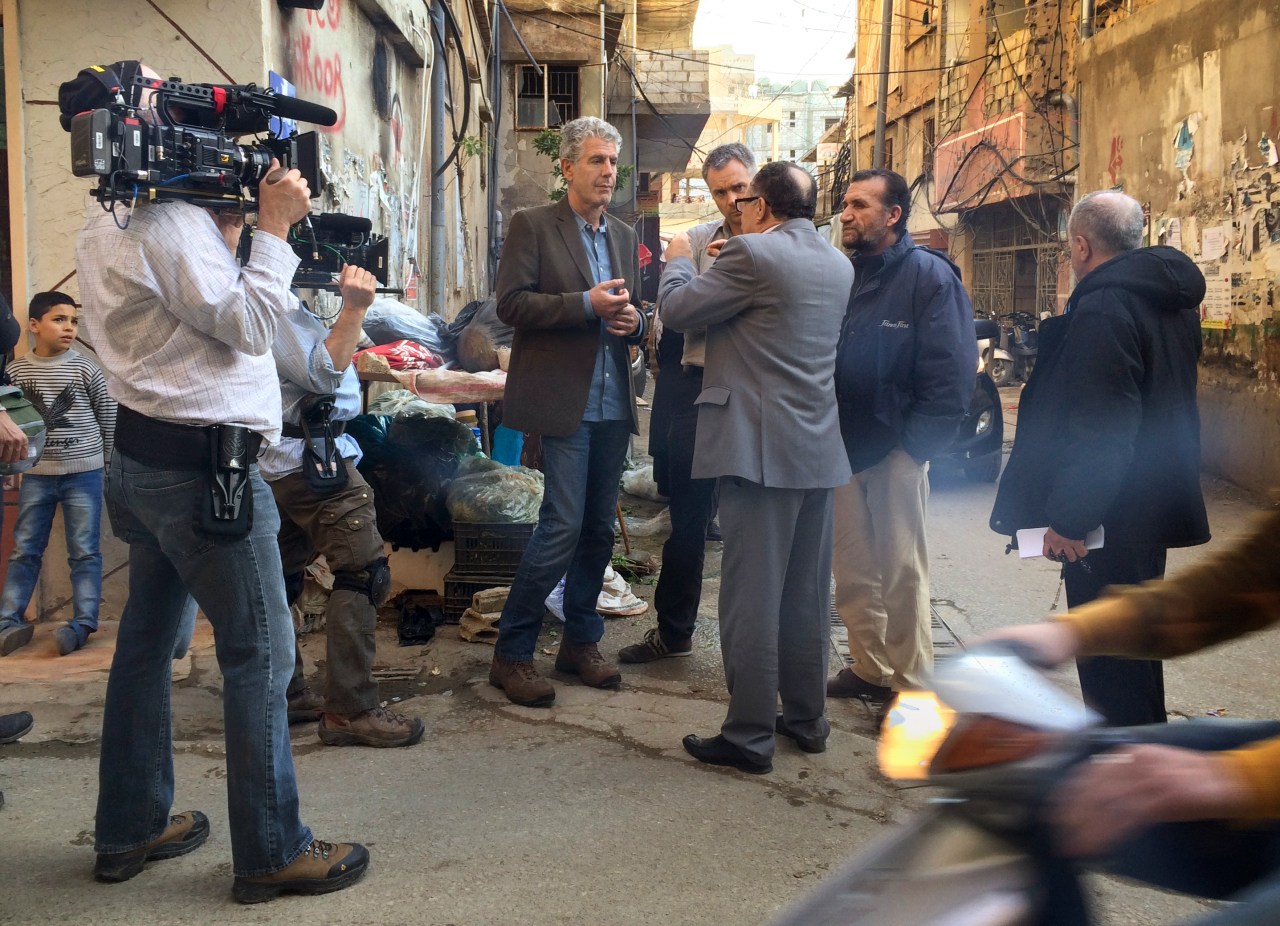
The Blog Baladi critique speaks to something deeper than a complaint about representation. It names something structural: that the last person who should be teaching any culture about its own food ecology is a white American man with a camera and a network budget. And yet this is the tension. There’s something in Bourdain’s approach that resists the easy dismissal. I can say that it is sort of wonderful to see someone earnestly follow traces, listen to his collaborators, and end up in unexpected places. What the typical food travel format has never accommodated, and what its successor, the polished, picture-perfect food influencer has made even worse, is genuine openness: the willingness to arrive somewhere without already knowing what it means, to trust someone to take you to a meal google reviews or a food critic didn’t tell you about, to find somewhere that is forgettable, to allow the meal teach you about what governs taste, even if it ends up mediocre or uncomfortable, and to leave without a tidy conclusion.
This is what Beirut gave Bourdain that he could not have manufactured. The war interrupted his show and, in doing so, made it honest. The question his Beirut trilogy keeps returning to implicitly in every subsequent episode he made in the region is whether that honesty is possible without the interruption. Whether the table, left undisturbed, is enough. And whether it is enough to just be amazed.
Contemporary travel content has accelerated the consumability of travelling, while removing whatever remained of its self-awareness. The spectrum of travel content online is wide, but the poles are recognisable; on one end, extreme polish: the influencer with the curated itinerary, the colour-graded plate, the experience pre-digested into aesthetic, and to something flattened and extractable. These accounts sell a version of the world as a collection of beautiful surfaces, each destination interchangeable with the last at the level of visual grammar, even as they are presented as singular and unmissable. The place exists to be consumed, and the consumption is frictionless, aspirational, and clean.
On the other end: the exoticisation of precarity; the backpack influencer who frames poverty as atmosphere, precarity as thrill, conflict as backdrop, instability as adventure. The trip is simply something to tell at parties to sound more interesting, and the cultures and people from the places they’re visiting are just props to the set. This type of influencer arrives in a city under pressure and finds it thrilling in a way that depends on having a passport that lets them leave. Who films the chaos with the energy of someone for whom it is not, and has never been, their actual life. Both poles are expressions of the same underlying logic: the destination as content, the same mechanisms of Othering, the people in it as silent, the culture as raw material for someone else’s self-construction.
But the consumability of travel did not begin with Instagram, or with Bourdain. The Western traveller moving through the non-Western world with a camera has a longer history, and it is not an innocent one. Photography arrived in the 19th century alongside colonialism, not incidentally but structurally, the same century that produced anthropology and the census and the archive also produced the camera, and they were all doing related work.
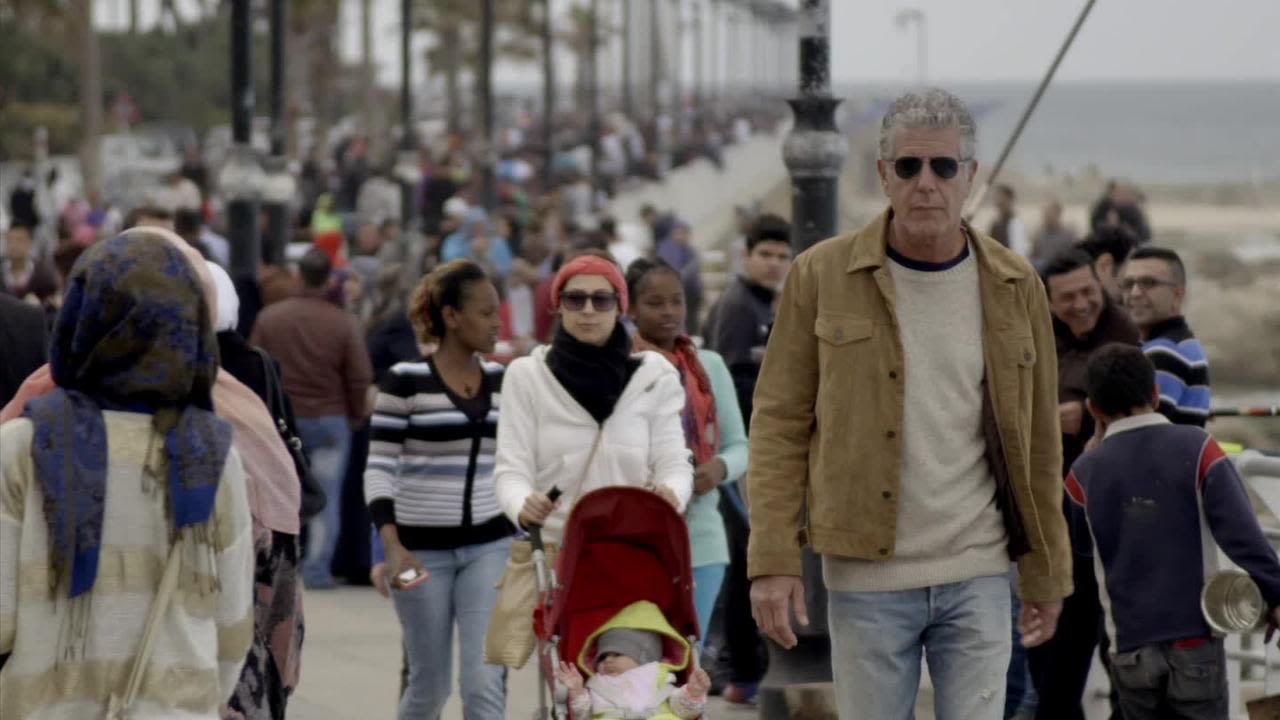
Sorting the world, reorganising how we understand each other, and claiming to make the foreign legible. Returning images home as evidence of a world that was, in some fundamental sense, available. The colonised, the poor, the unfamiliar were rendered into subjects, objects of the gaze, available for documentation, not asked whether this was the version of themselves they would choose to circulate. To photograph something was understood as a claim, a kind of possession over it; to make it yours to show, and to narrate the story around it.
When the Kodak arrived in 1888 and would soon put a camera in anyone’s hands, it didn’t dissolve this structure. It democratised access to photography and documenting travelling, but kept this punctuation of Othering intact. The empire’s gaze became everyman’s gaze through each subsequent wave of technology. The holiday snapshot, the camcorder, the digital camera, and the smartphone made the taking of images faster, cheaper, and more detached from any considered relationship to what was being photographed. The reel is the logical end of this arc. It inherits the colonial visual grammar without the self-consciousness of knowing it does. The destination is exotic, or it is resilient; it is discovered, or it is ruined. What drops out entirely, across this long history from the colonial lens to the 30-second reel, is the possibility that the place is not so easily readable, and that foreign people cannot be flattened into an image or short video. Likewise, what Bourdain’s format invited, and didn’t edit out, was how people often spoke back, interjected, or took charge of the narrative. Most of Bourdain’s interviewees refused to be passive.
On the other hand, what feels like a minority of travel influencers who are working against the grain emerge. They are harder to find and rarely the ones the algorithm surfaces first, but they exist, and something in their practice feels closer to what travel actually is when it’s done with care. They are slower. More willing to be lost, to listen to local cultures, to be open to chance, to admit not knowing, and to decenter their own experience. To travel with care is to realise your world is not the only world, and your experience is not always the centre. Maybe the most important lesson we can learn from travelling is that, in fact, there is never a real centre. What distinguishes good travel journalism is when someone comes prepared to have their world expanded, to arrive somewhere without a shot list and leave without a tidy conclusion, and the places they visit are legible as places rather than as content; specific, contradictory, resistant to the flattening that makes a culture consumable. An influencer/journalist/food critic who leads with care is someone who has the sense that they are genuinely available for the encounter rather than executing it. That they could be changed by what they find, and sometimes are.
This is not a new way of travelling. It is, in many ways, the oldest one; the tradition of the curious stranger who arrives somewhere and submits to being taught, who understands that the point is not to confirm what you already know about a place but to be corrected by it. What is new is that this approach now has to survive inside an economy that might feed off of the instant and the catchy. But I also believe there is a desire for content like this, that shows us there are different ways of living, knowing, and being in the world and that those differences also have the capacity to bring us together.
Bourdain was hungry, insatiably hungry, willing to eat anything, follow any trace and that hunger extended to a real curiosity about the world, but also the show framed him as someone who travelled to listen. When he frames Lebanon as a kind of liberal escape from the conservatism of the broader Arab world, a Lebanese host corrects: “That framing is yours, not ours.” When he returned to Beirut in 2010 to make the show, he felt he owed Lebanon. He returned to the same restaurant, ordered the same dishes, yet he was different. He had been directly confronted by something the food travel format is designed to avoid: that he was not a neutral observer passing through, but someone whose camera decided which version of a place reached millions of people, and whose presence in a city under siege revealed exactly how much freedom of movement his passport, his network, and his skin afforded him. The 2006 episode didn’t make him a better journalist overnight. But it made it impossible for him to pretend that pointing a camera at someone else’s life was a consequence-free act. That pretence is one most travel content has never abandoned.
The 2015 Parts Unknown Beirut episode is the most complicated and the most revealing. By now, he arrives as someone familiar with the city, and the episode moves accordingly fast, tonally restless, unwilling to settle. He visits a Palestinian refugee camp, has drinks at a hip-hop night in east Beirut, eats with a family in the Hezbollah-dominated southern suburb of Al-Dahiyeh, and ends up at a communist-themed bar in west Beirut. The Syrian refugee crisis runs through the narration of the episode; Lebanon was straining under the weight of displacement by then, and Bourdain doesn’t look away. He meets Mr Najem, a Syrian English teacher who fled to Beirut three years earlier. “We have no area in the world,” Najem tells him. “We belong to nowhere.”
The episode’s centre of gravity is a lunch with Lebanese feminist writer and activist Joumana Haddad in Mar Mikhael. Bourdain tells her across the table that he loves Beirut. She doesn’t let it sit. “Don’t you think,” she asks him, “that the main reason behind you seeing this as a thrilling, exciting place to live in is that you’re a visitor?” The question is not hostile, but precise. It locates the mechanism by which outsider affection for a place in crisis becomes a form of consumption, metabolising someone else’s wound as aesthetic experience, or as a spiritual realisation of one’s own privilege. Bourdain is visibly unsettled, and he doesn’t deflect or charm his way out of it. He turns the question on himself and asks it aloud: Am I wrong to love this place?
Perhaps, I will end by providing a counter to Bourdain’s, which to me reads as an earnestly naive flattening of a larger question. To reflect on not if it’s wrong to love this place, but to ask what that love can effectively do. Haddad urged Bourdain to think about how loving Beirut is not without nuance, and neither is witnessing. It carries the risk that affection becomes aestheticisation, that witnessing is at risk of being merely consumption, that you metabolise someone else’s wound as your own revelation. That risk is real, and it doesn’t dissolve because your intentions are good or because you are close enough to the pain to feel it personally. But I think there is a difference between loving a place and consuming it. The difference is what you do with the love. Whether it moves toward testimony or toward spectacle. Whether it names the arsonist or just mourns the fire.


