
News


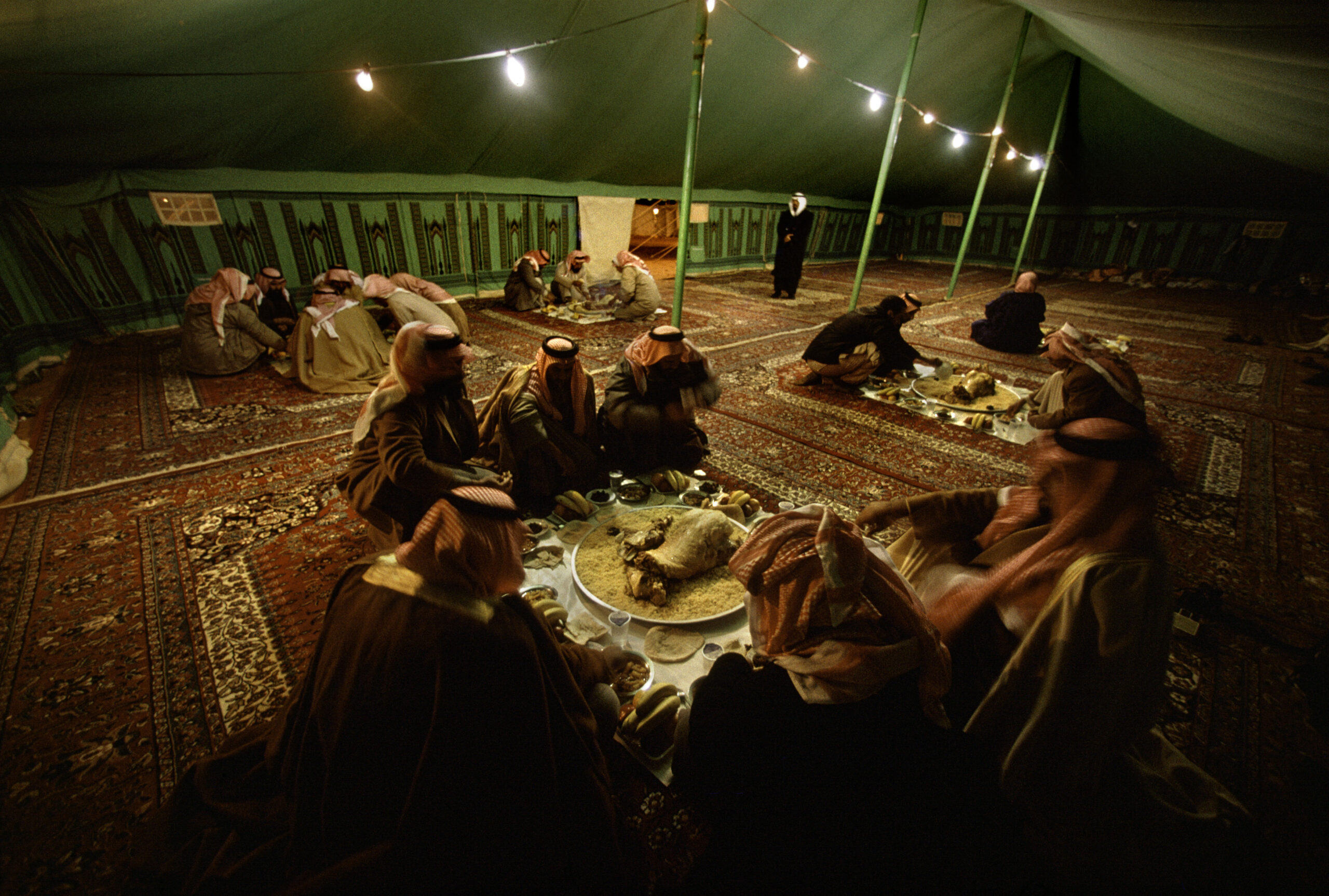
Some words function less as nouns and more as worlds. Words that are beyond attainable within a singular definition because they have spent centuries accumulating meanings, shedding them, refining them, and expanding them. Majlis is one such word.
At its literal basis, Majlis is etymologically rooted in jalasa (to sit in Arabic). It also means a seat, a gathering, or a room. Yet each translation feels inadequate. To translate majlis merely as a room is to miss its social life; to translate it as a gathering is to overlook its architecture; and to understand it as a political institution is to neglect its intimacy. The majlis exists simultaneously as a physical space, a social ritual, an instrument of governance, and a cultural imaginary. Perhaps this slipperiness is precisely what makes it still compelling to this day.
In the last few years, the majlis has entered the regional exhibitionary circuits of art fairs, biennials, and museums, where it has become a recurrent spatial device through which questions of identity, hospitality, and collectivity are negotiated, manifesting in many formats and as a spatial model for participation. Aestheticised and branded, it raises a spectrum of speculations with each iteration: Can a majlis remain a majlis when put on display? What is at stake when participation becomes spectatorship? What happens when hospitality becomes curation?
Before jumping to answers, we must linger within the questions. Let us sit with them. Let us hold a majlis about the majlis.
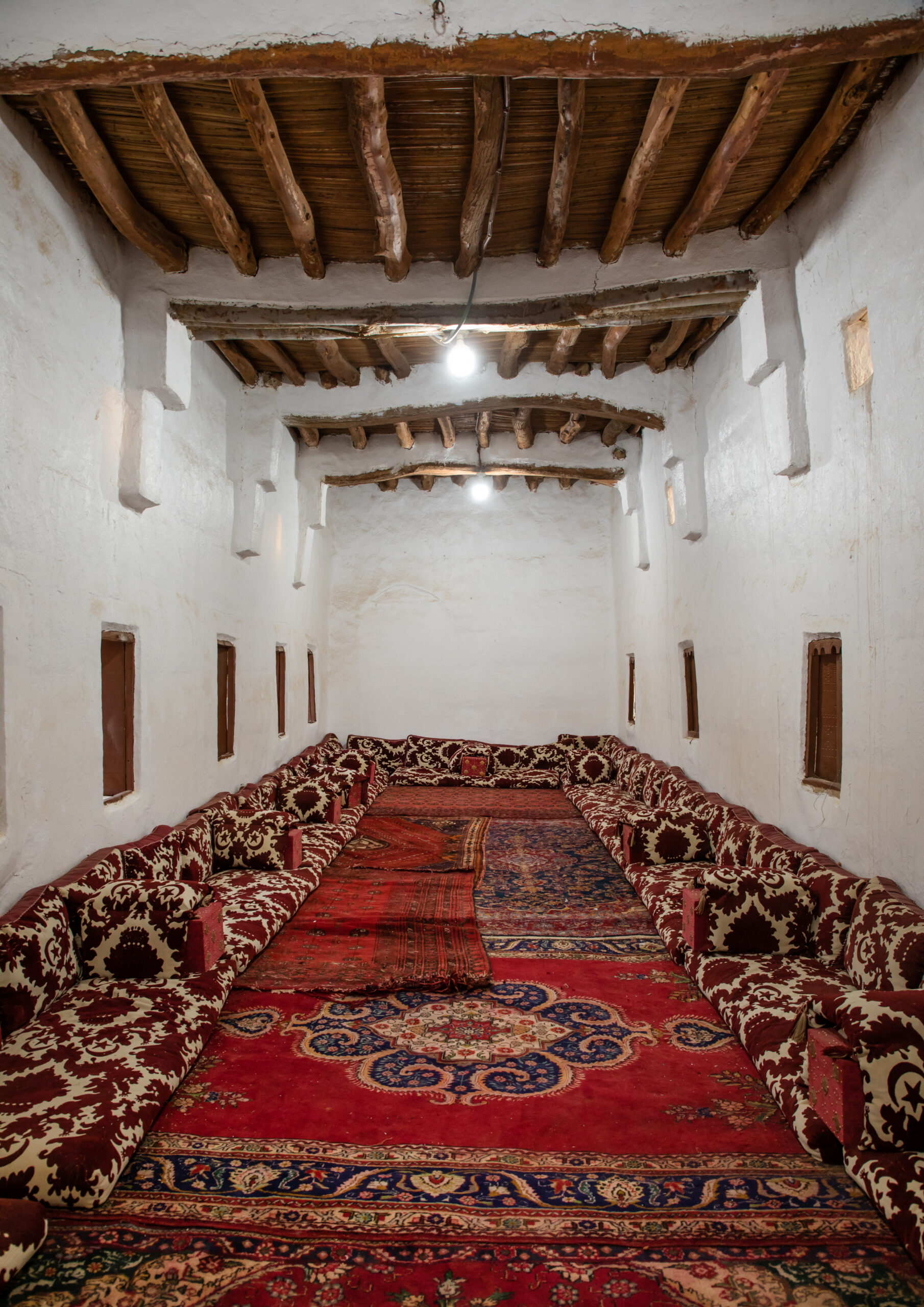
In Arabic, many words have meanings that remain tethered to actions rather than objects. The majlis belongs to this category. It is not defined by walls, furniture, ornament, or geography; rather, it is defined by the action of sitting. It is therefore less of a space than a condition, taking shape whenever bodies sit, gather, converse, listen, negotiate, remember, and disagree. Its meaning remains mobile because sitting itself remains mobile. A majlis can occur in a palace, a coffeehouse, a tent, a courtyard, a parliament, or an artwork. Social choreography comes first; the architecture is secondary.
This distinction becomes important because contemporary representations of the majlis often privilege its visual appearance and ambience over its social function. Cushions, carpets, textiles, coffee pots and ornamental details become shorthand for “Arab culture”. Reflecting on contemporary reinterpretations of the majlis across the Arab region, Arthur Debsi observes that “its role has expanded beyond the traditional gathering space and has been reinterpreted within artistic and cultural settings.” He argues that institutions such as the Media Majlis Museum in Doha and the Art Majlis in Riyadh have reimagined the majlis as a site of public engagement, hosting conversations, workshops, and exhibitions. These institutional reinterpretations of the majlis, Debsi further explains, “reflect an assertion of identity deeply rooted in the Arab world, and respond to broader cultural strategies aligned with institutional development.” Perhaps the majlis was never primarily visual; perhaps it was always associated with a layer of performativity.
Long before it became a museological artefact, an activation at a Ramadan event, or an Instagram backdrop, the majlis served as a political technology. Early Islamic accounts describe the gatherings of the Prophet Muhammad as spaces where matters of faith, governance, and communal life were debated and negotiated. Under the Rashidun caliphs, these assemblies became integral to the administration of an expanding polity, embedding consultation into the political imagination of the early Islamic world. Over time, the majlis travelled across scales and institutions, from intimate circles of deliberation to royal courts, tribal governance, and state bureaucracies.
Its traces remain visible today in legislative and consultative bodies across the Arab world, from Majlis al-Shura in the Gulf states to Egypt’s former Majlis al-Shaab and the various Majalis al-Nuwab of Jordan, Yemen, Bahrain, Morocco, and beyond. The endurance of the term is telling. Often translated as a consultative council, the institution operated as a space for communal decision-making, advice and deliberation.
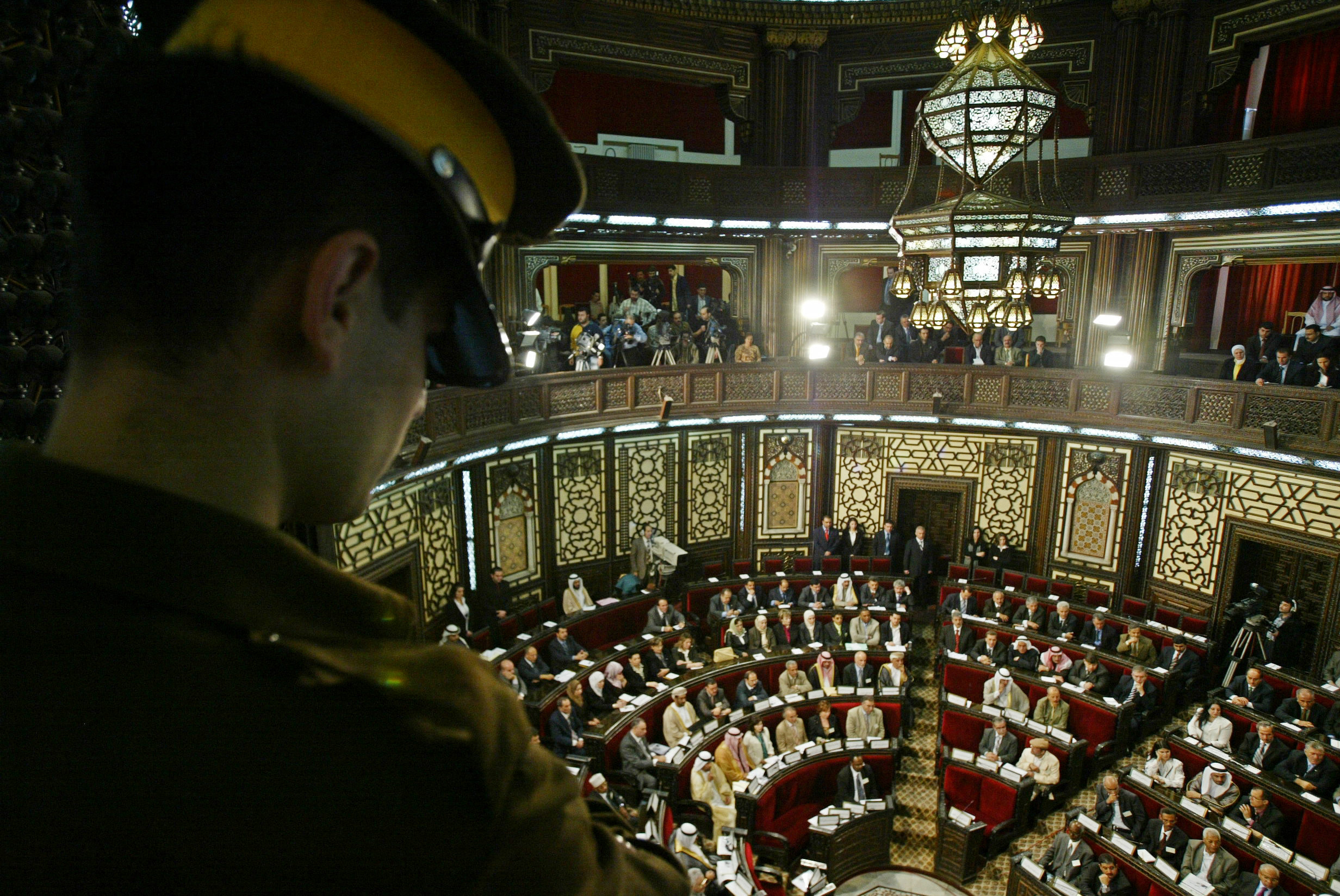
Yet the majlis has never been politically innocent. A gathering is never neutral. Who speaks? Who listens? Who enters? Who remains outside? Every majlis establishes a threshold between inclusion and exclusion. The romanticisation of the majlis as a democratic gathering often obscures these dynamics. Historically, many of the above-mentioned majalis [plural of majlis] were deeply hierarchical spaces. Access was regulated, authority was unevenly distributed, and gendered boundaries frequently structured participation. Yet, hierarchy alone does not explain their persistence. The majlis survived because it provided something modern bureaucratic institutions often struggle to produce: proximity. Power rendered embodied and accessible, whether that accessibility was “real” or “symbolic”.
The positioning of the ruler receiving petitions in a majlis continues to hold political power precisely because it stages governance as conversation rather than administration. Within this cadre, the majlis becomes a theatre of legitimacy. Or maybe a performance of listening, a spatial technology through which authority presents itself as intimate.
If politics gave the majlis one life, architecture gave it another. The majlis occupies a peculiar position within Arab domestic space, at once public and private, part of the home yet oriented towards and created for the outsider. Intimate and performative in the same breath.
Many traditional houses organised social life around such thresholds, where visitors were welcomed into spaces specifically designed for hosting, discussions, and negotiating familial relationships. In that sense, the majlis operates as an architectural mediator, a room of transition; neither entirely domestic nor entirely civic, but somewhere in the midst of both.
Historically, the majlis functioned as a predominantly male domain of sociability, deliberation, and authority, often positioned on the periphery of the house or entirely detached, reflecting broader social distinctions of gendered boundaries and the protected interiority of private domestic life. This ambiguity remains visible in historic houses throughout the region. In houses such as Bayt Al-Suhaymi in Cairo, reception spaces reveal sophisticated negotiations between privacy, hospitality, gender, climate, and social hierarchy. Similarly, Bedouin tents have long functioned as spatial systems through which hospitality, kinship, authority, and social interaction are performed not through the enclosure of these spaces but through their arrangements.
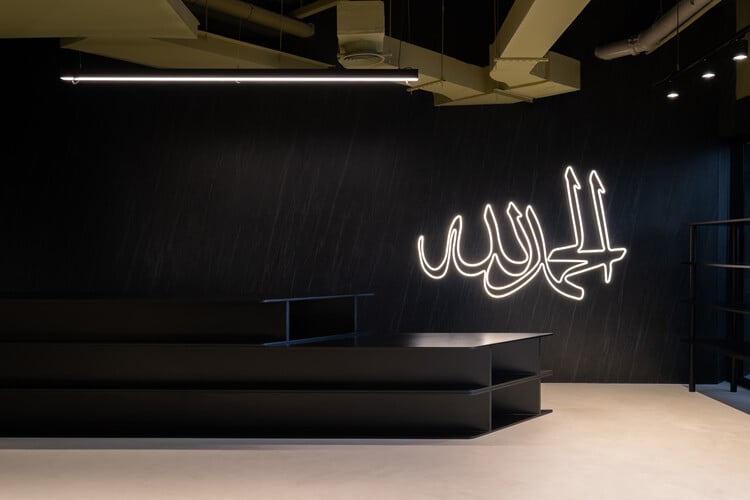
This liminality of the majlis has made it a site for ever-increasing architectural drift. Contemporary architects and artists continue to return to it, not simply as a spatial typology but as a flexible cultural signifier. Tasked with marrying architecture, commerce, cultural reference, and martial arts, MEAN, led by Riyad Joucka, recently completed the Send Location flagship store in Dubai around an octagonal majlis that “merges the Arab space of gathering with the UFC ring that defined Khabib’s career,” explains the studio. The gesture folds hospitality into spectacle, recasting the majlis through the language of branding, performance, and contemporary retail. Elsewhere, in the Assembly of Lovers for the inaugural Art Basel Qatar in Doha, Summaya Vally describes the majlis as “an act of love, hope, and resistance.” Paying tribute to gathering spaces dismantled across the Muslim world, the installation extends the majlis beyond a single architectural form, turning it into a vessel for memory, mourning, and collective imagination.
When asked about the contemporary resurgence of majlis in today’s art and architectural scene, Ziad Jamaleddine, co-founder of L.E.FT Architects and assistant professor at Columbia GSAPP, answered: “Do not translate.” Rather, he argues, those who wish to engage the majlis in English should “adopt its transliteration, embrace its ambiguity, and allow broader interpretation.” Perhaps what eludes translation is not just the word but the entire mode of social organisation. Understood in this way, the majlis emerges as a form of social infrastructure, where what matters is not merely where people sit but how sitting orchestrates relationships. Perhaps the majlis is not a typology at all, but a protocol. A recurring social script capable of inhabiting different architectures. Yes, the room matters. But the choreography matters more.
The history of Arabic literature is inseparable from the history of collective listening. We can glimpse this dynamic in the tradition of Maqamat, those wandering narratives that flourished between the 10th and 12th centuries, most notably in the works of Al-Hamadhani (968-1008) and later Al-Hariri (1054-1122). Composed in highly stylised rhymed prose (saj‘), the Maqamat are structured as episodic narratives built around repeated encounters between a narrator and a wandering trickster-scholar. Each episode unfolds as a self-contained performance of language, staged before assembled audiences and organised through the logic of the majlis. The entire genre does not simply represent gatherings; it is structured by them. Here, the majlis is both the setting and the subject.
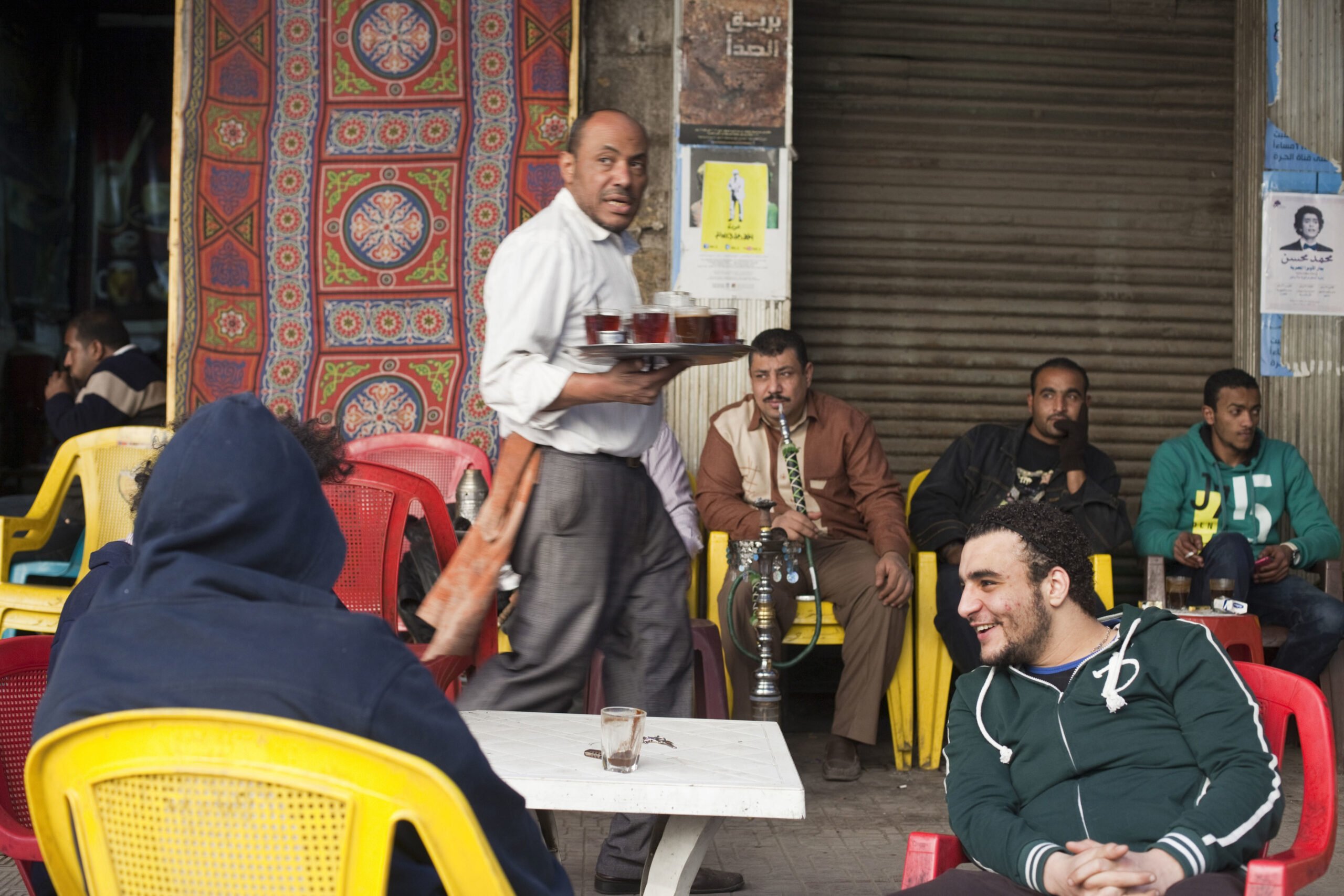
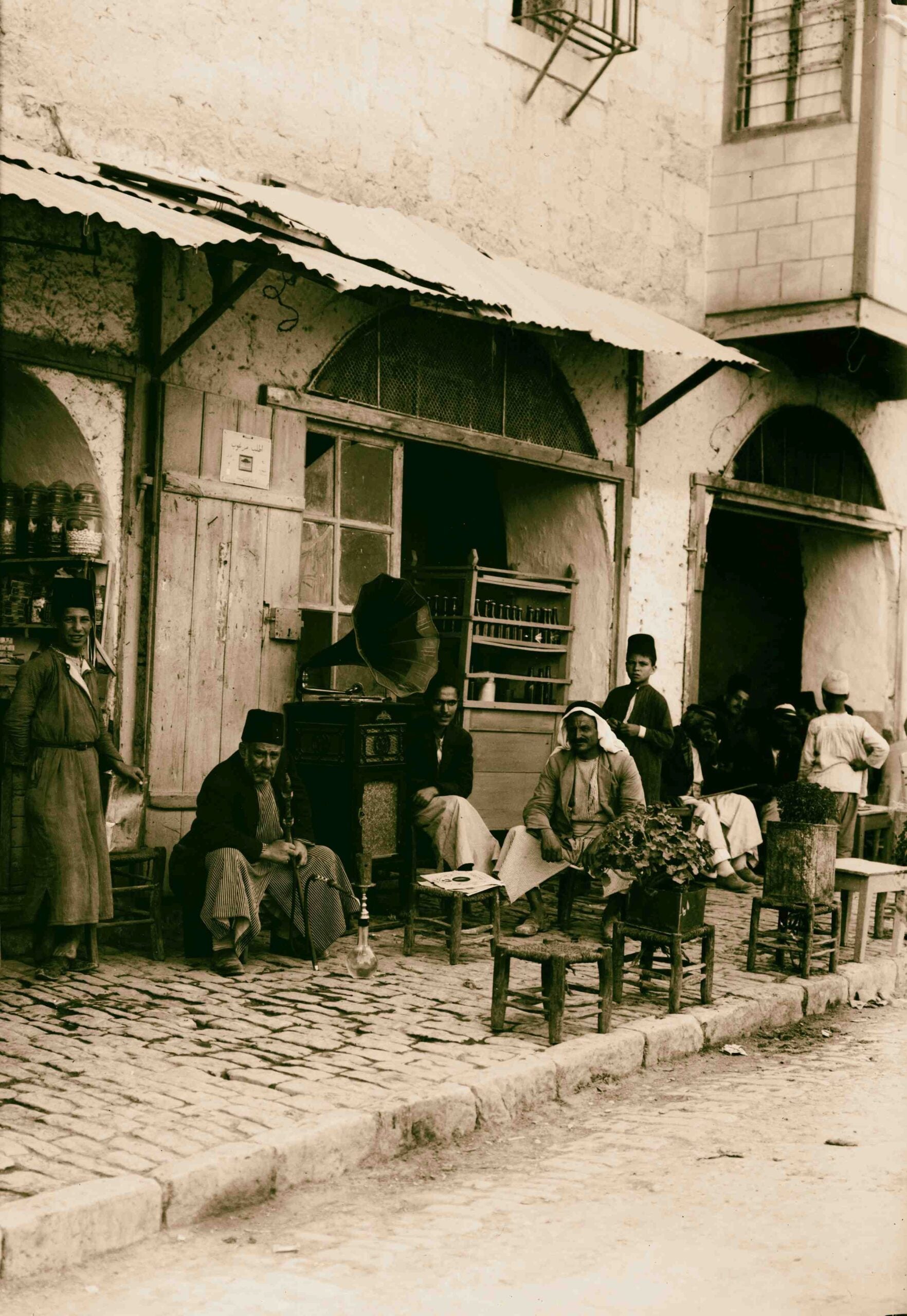
Centuries later, the echoes of this same dynamic can be found in Cairo’s coffeehouses. The coffeehouse has often been described as a modern urban majlis, a place where politics, literature, gossip, philosophy, and everyday life intersect. The capture of Naguib Mahfouz surrounded by writers and intellectuals in Cairene cafés has become part of modern Arab cultural mythology. But why do such scenes continue to have an awe-inspiring effect on us? Perhaps because they suggest forms of collective intellectual life increasingly threatened by acceleration, privatisation, commodification, and digital fragmentation. Maybe the majlis survives not merely as a space but as a fantasy. A fantasy of conversation, a fantasy of presence, a fantasy of transcending power – a fantasy that meaning might emerge through gathering.
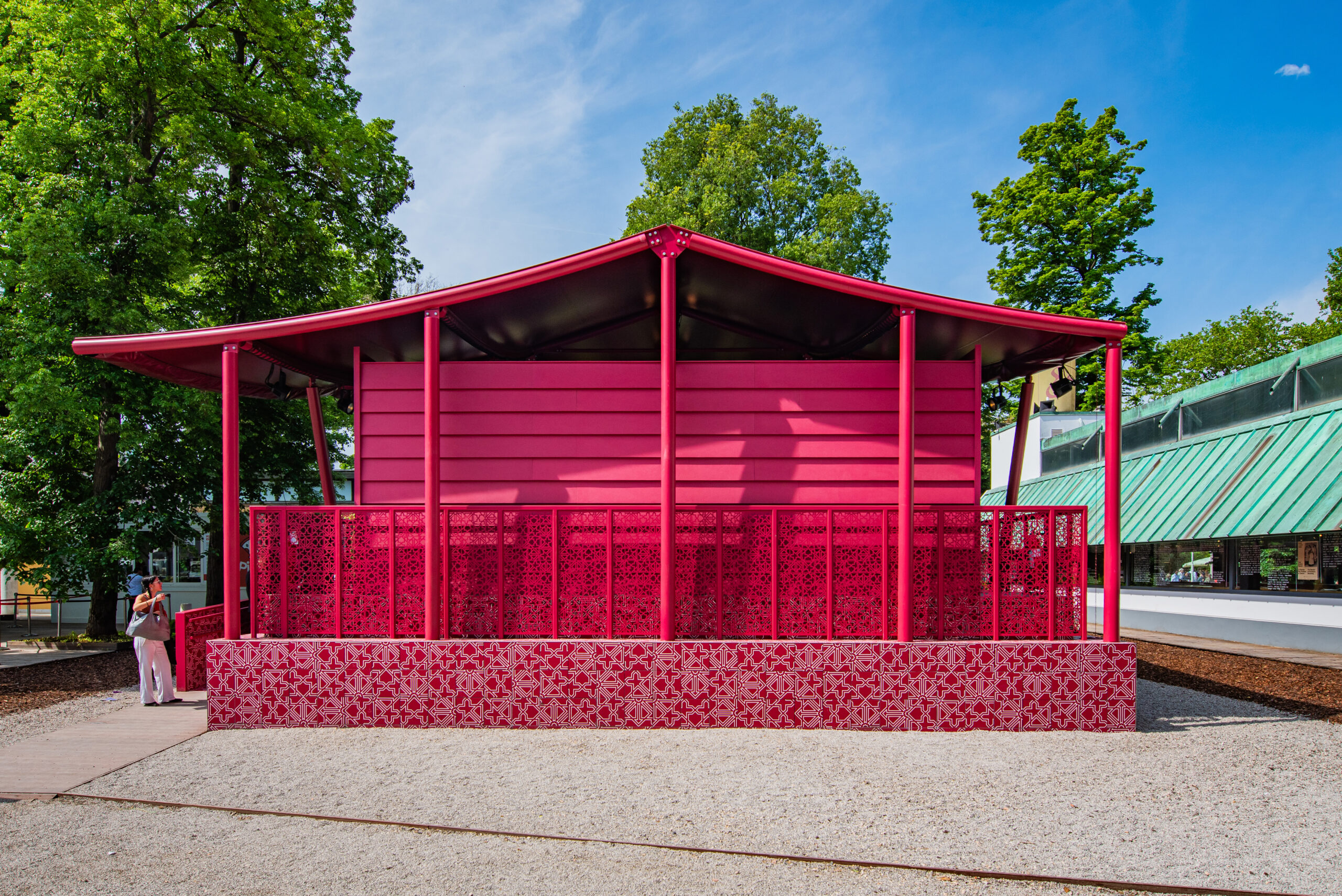
Today, the majlis migrated onto international stages and inside museums and biennials, and by that happening, it transforms. The function changes, the audience changes, and the economy changes. Recent artistic and curatorial projects across the Gulf have embraced the majlis as both subject and format. Heritage institutions reconstruct historical majalis, contemporary artists reinterpret gathering spaces, and national pavilions mobilise the majlis as a symbol of cultural identity and dialogue. Such projects are often thoughtful and ambitious, yet they inevitably produce tension.
The exhibitionary logic of those international and prestigious art platforms often transforms living practices into aesthetic experiences. Visitors encounter representations rather than the relationships associated with them. The majlis becomes detached from the social conditions that once birthed it; it just becomes an image, a brand, an atmosphere… a vibe.
Every discussion about contemporary representations of Arab culture eventually arrives at the same question: who is the audience? This question often appears straightforward, albeit it rarely is. When an Arab artist references the majlis in Venice, London, Paris, or New York, whose gaze is being addressed?
The accusation of “catering to the Western gaze” most probably emerges at this point of the discussion. Sometimes this accusation is justified, sometimes it is reductive, more often, it conceals deeper questions. The point here is not simply Western spectatorship. One of many problems is the unequal distribution of cultural power. After all, contemporary artists do not operate in neutral spaces. Biennials, museums, foundations, and global art markets remain embedded within structures shaped by histories of colonialism, extraction, annihilation, and capital accumulation. Representation always occurs within these conditions.
This is not new. See, for instance, the long history of Orientalist “Arab villages” and staged domestic scenes in 19th- and early 20th-century World’s Fairs and colonial exhibitions, where everyday cultural forms — interior spaces, hospitality practices, textiles, rituals — were extracted from lived contexts and reassembled as aesthetic spectacles for European audiences. Culture, power, and commodification were already entangled then. What has changed is the platform, not the underlying condition.
Yet insisting that any Arab cultural expression on an international stage is automatically compromised, “a suspect”, creates another trap. Such a position risks assigning Arab designers an impossible task: remain authentic, remain legible, remain political, remain local, remain globally relevant, represent your culture, but not too much, critique power, but do so elegantly. The demand becomes contradictory. Arab designers are simultaneously expected to perform identity and also transcend it.
Perhaps a more uncomfortable question lies beneath these debates: do we have the right to use our own culture as artistic material? The question may sound absurd, but perhaps we need to get down to the basics to adhere to any sense of orientation. Cultural symbols become burdened with expectations of fidelity and responsibility, and designers are often asked to justify their relationship to the very traditions they inherit. The majlis exemplifies this tension. To aestheticise it risks commodifying it. To avoid aestheticising it risks abandoning it. To historicise it risks freezing it. To modernise it risks distorting it. There is no innocent positioning.
This tension is compounded by a broader moment in which participation itself has become aestheticised. The language of participation is now ubiquitous, and participation generates value — a latent form of power, maybe. Community generates visibility, visibility generates attention, attention generates capital. The majlis enters this economy not merely as a cultural form but as an aesthetic resource: a visual language, a curatorial strategy, a branding device, its cushions, carpets, and atmospheres circulating through architectural renderings, exhibition designs, and institutional narratives. The question is not whether this process is good or bad, but what its aesthetics conceal about the politics underneath.
Underlying much of this is a disquieting recognition that the relationship between Arab cultural production and international art platforms remains uneven. This has produced a strand of critical discourse, well-intentioned for the most part, concerned with exposing the limits of Western interpretive frameworks and the persistence of cultural domination. At times, however, this focus risks becoming overdetermined, displacing attention away from the political conditions and state structures within which much of this work is also produced and circulated. Our governments.
To hold this majlis about the majlis is to sit with these contradictions, and within the boundaries of this hypothetical majlis on paper, perhaps we can extend the inquiry beyond the majlis itself, toward the broader aestheticisation and commodification shaping contemporary cultural production at large. This also requires a moment of reflection on our own positionality as Arab designers, writers, artists, and scholars, and exploring what it means to be an Arab today, amid ongoing genocides, American imperialism, and enduring structures of Western hegemony.
We cannot claim this is an entirely new epoch, as its contours have appeared in different forms throughout history, as the colonial exhibitions above remind us. But this particular moment, and the critical positionality it demands of us, comes with its own givens and contradictions. How are Arab cultural forms being aestheticised, commodified, and branded in the name of activism and representation? How are we “re-packaging” our culture? What is gained, what is lost, and what is altered as it moves across artistic, institutional, and geopolitical stages?
We can go to great lengths to fragment, dislocate, and decentre the experiential terrain occupied by structures of power and capital on international stages. But these gestures, while necessary, are not enough. We cannot remain within the comfort of critique alone, nor reduce the field to the familiar binary of “catering to” or “resisting” the Western gaze, a framework that has become too limiting, too easily absorbed into the very systems it seeks to unsettle. What is needed instead is a more unruly analytical stance, one that refuses closure and insists on plural, unstable, and shifting objects of inquiry.
In this majlis, we do not resolve tensions; we hold them. Not as a gesture of restraint but as a refusal to tidy them into legibility. Perhaps the task is not to defend the majlis, or to recover it, or to authenticate it. Maybe let it remain unsettled, sit within it longer than is comfortable, and refuse to wrap it up.


