
News


There are houses that make clothes, and then there are houses that make worlds. Hermès has always been the latter. Long before the home universe became a standard line item in every luxury brand’s portfolio, Hermès was thinking about what it meant to live well, not as an extension of its fashion identity, but as an expression of the same values that have governed every saddle, silk scarf and leather good it has ever made: the primacy of craft, the dignity of material, the idea that an object should justify its own existence.
For more than fifteen years, the house’s annual Milan Design Week presentation has been among the most anticipated events of the design calendar, a supremely stylish counterpoint to the surrounding noise, combining collaboration, detail, materiality and narrative in ways no other house quite manages. Since 2014, that vision has been steered by Charlotte Macaux Perelman and Alexis Fabry, co-deputy artistic directors whose backgrounds, architecture and spatial thinking for Perelman, photography, curation and publishing for Fabry, produce a rare balance of structural rigour and visual instinct.
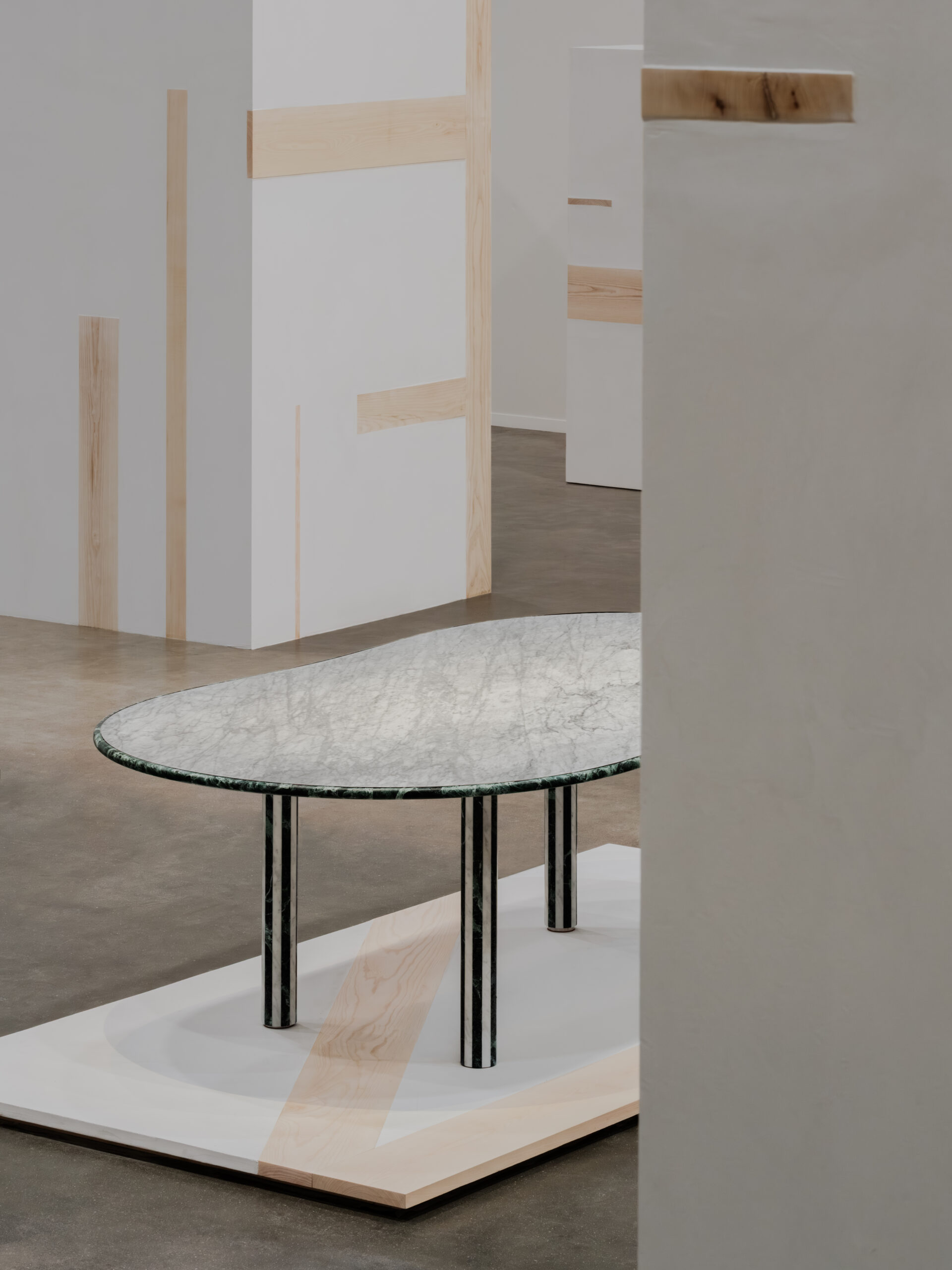
For 2026, the pair return with a collection that moves through furniture, objects and textiles with characteristic confidence. The scenography, designed by Macaux Perelman, structures the space as a journey: thirty rectangular columns, ranging from 80 centimetres to three metres in height and embellished with graphic motifs in wood, form aisles and create perspectives. It is a space designed for wandering, one where full and empty interact, and where each turn reveals something new.
The objects themselves are the point. The Stadium d’Hermès table, imagined by British design duo Edward Barber and Jay Osgerby, arrives in the form of a figure-of-eight in marble marquetry; a collaboration chosen, as Macaux Perelman has said of Barber and Osgerby, because “they’re masters of shape, they create the most beautiful forms.” Its top in Carrara Venato marble with Verde Alpi inlay, its slim legs carrying geometric Jumping motifs, the piece sits at the intersection of architecture and furniture without fully belonging to either.
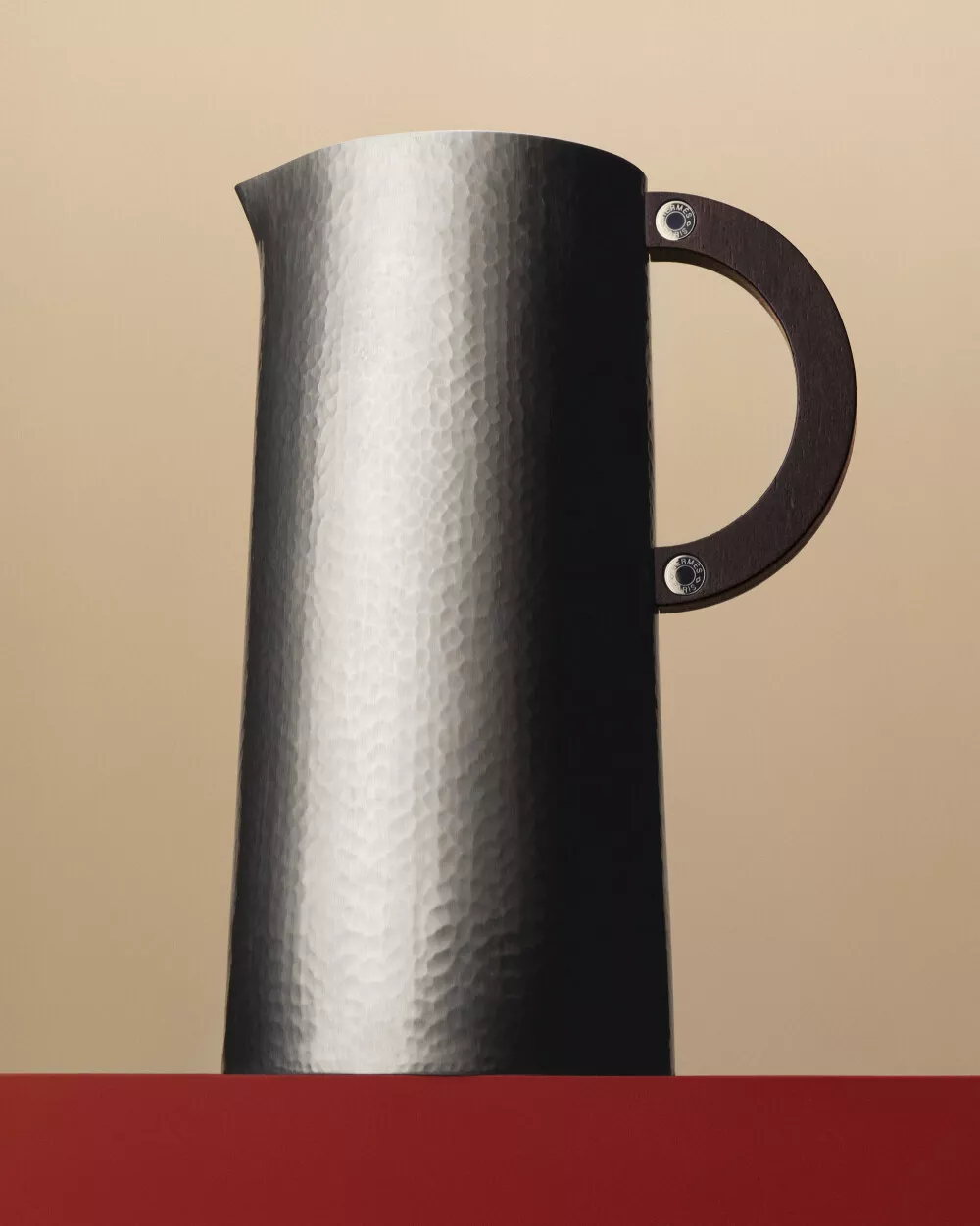
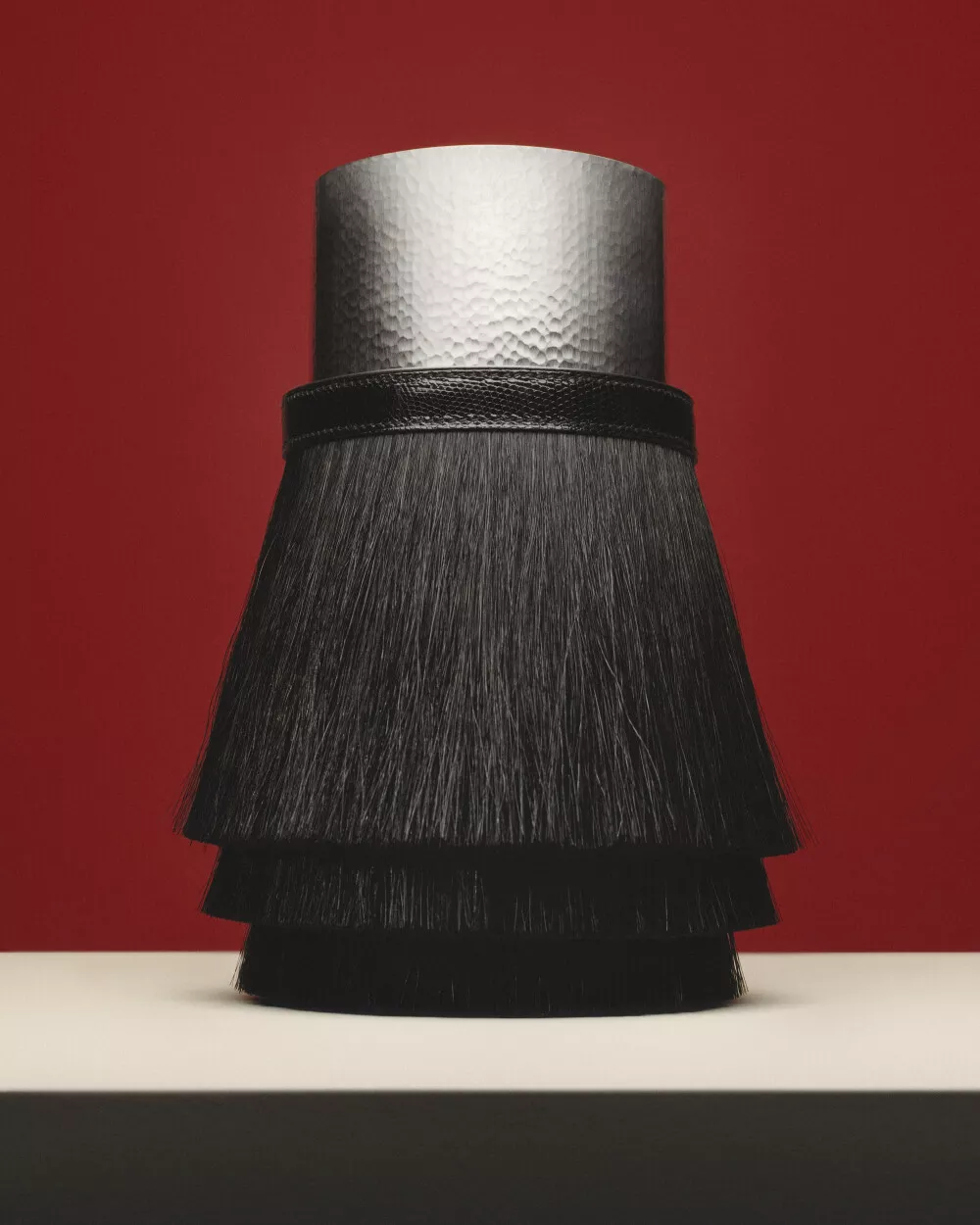
The Palladion d’Hermès line of hammered palladium-finish metal objects — centrepiece, jug, vases — takes its name from the statue of Pallas Athena, protector of cities. The silversmith’s hammer gives the metal its particular quality, vibrant and shimmering, capturing light differently with every movement. Against leather, horsehair and cassia wood, the metal behaves less like hardware and more like jewellery.
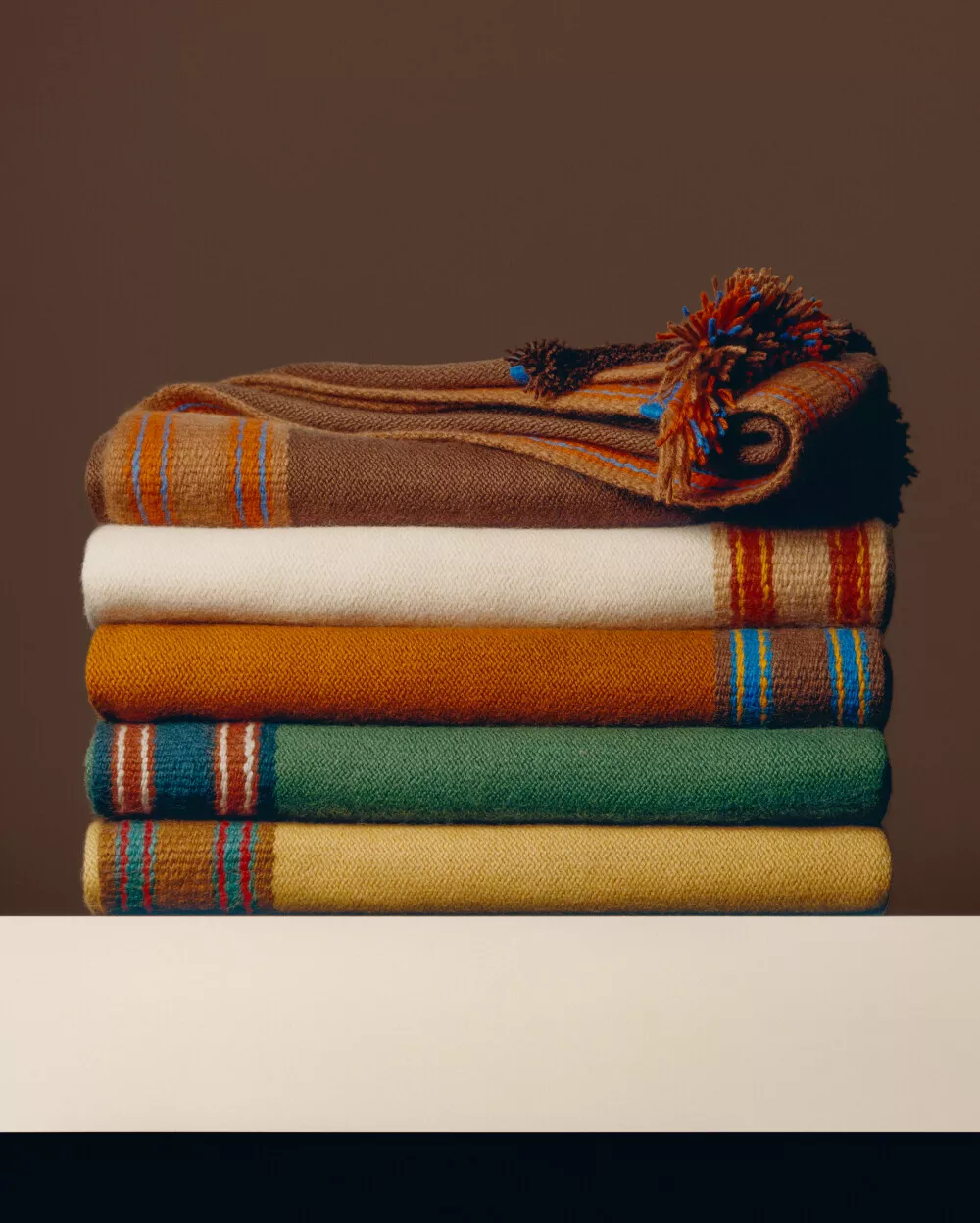
The textile works are equally considered. Clamp & Dye, H Letter, Sangles Sellier and Aventure, each textile arrives via a distinct process, from resist-dyed hand-woven cashmere to bojagi, the traditional Korean art of sewing textile panels together. The H Letter throw, designed by Hyunjee Jung, requires hundreds of hours of work to produce its composition of linen voile and cashmere seamed with coloured silk thread, a giant H concealed within it like a watermark.
“What we do is not about trend or novelty for the sake of it,” Fabry has said of the home universe. “We are quite comfortable with the idea that we work with the intangible — that is part of what we do.” The 2026 collection is proof of that comfort. Nothing here is chasing the moment. It is, instead, doing what Hermès does best: making things that belong to no particular season, in the quiet confidence that they will outlast all of them.
Collections for the Home is on view at La Pelota, Via Palermo 10, Milan, from April 20th to 26th.


