
News


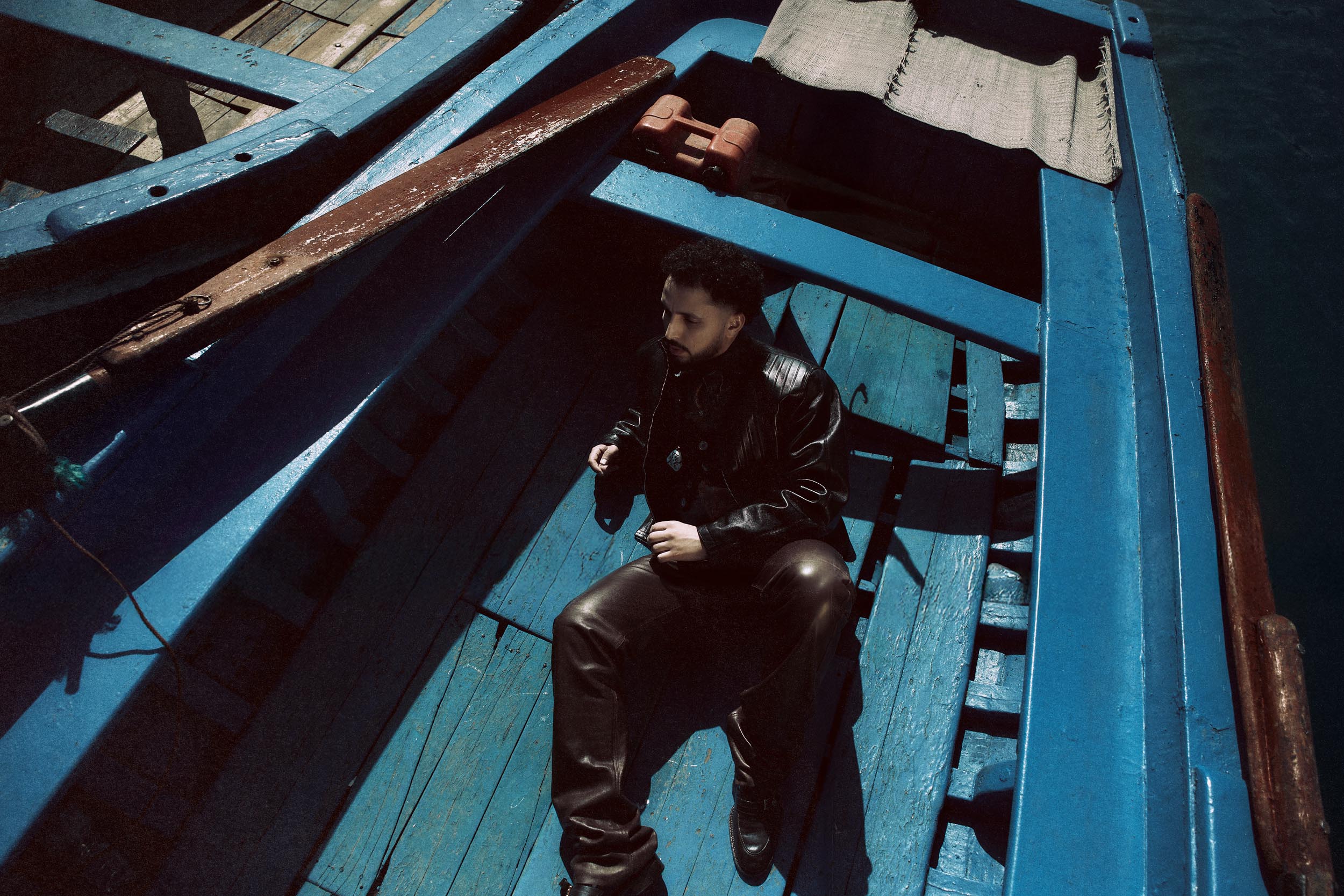
It probably would’ve been more interesting and easier to write a piece about Tawsen’s multifaceted identity, personal and musical. To hail him as one of the great multilingual, multicultural new-gen Arab artists. To delve into his identity as a diaspora kid and how it bled into his music. To juxtapose his many dualities. To call the piece The Many Shades of Tawsen and call it a day. To paint him as a victim-turned-success story of an identity crisis.
Perhaps that’s what’s expected, too.
The only Arab artists who seem to be getting picked up and covered by Arab or international media in recent years fit a familiar mould. Polylingualism dressed up as international reach. Experimentation repackaged as genre-bending. The slightest move they make canonised as groundbreaking. It is very easy to flatten Tawsen into that silhouette. He is, after all, a Moroccan artist who grew up in Italy, is based in Belgium, speaks six languages, and folds flamenco into raï into mahraganat like it’s playdough. All those colours, all that texture, all that satisfying complexity laid out like a well-grouted tile.
But Tawsen is, in all honesty and without diminishment, just one colour. And it’s blue.
This is not to say he isn’t all of the above. He is, visibly, undeniably. It’s that he carries every apparent contradiction with such unforced ease that to make a spectacle of it would feel like a betrayal of his actual character. If anything, he entertains these contradictions and bends the lines between them. As much as he radiates main character energy, he neither chases it nor particularly enjoys it. He’s just a chill guy. He’s just Tawsen.
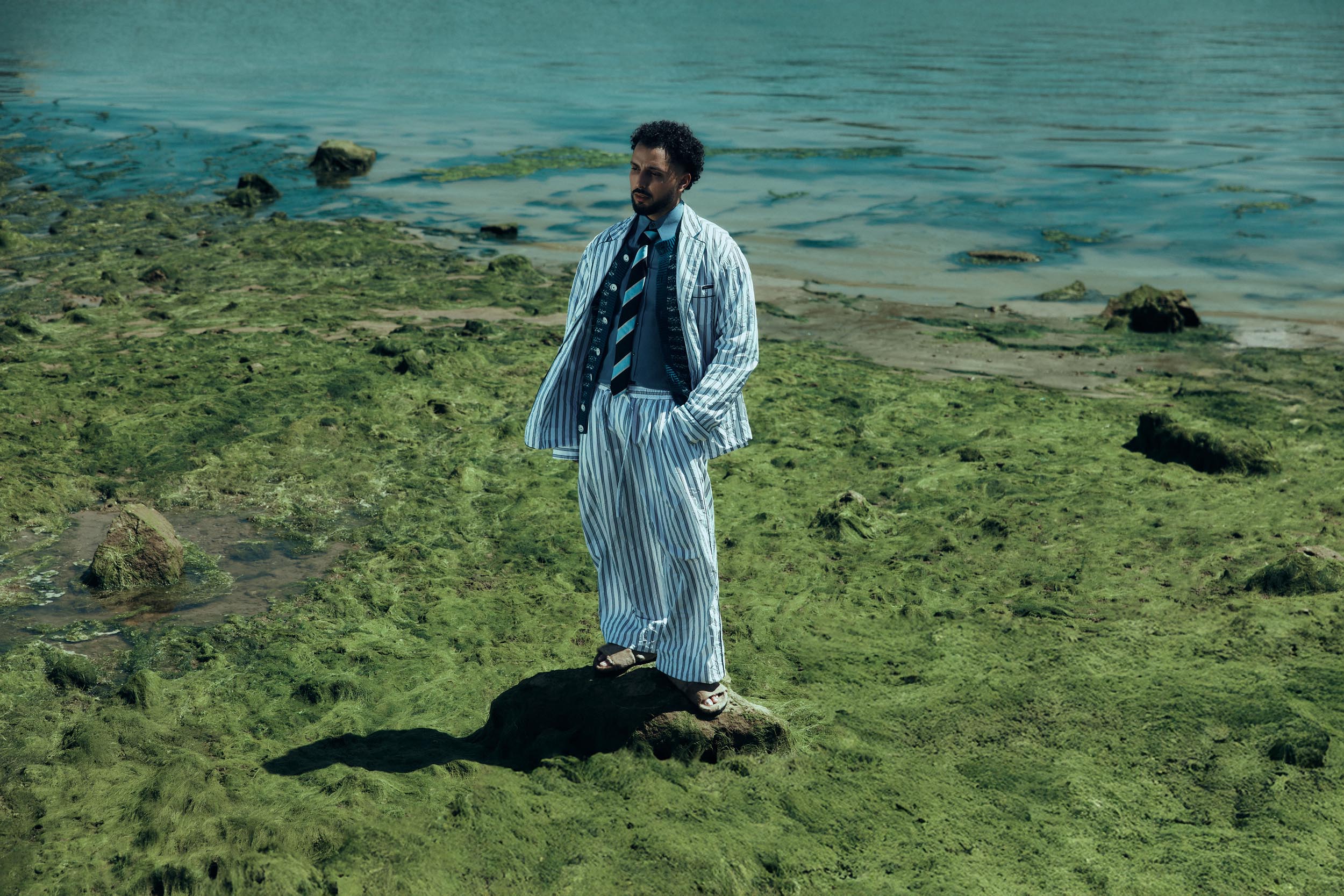
“I don’t like to be famous. I don’t like being in front of the camera, seeing my face and stuff,” he tells me over Zoom from Brussels. “My goal as a musician is to stop making music and just have a label to support other artists.”
He’s not in it for the fame, and he’s very aware of how clichéd this sounds, because no one ever seems to be in it for the fame. But Tawsen has grounds to support his case. In 2021, his French label pushed back against him putting his EPs Al Mawja, Al Warda, and Al Najma with their titles written in Arabic on the covers. Their position was essentially that he is in a French market. Tawsen took a stance.
From that point, he was effectively frozen out for close to three years, unable to release anything under his own name, kept alive in the public consciousness (and the streaming charts) only through features on other people’s records.
Any other artist would have cut their losses. Found something else to love, or at least something else to do. Tawsen can’t. “Is it an addiction? Maybe,” he says. “Even when I’m on vacation and telling people, let’s go to Brazil, I don’t want to do music, I find myself in a studio in Rio. I’m like, what the fuck? I said let’s stop.”
By the time Tawsen surfaced from that enforced hibernation, he had worked through almost every genre available to him. “Maybe except metal,” he admits. “I don’t think my voice could do it, but I really tried everything.” The result, distilled from all of that quiet labour, is his debut album, Chokran.
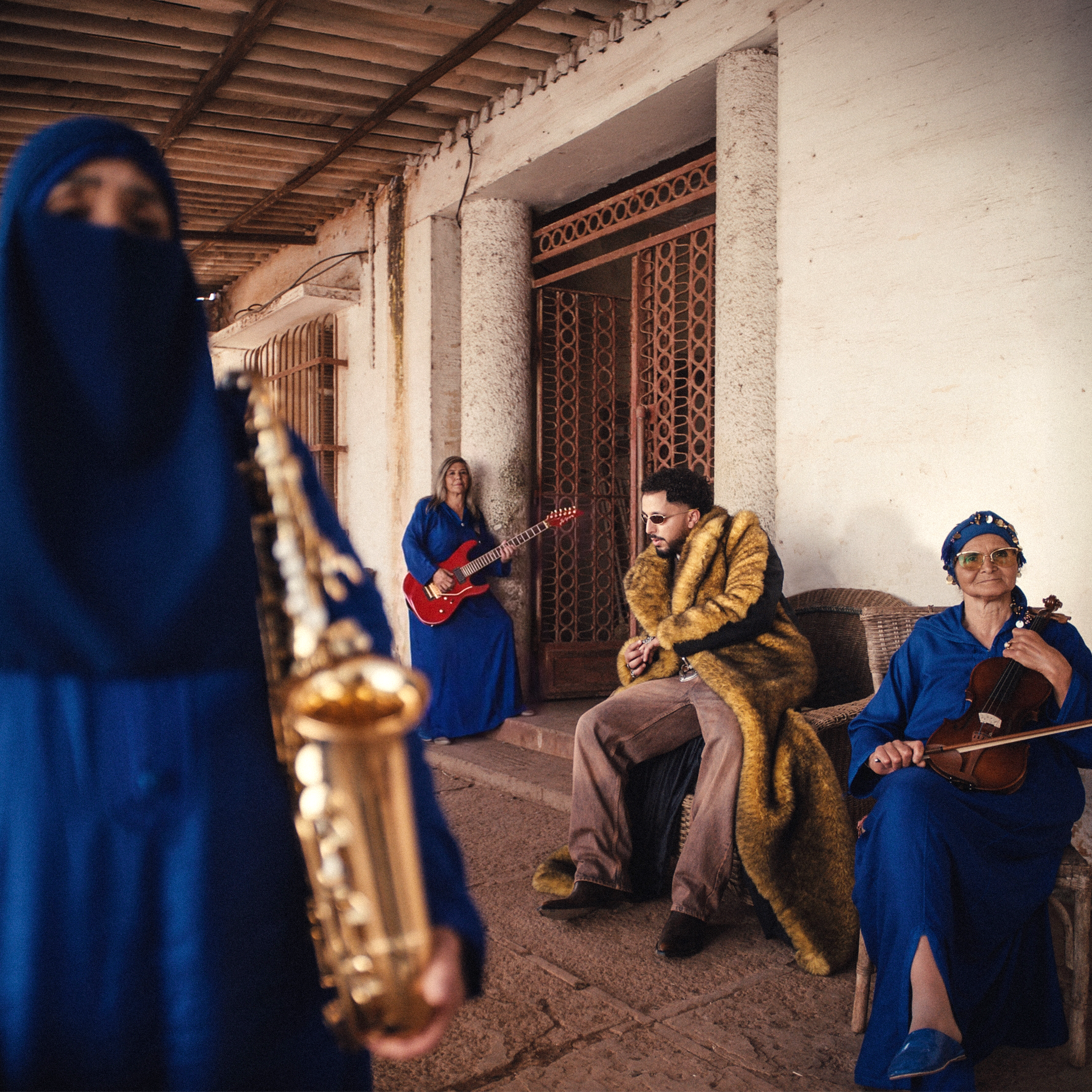
Asked why it took seven years to release his first album, he offers no deflection. “I wasn’t ready.” It would be easy, almost irresistible, to reach for a villain, of whom he has many. The label. The industry. The years swallowed by someone else’s contract. But he doesn’t. He holds the mirror squarely at himself. “I had to learn to try a lot of stuff. The two years of my disappearance were the worst and the best thing ever as an artist, because I didn’t have the pressure of dropping an album. I didn’t have labels or someone telling me, ‘We need this album because we put a budget.’ I just went to the studio and tried everything. I wanted to be sure 100%.”
“The two years of my disappearance were the worst and the best thing ever as an artist.”
When Tawsen first arrived on the scene, Moroccan music still largely lived within its own borders, contained, circulating within the country and its diaspora, moving through specific channels to specific rooms. By the time he was free to release again, those borders had dissolved entirely. Moroccan music was everywhere, charting across continents, suddenly in the ears of people in the region and beyond. For Tawsen, this shift was both an opening and a complication.
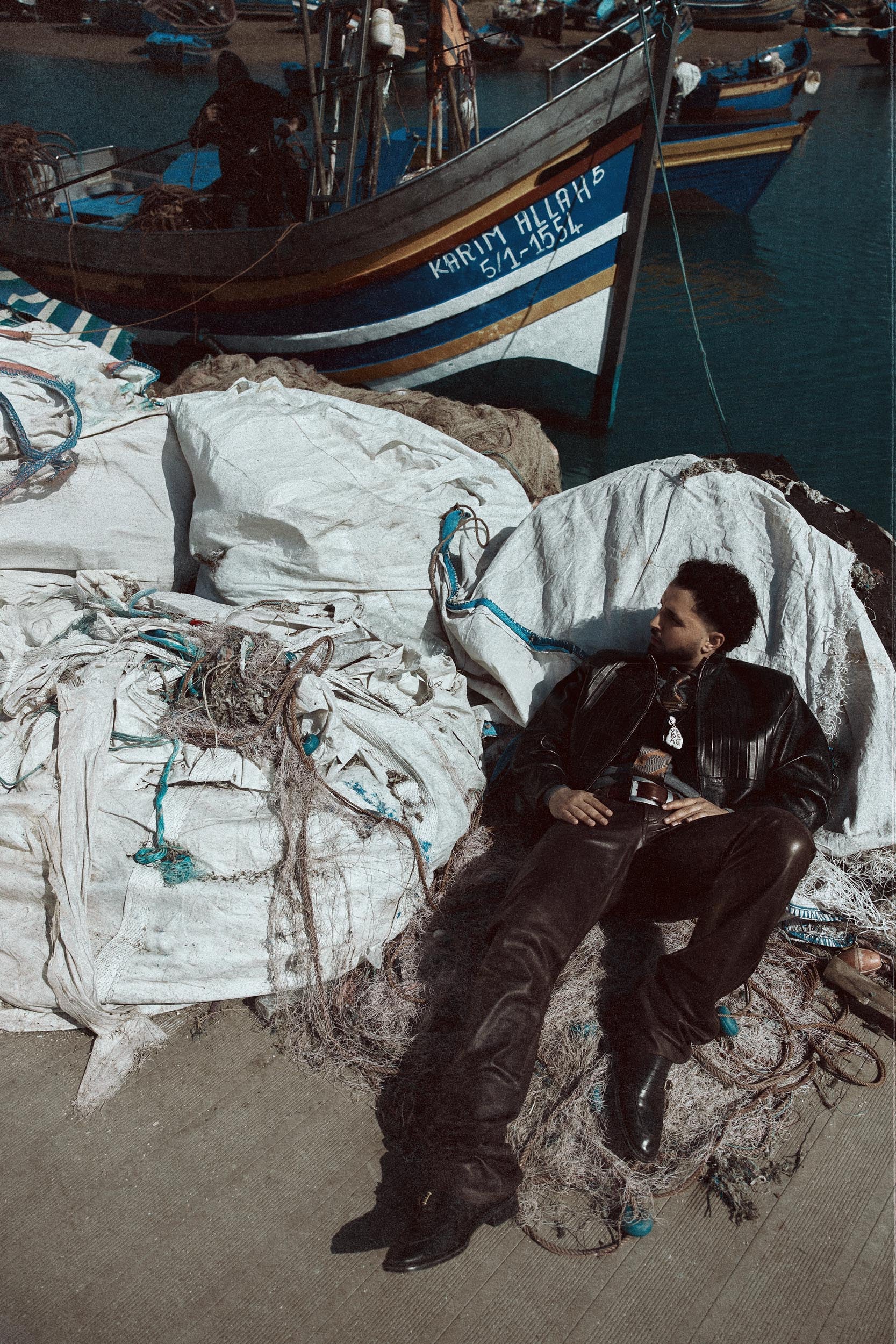
The record lives entirely in the Maghrebi sonic world he’d been building for years. The independent era had already proven the appetite was there. “Dawini”, his third release after going independent, hit number one on Spotify Morocco for a month and landed a Billboard Arabia nomination. The album was always going to follow that path. The question was doing it properly, which meant going to Morocco, working with Moroccan producers in Moroccan studios, and not faking the geography of the sound. “If I want to make a chaabi or a raï song, why should I work with a French guy who doesn’t understand it? Let’s go to Morocco and work with a guy who literally does this for a living.”

And so he did. He went to Morocco for a few months to make the album. But the welcome was, by his account, lukewarm at best. He was met with the suspicion that trails diaspora artists, that they arrive to extract rather than contribute, to capitalise on a cultural moment they didn’t help build, to “steal clout” as he says.
“I was in Morocco for four months, working on the album. I wanted to live there, be with the people. And I felt this energy: what does he want? He’s from outside. Why is he here and asking for features now that Morocco is doing stuff? And I was like, ‘Guys, I was charting way before you dropped your songs. You listen to my music way before.’”
It is a particular kind of exhaustion, being claimed by nowhere. In Europe, he is the Moroccan kid. In Morocco, he is the European one. Both rooms have the same unspoken question: who exactly gave you permission to be here? Tawsen has decided, with some deliberateness, not to marinate in it. “I just prefer to laugh about it in my music.”
The album opens with a direct answer to that accumulated noise with “Zid Sawt”, a track addressed, as Tawsen puts it, to everyone and no one. “It’s not a diss for someone. It’s just a big answer for all the stuff I heard about Tawsen trying to sing in Arabic, Tawsen and other diaspora artists.” The gauntlet was thrown from the get-go, and he moves on. Because Chokran (thank you, in Arabic) was never going to be a grievance record, however justified the grievance. But a record of gratitude.
Asked who he wants to thank, he has four. “I want to say Chokran to God first. During my two years locked out, I was talking a lot with God, asking him if this was the right thing to do or not. Without his power, I wouldn’t be here today. Second, I should thank myself. Because we’re still here, baby. And third, the people around me. The family, the team, the management. Those who kept walking beside me even when I had no music dropping, nothing going on. People who were still there, still believing, still saying: okay, Tawsen, take your time. If you’re coming back in one year, two years, we’re still going to be there. And obviously, the fans.”
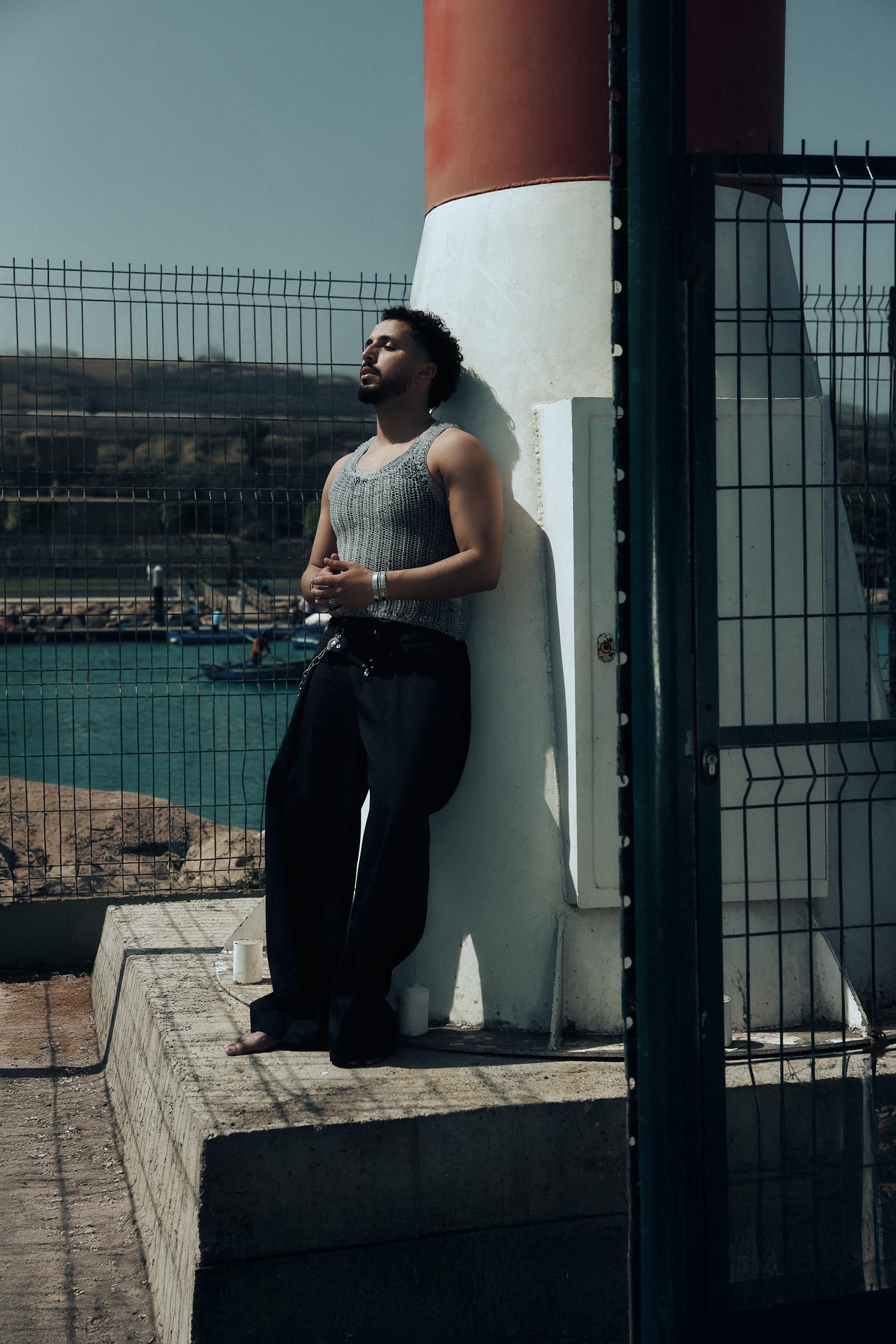
Tawsen acknowledges his people and the power of collabs sprinkled throughout his career, the ones that, if anything, kept him afloat when he couldn’t release as a solo artist. For Chokran, though, the original instinct was to have a debut album fully his with no features. The universe, however, had other ideas. It now has four collaborations, and not one of them was engineered.
Fares Sokar, recruited for “Estanna,” a mahraganat track, turned his verse around in 24 hours. Sabah, the Moroccan-Andalusian artist whom Tawsen had been quietly admiring from a distance, appears on “Mitad.” Inez, his most recent single partner on “La La,” features on “Anani.” And threading back through the independent era, “Dawini” alongside Ayoub Anbaoui.
To promote the album, Tawsen painted everything blue. Extracted from the glaze of a plate that lives in virtually every Moroccan home: the tabsil taous, the peacock plate set aside for grand ceremonies. “The mom or the grandma would put it out when there are great occasions,” he shares. “Sad ones or happy ones, but it’s for the big occasions.”
Seven years later, the plate is off the shelf. The occasion is here.
Tawsen, who holds a graphic design diploma and designs every Instagram post himself at 4 AM on his laptop, did not build this campaign with a budget. He built it with a colour swatch, a theory, and a level of faith in his audience that most traditional marketers would find naive. The blueprint, or the green print, as it were, was Charli xcx’s brat summer. “I believe in non-promotion promotion. People are not dumb. If you just write, my new album is here, go listen to it… No one is going to listen.”
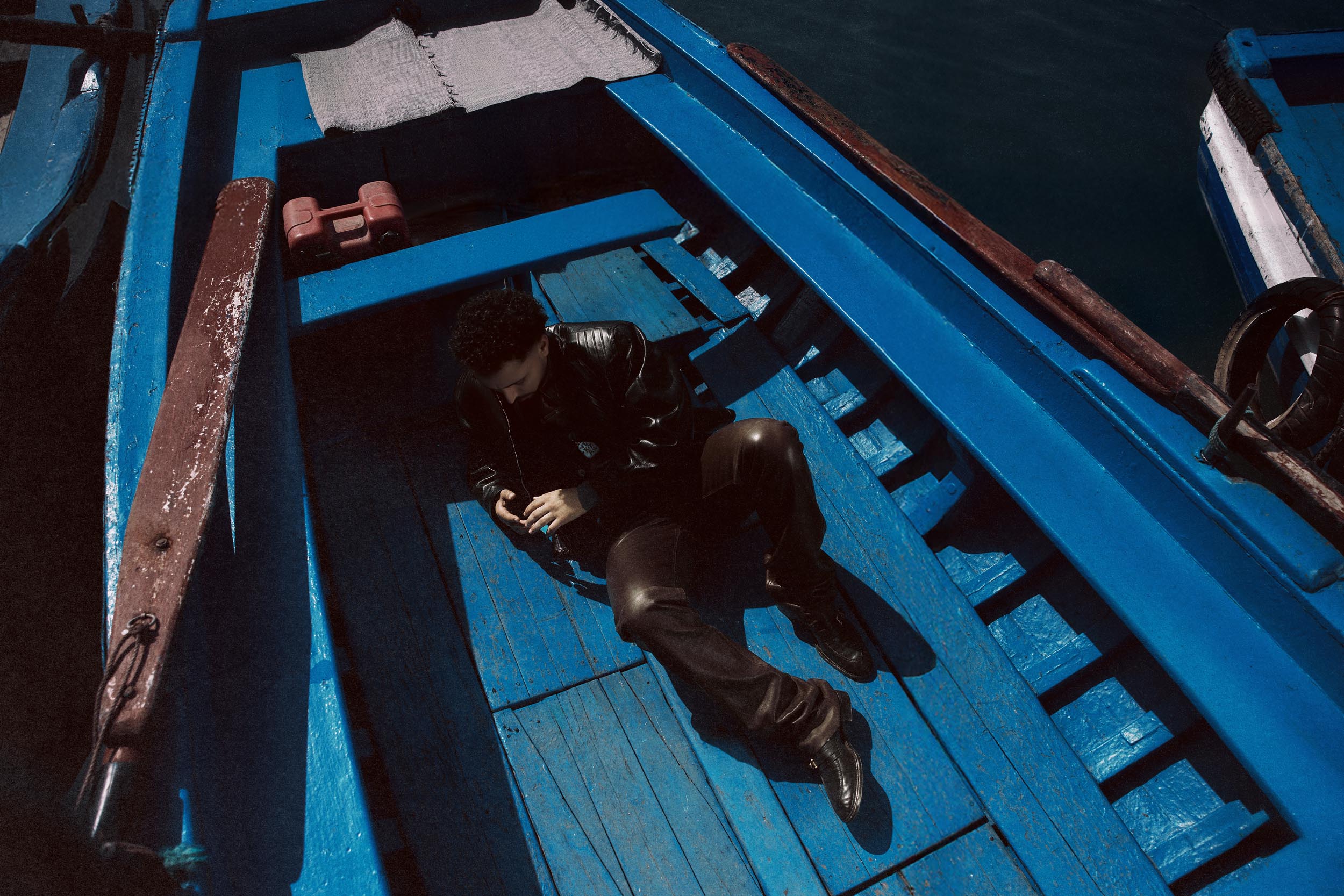
With the plate as the cornerstone of his visual language, and his name itself derived from the family name Taouss (Arabic for peacock), the symbolism was always load-bearing. I tell him it’s a bold alias, given how Arab culture reads the peacock as preening and self-admiring. He tells me he enjoys living inside that tension between the apparent and the actual.
This is also evident through the way he uses fashion. When I tell him that the fur coat from the Khallini video is the image that arrives first to my mind whenever his name comes up, he yanks his fist down triumphantly. “Was that the intention?” I ask.
“I’m a super chill guy,” he explains. “I’m not moving in fur coats in my daily life. The Khallini music video was one take, and I had to run through three levels. I said, ‘Let’s do it. But with a fur coat, like I’m a big superstar.’ I’m singing raï music. I had grills, super cool clothes, and Acne Studios jeans. I look like a bad guy, but I’m singing another type of music. That’s the thing I love. To just shake it up, merge a style, an aesthetic.”
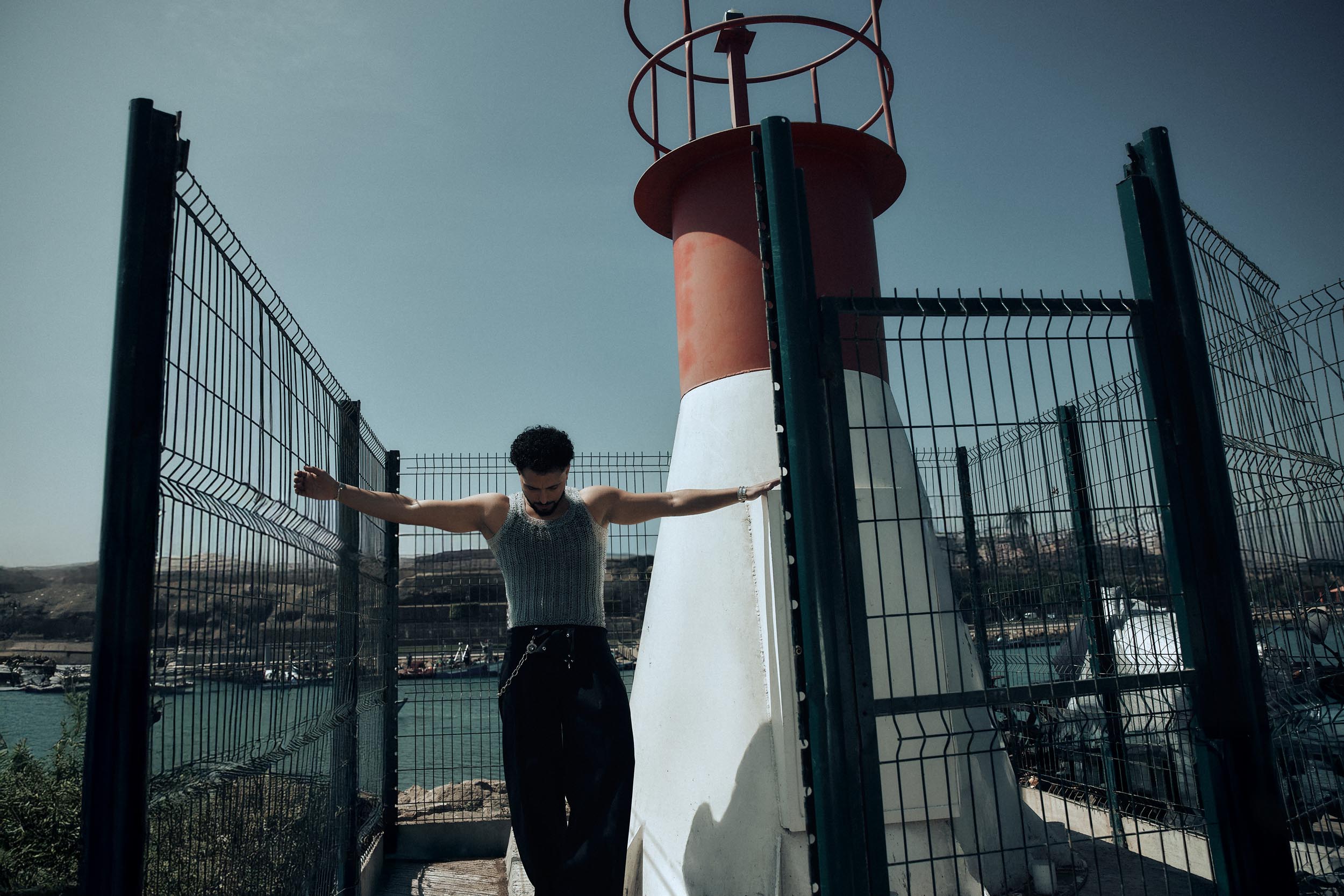
He has been entertaining this kind of discrepancy since his earliest gigs. For one of his first appearances in Brussels before the buzz and the budget, he walked on stage in a Gucci hat and a black sweatshirt, your standard-issue North African guy attire. The room braced for non-stop Moroccan rap. What came out was soulful, melodic, entirely elsewhere. “I remember this reaction. I was like, ‘Okay, I want this every day. I want this contrast.’”
The attention to clothes, though, precedes any stage. It started with a single pair of Asics Tigers.
“This fashion thing started when I was a kid living in Italy. My mom was buying one pair of shoes for the school year. She bought me these shoes, and I was super happy about it. It was a pair of Asics Tiger, the white with the blue and red lines. I put them on, went outside, and played football. I destroyed the shoe on the first day. So I came back home, and she was like, I can’t afford to buy you a new one. School didn’t even start. You will wear this one for the whole year. I remember this thing about me being careful about my clothes, like okay, I need to choose stuff so I can go outside with it, I can go to school with it, I can play football. It started when I was little, with this shoe, this attention about clothes and colours.”
Years later, with money in his pocket, the first thing he reached for was a Baby Milo sweatshirt. Pink. “Imagine you’re a Moroccan guy, living in a Moroccan neighbourhood, coming in with a Baby Milo pink sweatshirt.” He knew exactly what he was walking into. He bought it anyway. That particular combination of total self-awareness and total refusal to be governed by it is what makes him Tawsen. He is, after all, just a chill guy.
Photography: Abderrahmane Ajia
Creative Direction & Styling: Nathalie Sicart
Styling Assistant: Ching En Kao, Anna Billon
Producer: Nik Van Dalen
Assistant Producer: Nathalie Sicart
Retouching: Ali Sadalh
TOP BANNER IMAGE ALICE SHIRT, ANNA BILLON. LOOSE SUIT PANTS, ÉTUDES STUDIO. CREPE-GR9 SUNGLASSES, GENTLE MONSTER. SCALE RING, CAVITY RING, DYSKINESIA


