News


Words_ Kaja Grujic
Before we see her face, we are told it will be difficult to look.
In the opening frame, against a black screen, a man’s voice speaks of the abundance of ugliness in the world, warning that the images to follow will reveal suffering that cannot be ignored. The darkness then gives way to a woman seated before a mirror. A hijab wraps closely around her skin, her face framed by etched flowers, a teapot and other ordinary objects. The image is intimate and immediately recognisable: a woman preparing herself to be seen. Yet, as the camera slowly zooms in on her reflection, her scarred skin and missing eye are revealed. The narrator’s prior warning of ugliness sits confusingly with the woman’s calm gaze at her own disfigured image.
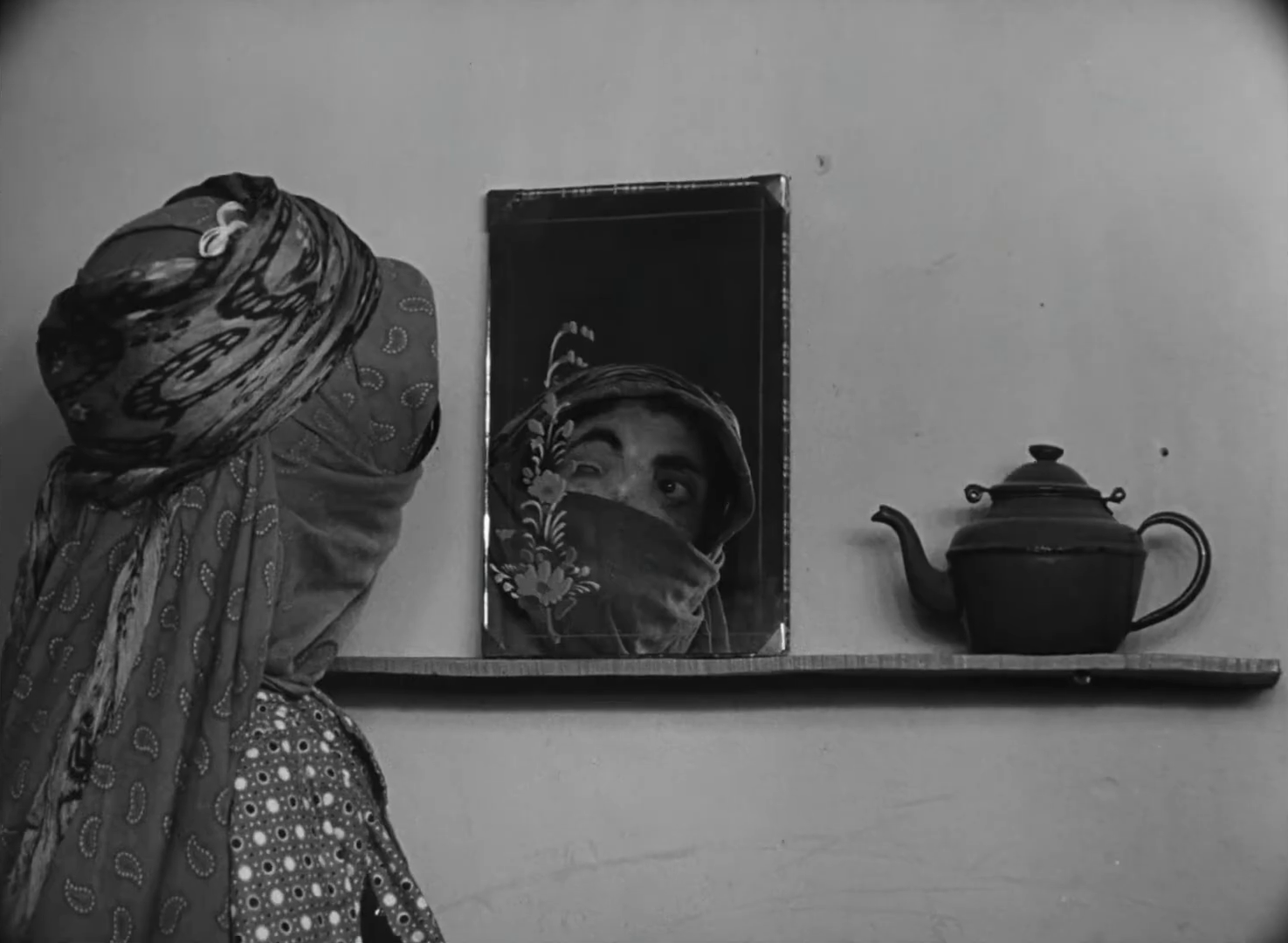
Filmed inside the Bababaghi leper colony in 1962, Iranian poet and filmmaker Forugh Farrokhzad’s 20-minute documentary brings into view a community that Iranian society had largely removed from public life. Yet, The House Is Black neither presents its residents as objects of sympathy nor asks the viewer to locate beauty beneath physical difference.
Instead, Farrokhzad makes the act of looking itself the film’s central question: Who is permitted to be seen? Who is recognised as beautiful? And what happens when someone represented through disease and deformity returns our gaze?
In her first and only film, Farrokhzad refuses the supposedly objective distance of ethnographic and medical documentaries. Her approach belongs to a broader resistance among filmmakers to the Western ethnographic gaze, later captured in Ousmane Sembène’s rebuke to filmmaker and ethnographer Jean Rouch: “What I hold against you is that you look at us as if we were insects.” The accusation lays bare the hierarchy behind detached observation — the assumption that one person may study another without becoming implicated in the act of looking.
Farrokhzad offers no such neutral vantage point. Her camera moves close to faces and bodies as her own poetry runs through the film alongside prayer, classroom recitation and clinical narration. The result belongs to the same artistic world as her verse, which approached female desire, confinement and loneliness from an insistently personal position before her early death in 1967, aged 32.
The residents of the leper colony, hidden from social view, have been relegated to the category of ugliness. In The House Is Black, Farrokhzad does not merely replace “ugly” images with conventionally beautiful ones. Instead, she changes the conditions under which these bodies are seen. A woman draws kohl around her scarred eyes; another brushes her long hair before glancing shyly towards the camera, revealing a face and hands marked by leprosy. Two girls groom themselves side by side, their gestures mirrored across bodies differently touched by illness, while elsewhere a wedding turns adornment into a collective ceremony. Farrokhzad gives these women the kind of cinematic attention most often reserved for actresses and idealised faces.
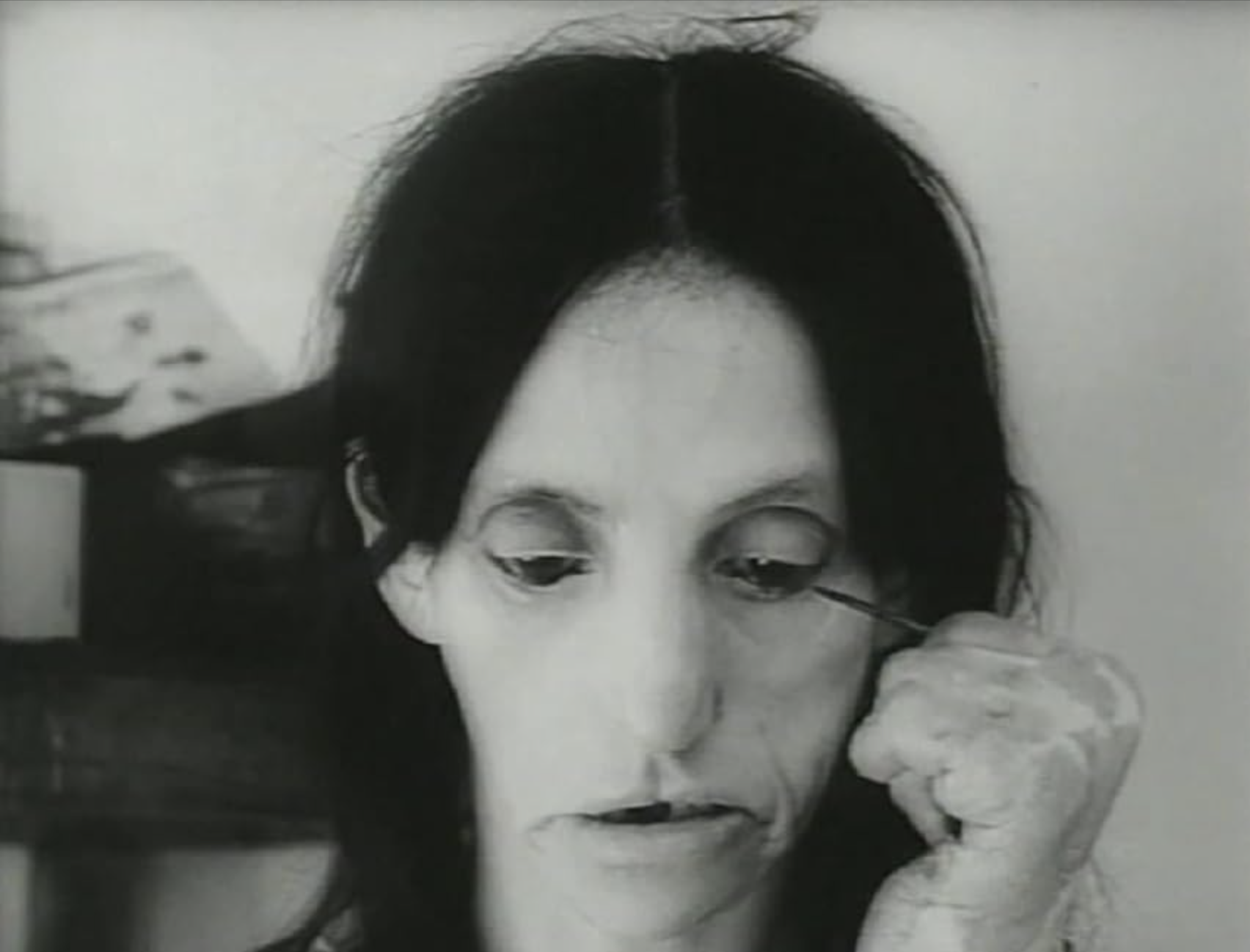
Over these images, Farrokhzad addresses the “time-forgotten one, dressing yourself in red, and wearing golden ornaments, anointing your eyes with kohl.” Farrokhzad’s narration shifts from the singular “you” of the women to the shared “we” of captivity: “the evening shadows are stretching and our being like a cage full of birds is filled with moans of captivity. The harvest season has passed, the summer season came to an end and we did not find deliverance.” Beauty becomes a collective elegy. The change in pronoun collapses the distance between the women on screen, the filmmaker behind the camera and the viewer watching from the outside. Farrokhzad’s “we” implicates us all in the same fragile passage towards ageing, illness and ultimate death.
These women also look back. Laura Mulvey’s theory of the male gaze describes cinema as a structure that often grants the viewer visual control while turning the figure on screen into an object of display. Farrokhzad disrupts that hierarchy. As film scholar Nicole Brenez argues, the bodies in The House Is Black become the source of their own representation. The residents do not remain passive beneath the camera’s attention, but meet it directly. Their gaze recalls what bell hooks would later call the oppositional gaze, a way of looking back that resists the meanings imposed by dominant visual culture.
Seen this way, the film’s scenes of grooming form a kind of counter-masquerade. Kohl, jewellery and carefully brushed hair do not conceal a truer body underneath. Instead, they reveal how unstable the categories of “beautiful,” “normal” and “healthy” already are. Farrokhzad allows adornment and physical difference to occupy the same image, until the standards used to separate beauty from ugliness begin to blur.
Farrokhzad later shows a classroom, where children recite passages from the Old Testament and the Quran praising the beauty of God’s creation. Their recitations of gratitude for “flowing water and fruit-bearing trees” become increasingly fraught as the children thank God for the eyes, ears and hands through which they encounter the world, even as their own bodies bear the visible effects of leprosy.
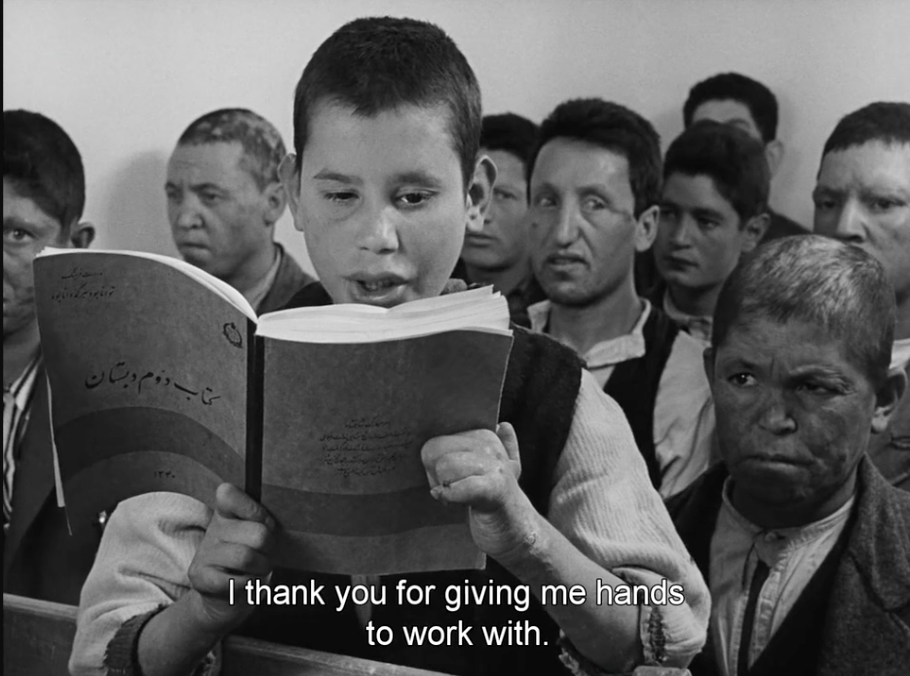
The tension between devotion and lived suffering sharpens until Farrokhzad asks, “Who is this in hell praising you, O Lord?” The film holds this irony, following a sequence of close-up portraits meeting the camera, not hiding their deformed faces. She leaves the audience suspended inside this unsettling question: is this ugliness hell?
This question is rooted in a long battle between beauty and ugliness, in which aesthetic qualities are conflated with questions of morality. In The History of Ugliness, Umberto Eco traces how Western religious and artistic traditions repeatedly bind physical difference to sin, disease and moral corruption. Distorted bodies become visual shorthand for evil; beauty, by contrast, is made to signify purity, harmony and divine order. In Aesthetics of Ugliness, Karl Rosenkranz famously describes ugliness as the “hell of beauty,” defining it not as an independent category but as beauty’s fallen, corrupted other. Farrokhzad’s images expose how deeply this moral grammar shapes the act of looking.
That hierarchy is not only organised around the able body; it is also racialised. In Black Skin, White Masks, Frantz Fanon examines the psychic violence of a colonial world in which whiteness presents itself as the universal measure of beauty. In his analysis, whiteness — which is seen as better, purer, more complete — treats the bodies of others as subordinate, ugly. For Fanon, the deepest violence of the colonial gaze does not simply exclude certain bodies from beauty, but trains them to experience themselves through this whiteness. When he looks in the mirror, he sees the body of a criminal, a barbarian. He points to the traumatic irony of a person imitating their oppressor, “When it was I who had every reason to hate, to despise, I was rejected?” Whiteness becomes an unattainable ideal, a mask the colonised subject is pressured to pursue through language, behaviour and self-presentation.
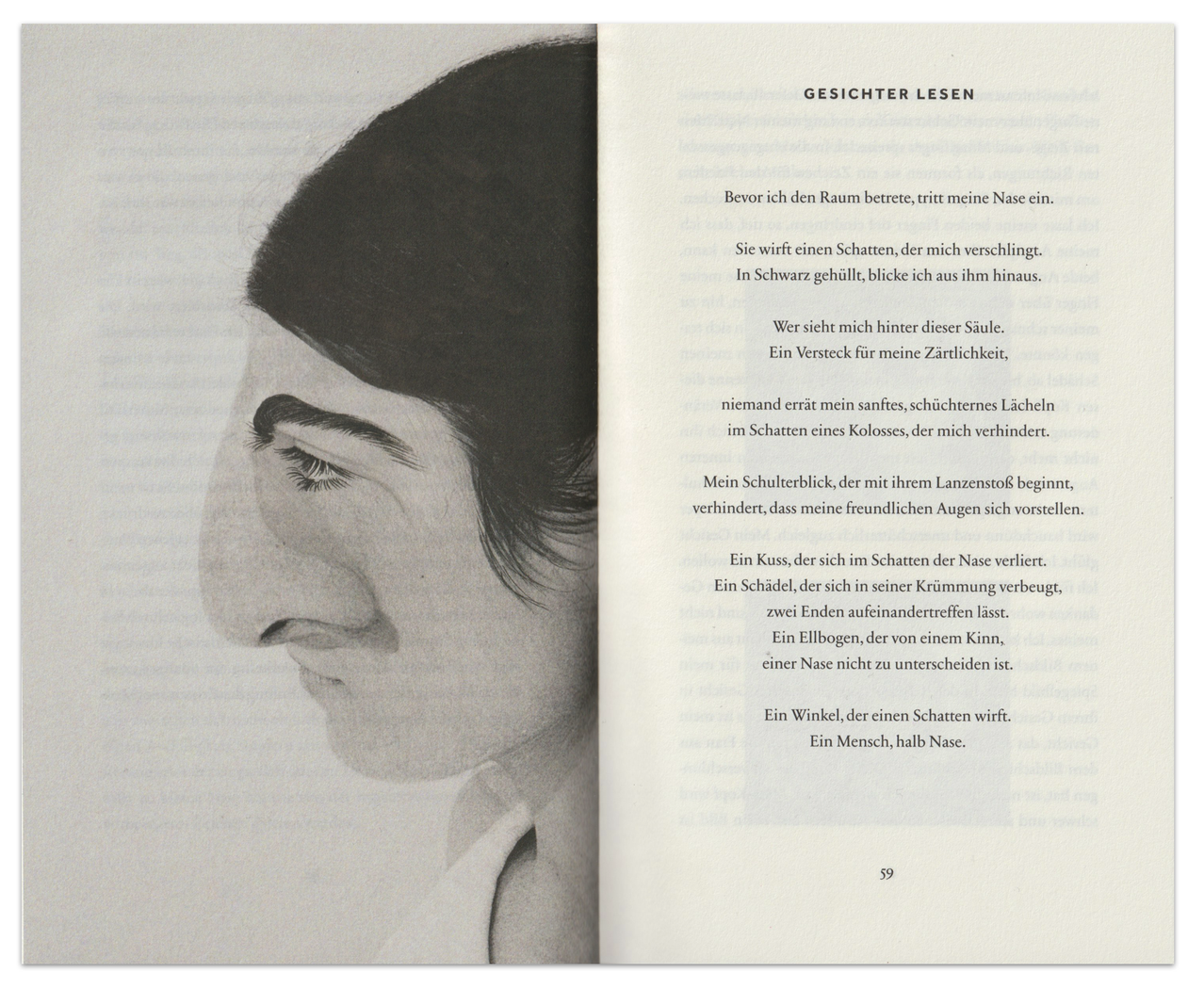
Moshtari Hilal, Afghan-born writer and artist, explores this concept of racialised beauty in her book UGLINESS. Through a series of essays, poetry, and artworks, Hilal breaks down the cultural lens through which ugliness is constructed. She writes, “At fourteen I learned fourteen times that I’m ugly.” Growing up in Germany, she viscerally feels this white mask taut on her skin. In the chapter “Cartography of My Ugliness,” her hairy legs, bushy eyebrows, and lip moustache are not simply ugly but dirty and unhygienic. Planning how to rid herself of this evil, she maps out her body, “and declares war on her skin over and over again.”
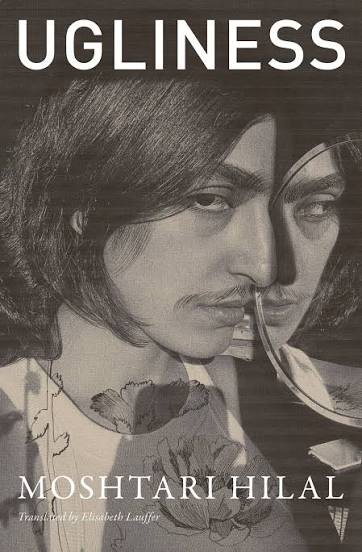
In another chapter, Long Suffering Nose, her protruding nose becomes the next victim of punishment. In a poem she writes, “Before I set foot in a room, in walks my nose. / It casts a shadow that engulfs me. / Cloaked in black I peer from its depths.” This physical marker of difference arrives in a room, before she even has space to exist. Where she is from, and her lack of whiteness enter the spectacle of being seen before she has room to even speak. Aware of this gaze, she continues, “My head grows heavy and collapses between my shoulders… My chin like a cliffside, teeth like iron bars, nose like a phallus. I wear a mask. I touch it with my fingers. It belongs to me. My face is a mask.”
Ugliness, like a disease, morphs into a condition that needs to be cured through a set of self-optimisation and beautification steps — including make-up, food and workout regimes, and most obtrusively plastic surgery. Medicine no longer intervenes only in illness; it is recruited into the pursuit of an aesthetic ideal. The body becomes a site of correction.
Cosmetic surgery gives aesthetic preference the authority of medicine, transforming dissatisfaction into a condition and alteration into treatment. Anthropologist Sara Lenehan’s 2011 research on rhinoplasty in Iran — which has the highest rate of nose jobs worldwide — shows how unaltered or distinctive noses are seen as provincial, underdeveloped or working-class. Although “European nose” remains the sought-out ideal, over time, the surgically altered nose has permeated so deeply in the culture that it is now understood as the “modern Iranian face.” Through this medical language and procedure, the white ideal is inscribed onto the national face. The body is no longer simply judged as beautiful or ugly; it is treated as an object of diagnosis, a project to be optimised and “cured” into beauty. The language surrounding contemporary beauty culture often completes this shift. Surgeons speak of ideal proportions and corrective procedures, while celebrity features circulate almost like symptoms to be reproduced. Kim Kardashian has been described by cosmetic surgeons as “Patient Zero,” borrowing the vocabulary of infectious disease. Beauty, once framed through morality, now increasingly speaks in the language of pathology.
While this language is present in The House Is Black, Farrokhzad understands the danger of framing a body as an object to be simply diagnosed and cured. Set inside the colony hospital, a male narrator identifies leprosy through the measured terms of medicine: its symptoms are named, its progression explained and its treatment presented as possible. The colony’s residents first appear within a clinical framework that promises to define their bodies and, potentially, repair them. However, Farrokhzad unsettles that authority, asking what remains beyond the reach of medical language.
Returning to the classroom scene where students recited bible and Quran verses, spirituality once again becomes the moral centre. The teacher asks “Why should we thank God for having a mother and father?” and the child answers with disarming simplicity: “I don’t know, I have neither.” The lesson then turns to beauty. Asked to name a few beautiful things, another student lists the moon, sun, flowers and playtime. But when the teacher asks for examples of ugliness, referencing the previous spiritual verses, another cheekily replies: “Hand, foot, head,” prompting giggles from the room.
Interviewed 25 years after The House Is Black was made, the film’s producer and Farrokhzad’s partner, Ebrahim Golestan, described the film as an allegory for an Iranian society constrained under the monarchy. That wider political reading surfaces throughout the documentary, particularly in Farrokhzad’s repeated use of the collective “we,” which folds her own loneliness and grief into the experience of the colony. Yet it is the children’s laughter that most clearly punctures this atmosphere of confinement. Their humour is playful and unguarded. In that brief exchange, their answers slip beyond the categories meant to organise beauty, ugliness, gratitude and deprivation, exposing the absurdity of the distinctions through which the outside world has judged them.
These themes find a striking echo in Moroccan photographer Hicham Benohoud’s La Salle de Classe, produced between 1994 and 2002. Working as an art teacher within Morocco’s rigid educational system, Benohoud turned the classroom into both studio and stage, collaborating with his students to make images that disturb the order of the space from within. In one photograph, a boy’s limbs are lengthened with cardboard tubes until his body takes on the angular, deformed shape; elsewhere, familiar desks and walls become settings that are comic, awkward and faintly threatening.
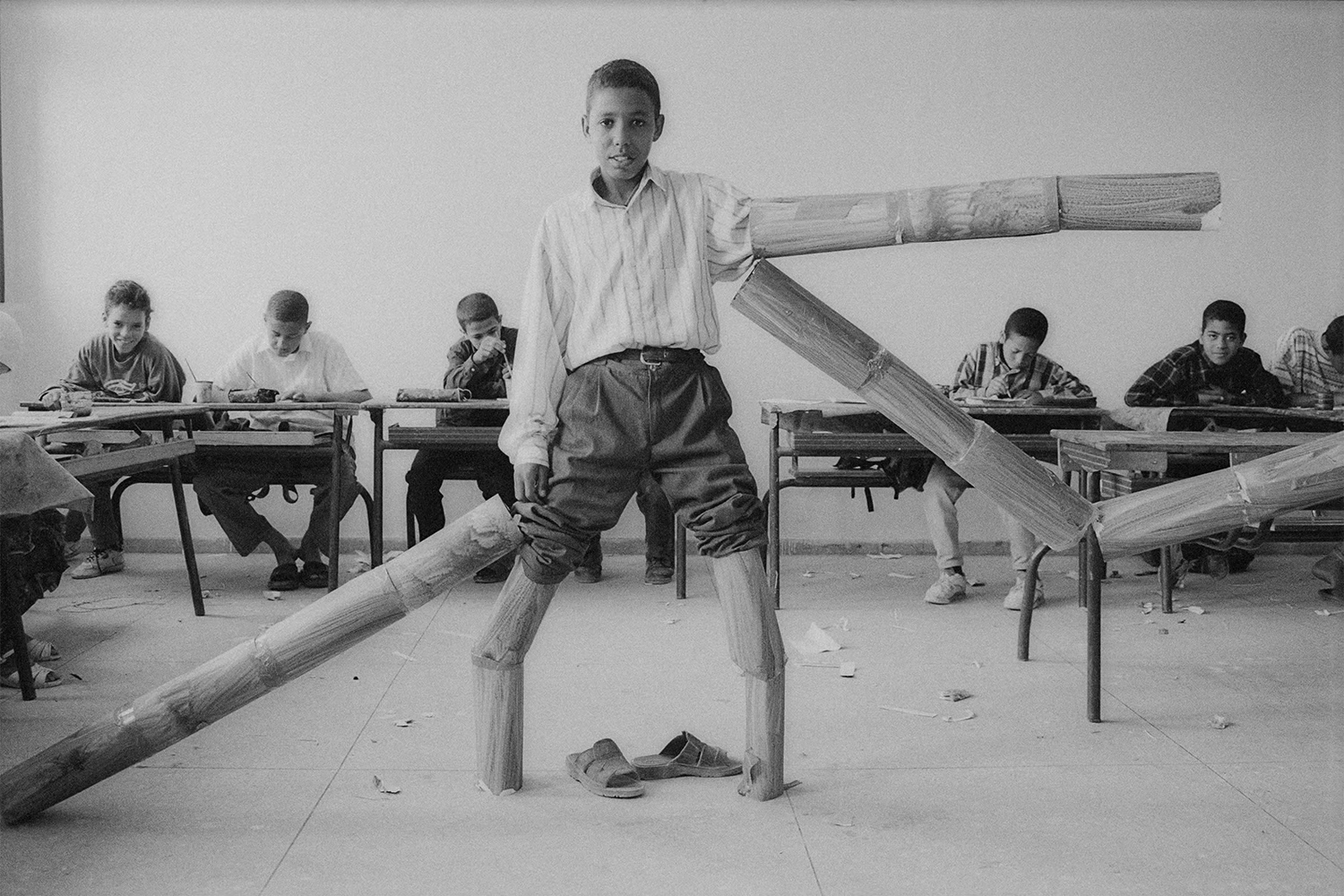
Like Farrokhzad’s classroom sequence, the work uses children’s play to expose the structures meant to contain them. Humour becomes a way of testing the boundaries of discipline, while absurdity makes visible the repression embedded in educational, cultural and religious conventions.
In the film’s final moments, the residents of the colony move towards the camera in procession before closing the gate behind them, pushing the lens — and with it, the viewer — back outside. The gesture reverses the terms of visibility one last time. Having spent the film looking in, we are finally denied access. Back in the classroom, a child is asked to write a sentence using the word “house.” On the chalkboard, he completes it simply: “The house is black.” The screen cuts to darkness, and Farrokhzad’s voice returns with a final invocation: “O overrunning river driven by the force of love, flow to us.”
More than 60 years later, The House Is Black still resists the comfort of resolution. It does not ask us to replace ugliness with beauty, illness with cure, or exclusion with a more generous form of spectacle. Instead, it leaves those categories blurred at their edges. The mirror, the classroom, the clinic and the camera all become sites where the body is named, disciplined and judged, but also where those judgements begin to fail. A woman continues to line her eyes. A child laughs at the language meant to organise the world. A face marked by illness looks back without apology.